
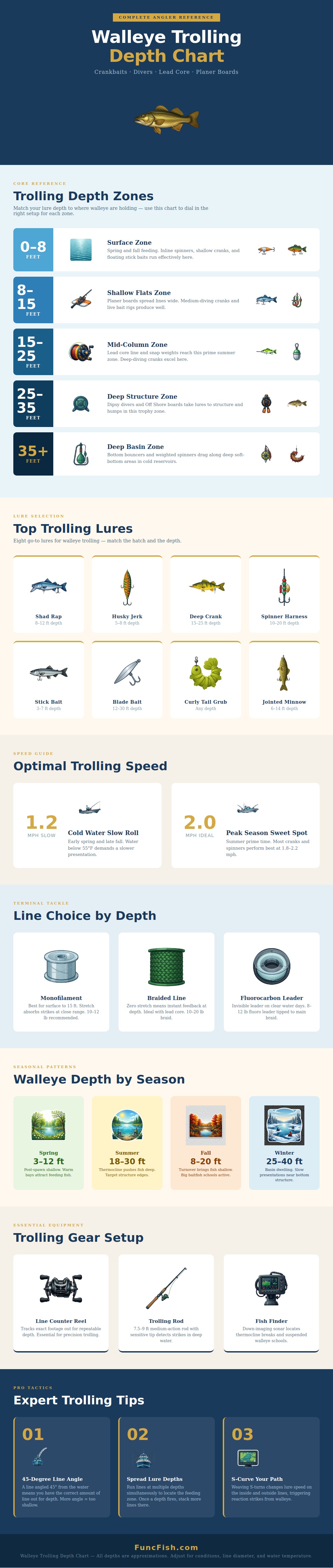
Walleyes will only strike when the bait is direct in front of the fish. If the bait is above or below the walleyes, the walleyes will not strike the bait. Most walleye anglers fails to land any walleyes because most anglers dont properly control the depth of their lines.
The depth of the lines is a factor that will determine whether or not the walleyes will encounter the bait. In order to control the depth of the lines properly, anglors must understand how the walleyes move in the water column, and why they tend to stop at specific depths. Walleyes move to different depths in the water column due to the changing water temperatures and the location of the food in those depths.
Find the Right Depth for Walleyes
During the spring, walleyes tend to move towards the shallow water of the lake. This is due to the fact that the water near the surface is warmer than the depths of the lake during this season, and that the baitfish that the walleyes eat move towards the warmer water. During the summer, the walleyes begin to move to the cooler depths of the water column.
These depths have both a comfortable level of dissolved oxygen for the fish, as well as the baitfish that live in those depths. Both floating stick baits and inline spinners may be used in the shallow waters of the lake during the spring and summer. In deeper waters, though, anglers will use lead core, snap weights, and diving planers to allow the lures to reach the walleyes that live in these deeper portions of the lake.
The lure that is used must be chosen according to the depth that the walleye lives at in the area that is being fished. Crankbaits that dive shallowly into the water will not be able to reach walleyes that live at depths of twenty-five feet. Deep diving lures may become entangled in the weeds at depths of only five feet of water.
Knowledge of the type of bait that will best fit the depth of the walleyes is necessary to successfully catch these fish. For example, Shad Raps tend to be effective in depths of eight to twelve feet. Blade baits tend to be effective in depths up to thirty feet.
The trolling speed will affect how the walleyes react to the bait. In lakes with colder water, the walleyes will move slow through the water. In this case, slow movement of the trolling boats will allow the walleyes to encounter the bait.
In lakes with warmer water, though, the walleyes will move faster, so trolling speeds will have to be faster to entice them. A trolling speed of two miles per hour is common throughout the season. This speed is midway between the slow and fast speeds.
If the anglors spot the walleyes on there fishing electronics, but do not feel any strike with the baits, they should slow the trolling speed by half a mile per hour before changing the bait. The type of fishing line that is used will affect both the depth of the baits, as well as the way that the anglors feel the strike of a caught walleye. If anglers use monofilament lines, the line may stretch.
This can make it hard to feel a strike with a light mouth of a walleye. Braided lines do not stretch, so every strike will be felt instantly. Because braided line does not stretch, an angler should use a shock leader.
Additionally, if the water is clear, an angler should use a fluorocarbon leader. Walleyes can see the fluorocarbon line better in clear water. In stained water, though, an angler can use braided line because visibility of the line is low in stained water.
Walleyes tend to stick to specific depths throughout the year. During the spring, walleyes will head towards the shallow waters where the baitfish congregate during the warmer water temperatures. During the summer, walleyes will head towards the depths of the water column where there is a comfortable level of dissolved oxygen, as well as the baitfish that live in those depths.
During the fall, walleyes will begin to move towards the top of the water column to encounter the baitfish schools and to experience the water turnovers in the lakes. During the winter, walleyes will move to the deepest portions of the lake basins. During the winter, walleyes will move slowly throughout the lake.
Some of the gear that is used for trolling will help manage some of the variables of trolling. A line-counter reel will allow the angler to know how much line is out on the water, as well as allow the anglor to return to that depth during the next pass by adding the same amount of line in. Long fishing rods will help keep the lines from tangling, as each line will remain away from the others.
Additionally, long rods will allow the angler to have more leverage when a fish hit one of the lines. Fishing electronics will help the angler to see the depths of the thermoclines in the water, as well as the location of the schools of baitfish. This equipment will not catch the fish by itself.
However, it will make the information displayed on the depth chart easier to use. The goal in trolling is to have multiple lines move at various depths and speeds at once. When trolling in S-curves, the outer lines will move faster than the inner lines.
When a fish hits one of the lines, the angler will note the depth and the speed of that line. The angler can then adjust the other lines to those depths and speeds, so that the angler can catch more walleyes. Walleyes will be almost always at a specific depth while trolling.
Thus, the lure should be adjusted to that depth, and the trolling should be performed at that depth. You should of used a lot of different lures to find where they are at.