Water Oxygen Depletion Overnight Calculator
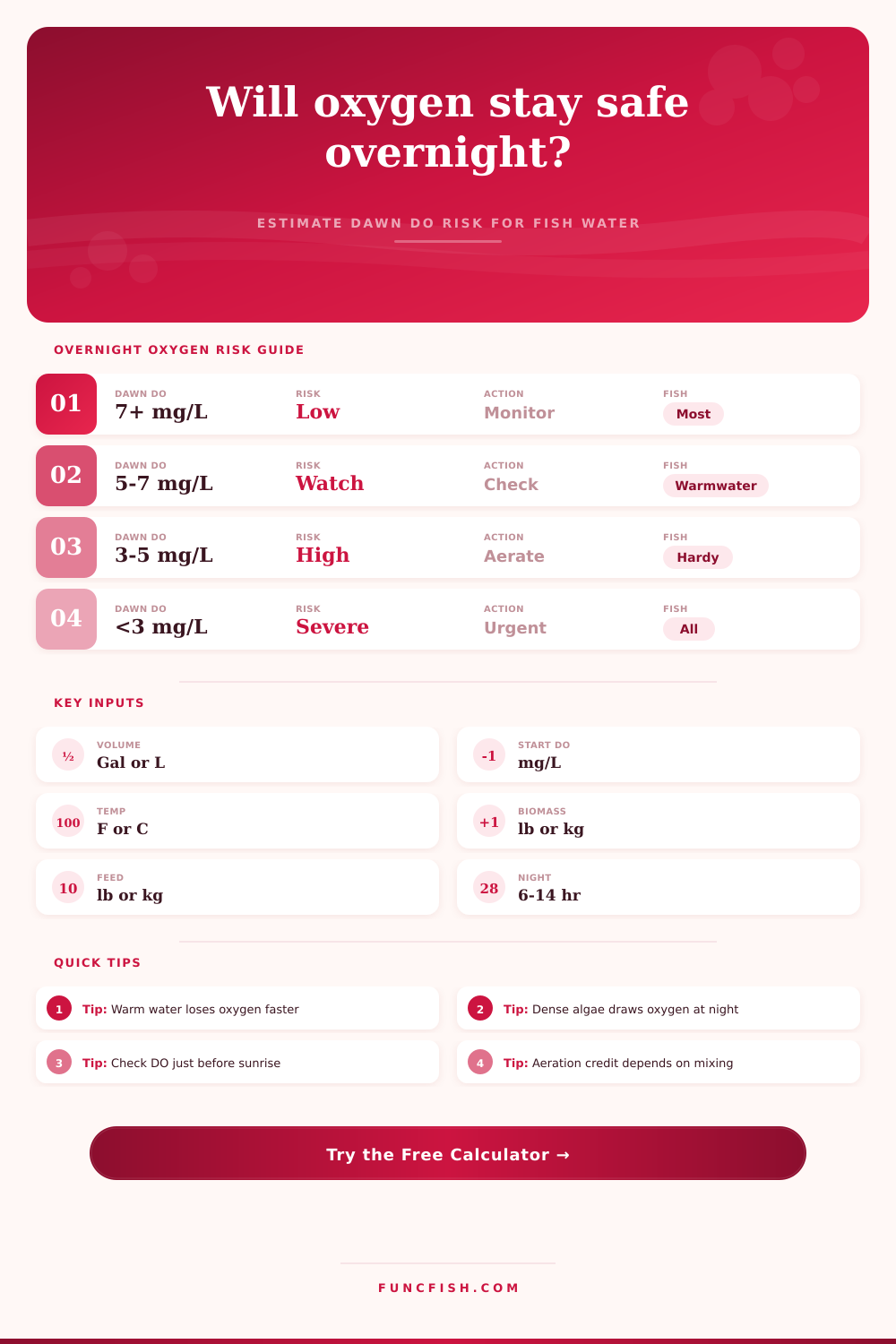
Estimate how far dissolved oxygen may fall before sunrise by combining fish biomass, feed demand, plant respiration, water temperature, and aeration credit.
📌Scenario presets
⚙Oxygen settings
Overnight oxygen forecast
Full breakdown
📋Oxygen load factor grid
Fish Respiration
Feed Demand
Plant Draw
Aeration Credit
📊Temperature and saturation reference
| Water temp | Approx saturation DO | Respiration effect | Overnight note |
|---|---|---|---|
| 50°F / 10°C | 11.3 mg/L | Slow | Coldwater buffer is high |
| 59°F / 15°C | 10.1 mg/L | Moderate | Trout range is still sensitive |
| 68°F / 20°C | 9.1 mg/L | Baseline | Balanced pond estimate |
| 77°F / 25°C | 8.3 mg/L | High | Warmwater fish use more oxygen |
| 86°F / 30°C | 7.6 mg/L | Very high | Low saturation and fast draw |
🐟Species oxygen comparison grid
| Fish group | Comfort DO | Stress window | Severe risk |
|---|---|---|---|
| Trout / salmonids | 7.0+ mg/L | 5.0-7.0 mg/L | Below 5.0 mg/L |
| Bass / bluegill | 5.5+ mg/L | 3.5-5.5 mg/L | Below 3.0 mg/L |
| Catfish | 5.0+ mg/L | 3.0-5.0 mg/L | Below 2.5 mg/L |
| Tilapia | 4.5+ mg/L | 2.5-4.5 mg/L | Below 2.0 mg/L |
| Baitfish / shiners | 6.0+ mg/L | 4.0-6.0 mg/L | Below 3.0 mg/L |
| Koi / goldfish | 5.5+ mg/L | 3.5-5.5 mg/L | Below 3.0 mg/L |
⚖Plant load and aeration reference
| Plant or algae condition | Night draw used | Typical water look | Calculator meaning |
|---|---|---|---|
| None - indoor tank | 0.00 mg/L/hr | Clear, no algae | No plant respiration penalty |
| Low - clear water | 0.04 mg/L/hr | Light tint or sparse plants | Small background draw |
| Moderate - light green | 0.12 mg/L/hr | Green tint, disk visible | Normal pond night demand |
| Heavy - dense bloom | 0.24 mg/L/hr | Dark green, low visibility | High pre-dawn risk factor |
| Matted plants / scum | 0.36 mg/L/hr | Surface scum or mats | Severe respiration penalty |
| System type | Aeration credit | Target dawn DO | Best matching use |
|---|---|---|---|
| Earthen pond | 75% | 5.0 mg/L | Farm pond or growout water |
| Garden pond | 70% | 5.5 mg/L | Koi or ornamental fish |
| Holding tank | 85% | 5.5 mg/L | Short-term fish holding |
| Raceway / flow tank | 95% | 7.0 mg/L | Coldwater raceway water |
| Boat livewell | 80% | 6.0 mg/L | Tournament fish retention |
| Recirculating tank | 90% | 6.0 mg/L | Biofilter-supported tank |
| Polishing pond | 72% | 5.0 mg/L | Warm, plant-rich finishing water |
💡Practical checks
Tip: The lowest oxygen reading is usually just before sunrise. If the calculator lands near the target, treat the pre-dawn check as the deciding measurement.
Tip: Heavy algae can produce a high afternoon DO reading and still create a sharp overnight drop because plants respire after dark.
What’s going on? Your fish panic as the water warms up and sun sets.
It happens in all ponds, it affects the aquaculture farmer, the serious aquarium hobbyist, and any pond owner. You monitor your dissolved oxygen during the day… Maybe around noon, and notice plenty of gas from the algae. Seems like no problem. Then by dawn, it dissapears. Sometimes only a few milligrams per liter make difference between a healthy ecosystem and a fish kill.
Why Fish Lose Oxygen at Night
Once you take the guesswork out of it, it becomes obvious how that loss occur. The thing is, it’s basic biology. During the day, plants are producing oxygen via photosynthesis. But at night, they’re not only ceasing production but also respiration, as are your fish. That means if you’ve got a lot of plant or algae, there could be huge amounts of nighttime respiration.
The calculator do the math for you. It considers your own feed load, your own biomass, your own density of plants, etc and it calculates what it thinks the bottom will drop out to. It uses things you know to predict the risk.
This multiplies itself with water temperature. Warm water contain less oxygen then cool water, and fish in that warm water burn up whatever they have more rapidly. An eighty degree pond doesn’t have as much natural buffer than a sixty degree one, and the fish themselves has a higher metabolism. There is a double penalty. There is less capacity and there is greater demand from life in it. The tool adjusts its respiration rate to account for this and it does so based off the temperature you enter.
It gets even more complicated with feed. Feed means eating, which means digestion, which take oxygen. So if you fed them heavily right before sunset, then that create a spike in overnight demand because your fish need oxygen to break down what they just ate. And typically, some fraction of that demand go into the dark hours. That’s an oxygen cost of the feed and it does matter. Don’t ignore the feed load, you are ignoring the fuel on the fire. There may not be much flame now, but there’s plenty of fuel to keep burning throughout the night.
Aeration provides the balance. Air pumps and aerators takes oxygen out of air and transfer it to the water. How efficiently that happens is based on type of aeration system. Most of the oxygen you inject will remain in the water if you are mixing well (a recirculating tank or raceway). You’ll lose more of the oxygen potential if you aren’t mixing well (an earthen pond or even a stagnant garden pond). This is illustrated by the reference table on the page. It illustrates how various set-ups turn mechanical energy into actual dissolved oxygen.
Don’t be a chemist. Use this. All you have to do is weigh your fish. Know volume of whatever container they’re in. Have a general idea of how green your water is. Not sure? Use the presets. They have typical situations like a crowded bait tank or a bass growout pond. It’s not exact science but it’s close enough to alert you before there’s a problem.
Most species will be in danger zone when the expected dawn level falls below three milligrams per liter. Emergency below two. You want to act early. Don’t wait until you see the fish gasping for air at the top. Look at those numbers while there’s still daylight.
If it appears close, think about shutting down another aerator or feeding less later in the day. Better to have more O2 than to lose a season’s worth because of a quiet night. Make sure water is flowing. Monitor the temp and let that tool do most of the work. Focus on keeping your stock happy and healthy. You should of monitored it sooner if things looks bad.