Wet Brine Salt Concentration Calculator
Calculate fish wet-brine salt concentration from water volume, starting salinity, target percent, salt crystal density, species profile, batch weight, and coverage ratio.
📌Wet brine presets
⚙Concentration inputs
Fresh water is 0 ppt; seawater is often near 35 ppt.
Percent is salt weight compared with water weight.
🐟Species concentration grid
🧂Salt density table
| Salt crystal type | Bulk density | Weight reference | Measurement note |
|---|---|---|---|
| Fine table salt | 292 g/cup | 1 oz = 28.35 g | Dense small crystals make smaller cup measures. |
| Pickling salt | 280 g/cup | 1 cup = 16 tbsp | Fine clean reference for repeatable wet brines. |
| Fine sea salt | 288 g/cup | 1 tbsp = 3 tsp | Close to table salt when crystals are fine. |
| Coarse sea salt | 240 g/cup | 1 cup = 236.6 ml | Coarse crystals occupy more volume per gram. |
| Morton kosher salt | 218 g/cup | 1/4 cup = 4 tbsp | Lower density than fine salts; weigh when possible. |
| Diamond kosher salt | 144 g/cup | 1/2 cup = 8 tbsp | Large flakes need much larger cup measures. |
| Flake salt | 120 g/cup | 1 cup is light | Airy crystals vary most by packing and scoop style. |
📊Target concentration table
| Brine purpose | Typical salt concentration | Coverage target | Best fit in calculator |
|---|---|---|---|
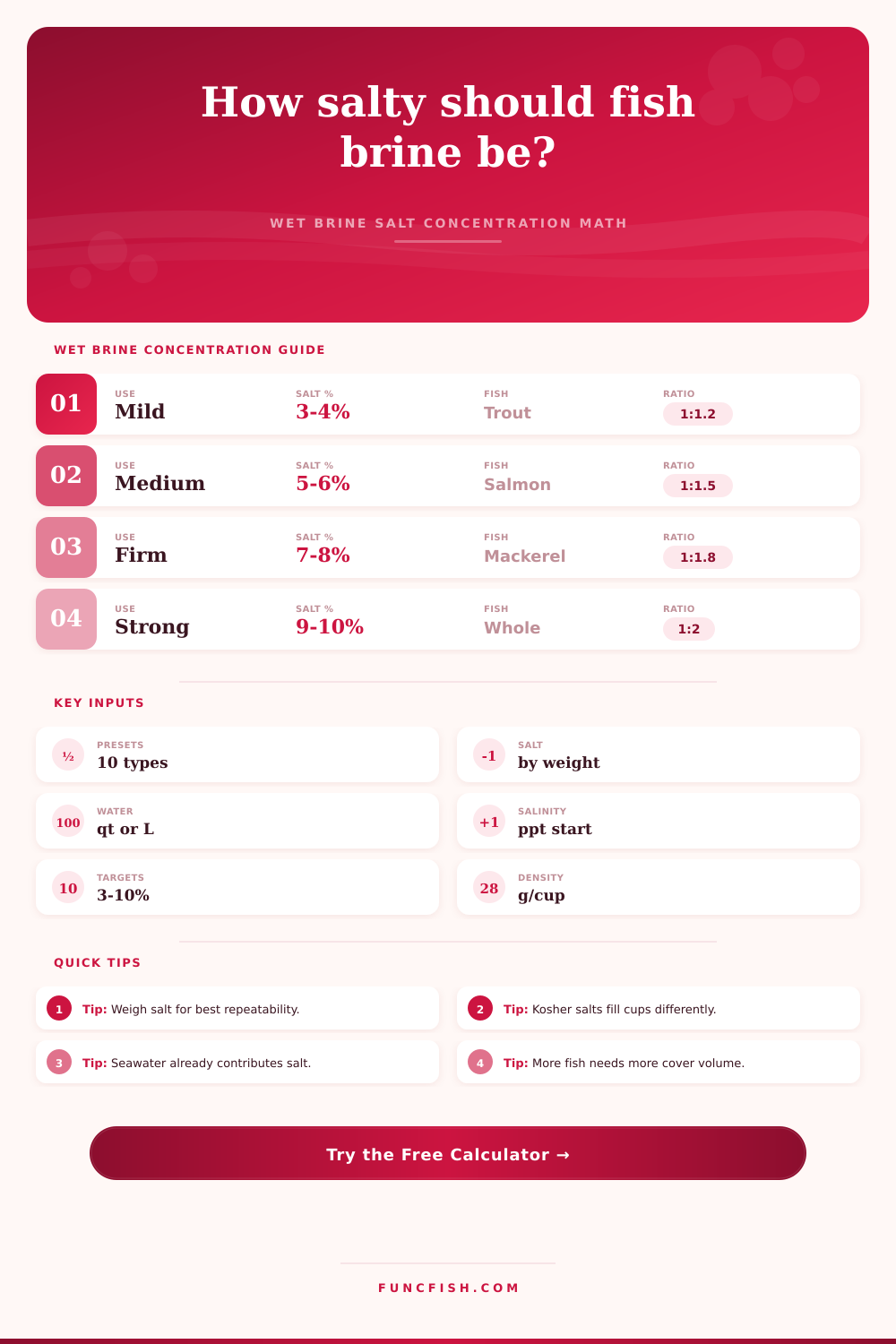
| Mild moisture brine | 2.5% to 4% | 1.0 to 1.4 liquid units per fish unit | Trout, catfish, halibut, short soaks. |
| Standard fish brine | 4.5% to 6.5% | 1.2 to 1.6 liquid units per fish unit | Salmon, cod, mixed fillets, general use. |
| Firm texture brine | 6.5% to 8.5% | 1.4 to 1.9 liquid units per fish unit | Oily fish, whole small fish, thicker portions. |
| Smoke-prep brine | 6% to 9% | 1.5 to 2.0 liquid units per fish unit | Fish headed for smoke or drying math. |
| Strong reference brine | 9% to 10% | 1.8 to 2.4 liquid units per fish unit | Use as a concentration reference, not a food safety rule. |
🧮Concentration conversion table
| Water volume | 3% salt | 6% salt | 10% salt |
|---|---|---|---|
| 1 quart / 0.946 L | 28 g / 1.0 oz | 57 g / 2.0 oz | 95 g / 3.3 oz |
| 2 quarts / 1.89 L | 57 g / 2.0 oz | 114 g / 4.0 oz | 189 g / 6.7 oz |
| 1 gallon / 3.79 L | 114 g / 4.0 oz | 227 g / 8.0 oz | 379 g / 13.4 oz |
| 5 liters / 5.28 qt | 150 g / 5.3 oz | 300 g / 10.6 oz | 500 g / 17.6 oz |
| 10 liters / 10.6 qt | 300 g / 10.6 oz | 600 g / 21.2 oz | 1000 g / 35.3 oz |
📝Species and coverage table
| Fish or cut | Concentration band | Coverage range | Profile factor |
|---|---|---|---|
| Trout fillets | 3% to 4.5% | 1.0 to 1.4 qt/lb or L/kg | 0.92 mild uptake profile |
| Salmon portions | 5% to 7% | 1.2 to 1.7 qt/lb or L/kg | 1.05 oily portion profile |
| Mackerel or oily fish | 6% to 8.5% | 1.4 to 1.9 qt/lb or L/kg | 1.18 firm-brine profile |
| Whole small fish | 7% to 10% | 1.6 to 2.2 qt/lb or L/kg | 1.28 whole-fish profile |
| Halibut steaks | 3% to 5% | 0.9 to 1.3 qt/lb or L/kg | 0.98 lean steak profile |
| Cod or haddock loin | 4% to 6% | 1.1 to 1.5 qt/lb or L/kg | 1.00 lean loin profile |
| Tuna steaks | 4% to 5.5% | 0.8 to 1.2 qt/lb or L/kg | 1.08 dense steak profile |
Fish are brined using a chemical reaction. They come out of it both tastier and more tender. And yet the line between success and salt-brick can be narrower then before. Typically, most home chef eyeball salt… An educated guess that’s one you shouldn’t have to make.
Use the wet brine salt concentration calculator to make the science easy. Plug in your desired strength and your water volume, and let the calculator work out the rest for you.
Why Use a Brine Calculator
Why? Because salt doesn’t simply season the exterior; it soaks into flesh, changing its molecular composition such that when cooked it will retain more moisture. Achieving that penetration is a question of precisely how much salt there is compared to how much water there are.
Another reason people gets tripped up is not knowing what kind of salt to use. Using one kind of salt in place of another won’t work if you don’t change the amount you use. Fine sea salt will be denser then flaky kosher salt (which has big gaps). One cup of Diamond Crystal kosher salt are about half the weight of a cup of table salt. If you don’t know the salt’s crystals is different sizes, you could easily accidently double the salinity called for in recipe, or halve it.
The calculator on this page prompts you for which sort of crystals you want so it knows how many cups/what weight to give you, depending on your target percent. It takes account of the differences between densities (so no more lookup table for the conversion each time you switch brands). That little detail help stop wasted batches.
Remember, it’s not just the salt but the source of your water too. Is your tap water straight from faucet? It is straight fresh water. Did you collect rainwater and brine near the coast? Your starting water may already be saltier then fresh water. Enter a starting salinity on calculator (in parts per thousand) so you know you’re starting with the right salinity.
Hoping to achieve the correct final salinity isn’t good enough. And don’t forget the coverage part. In order to cure evenly, fish must be completely covered by liquid. This means if the liquid doesn’t cover the entire layer, it won’t work and those fillet will either dry out or cure unevenly. Enter your coverage ratio to find out whether you’ll need to increase water volume or use a bigger container to totally cover the batch.
Brining affects each fish uniquely. Salmon and other oily fish hold up well to a stronger brine solution (more salt and time) than leaner varieties like cod or halibut, which may gets rubbery in a brine that’s too strong. Those reference charts provided on the page (with each species listed) explain this profile: Which concentration band will yield the desired texture?
Three percent of a mild brine would be ideal for poaching gently flavored trout fillet. Whole small fish destined for smoking do better with a strong brine at nine percent, where structural firming is required. Knowing this profile tell you if a given fish is good for preserving or merely enhancing.
Other variables include amount of sugar. This not only affects the flavor balance (offsetting the salty bite) but also helps to brown your fish during cooking. You can adjust how much sugar is used as a percentage of the weight of salt. The calculator maintains that same ratio if you want to increase or decrease the size of your batch.
And then there’s temperature. Colder brines penetrate more slowly (providing more time for you to work with them), while hot brines (used in some quick cures) get right to it, but run the risk of cooking the outside. With the index of the batch, you get a quick read on whether the concentration is aligned with the current temperature and type of fish. It is a sanity check. Adjust the soak time or the target percent if it doesn’t look right.
You are always looking for balance. Season the flesh but don’t overwhelm the taste. Tighten up the protein but don’t draw out too many of the natural juices.
The gold standard for repeatability is weighing your ingredients. It’s convenient that volume measures will do for quick estimates, but a kitchen scale means you’ll get the same thing every single time.
Brining becomes a precise craft once you know your numbers, no longer a hopeful experiment. You start with raw protein and end with something distinctly seasoned, firmer and cleaner; but now you would of known just why.