
Whale sharks is the largest fish in the world. When you meet one, it’s hard to tell if you’re looking at a fish or a submarine, until you look down into the blue and spot yourself standing next to a giant shadow. That’s often when people realize what they’ve encountered: a whale shark.
For these animals, size isn’t just headline stat. It explains their movement in the water, their survival strategies, and their vulnerability to today’s threats. This visual breakdown puts abstract measurements in your head, so you can imagine it for yourself… And change the way you think as you swim beside them.
Understanding Whale Sharks
They’re harmless filter feeders despite their enormus size. Unlike other aggressive cousins who hunts in groups or actively pursue prey, they simply cruise around using a five-foot-wide mouth as a big net. This mouth has no teeth but is covered in gill rakers instead. They scoop up fish eggs, plankton, and even tiny shrimp called krill, then send the water right back out again.
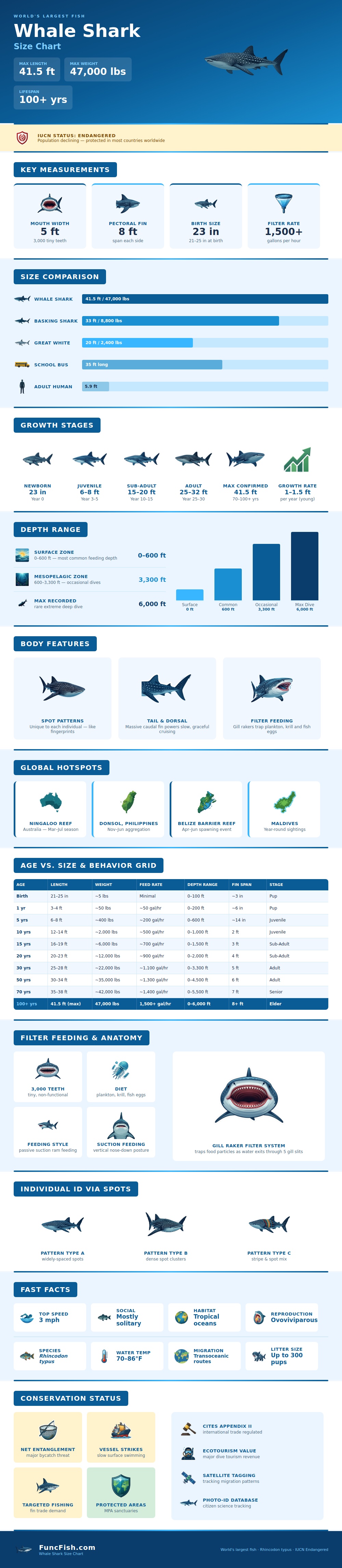
It is a highly effective system for feeding one gigantic body, which need an equally large amount of food. According to the chart above, each whale shark can process more than a thousand gallons of water per hour. It’s hard to grasp how much that is unless you picture yourself filling a small pool with water in mere minutes… and doing this constantly.
This is also why they are listed as an endangered species by the International Union for Conservation of Nature (IUCN): The growth of these giants is counted not in months but rather decades. In other words, these creatures don’t come charging onto the scene fully grown. When born, their pups measure about twenty inches long, roughly the size of a large baguette. That’s about the same size as a big baguette.
It would of take them years to achieve juvenile status and the size that you may see during a diving vacation in Mexico or the Philippines. By the time these gentle giants hit sexual maturity. At age thirty plus; they’ve gained maybe one foot of length each year. Because they reproduce so slowly, any loss of adult members to boat strikes or fishing nets impacts population for years to come. They just aren’t able to replenish themselves fast enough.
Now take a look at the max size we’ve got confirmed on the chart, those are some huge comparison bars! With an average length exceeding forty feet (as big as a school bus) and weighing nearly half that of five elephants, a whale shark dwarfs a great white shark whose max size barely hits twenty feet (and remember, a whale shark has no dorsal fin). Even the second-place basking shark doesn’t come close. And this mass enables them to reach depths we wouldn’t have expected while also holding their breath for extended amounts of time.
Though usually spotted near the surface, where there is the greatest density of plankton, they can be tracked diving down into the dark middle layer thousands of feet below. Despite what many people think based off seeing them up top, these guys aren’t all about the shallows.
Each shark has a distinctive pattern on its skin. It’s like fingerprints in people: no two whales has the same pattern of stripes and spots. By photographing them and using databases to follow them around the ocean, scientists know that they are making much longer trips across oceans different than ever suspected. They is migrating across ocean basins in ways we never imagined.
This means that local rules against catching them aren’t enough, because they move so far into unregulated international waters. That’s where this citizen science project comes into play. It proves we must protect them to help them survive. Don’t get in their way as they swim and eat, but enjoy their beauty from a distance.
And so, this whale shark size chart, what it really is, is not just numbers. It’s a chart, a map of an animal whose life strategy is designed to be efficient, not fast. Slow down; eat constantly; grow over time. Know that, and let it dispel your fears and fill you with respect for them.
Next time you’re looking out and see that huge gray shape cruising by the hull, keep in mind that it’s here to filter the ocean we swim in, a gallon at a time, in a world where there’s too much noise, but not enough room for giants.