Wind Fetch Wave Height Calculator
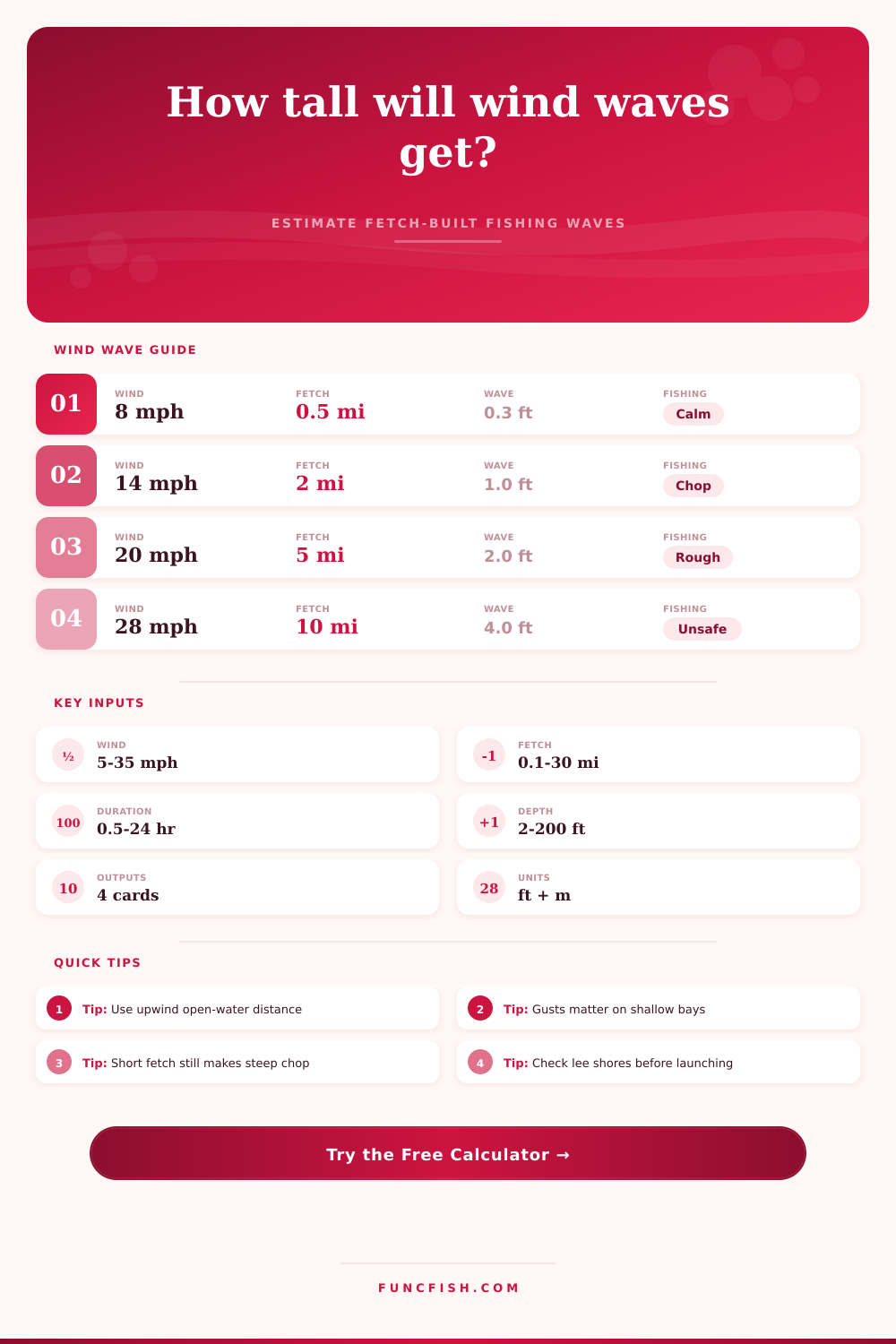
Estimate significant wave height, peak crest risk, wave period, and fishing comfort from wind speed, open-water fetch, wind duration, water depth, and exposure.
📌Scenario presets
⚙Wave settings
Fetch wave forecast
Calculation breakdown
💨Fetch and wave data grid
Usually ripple to low chop unless the fetch is long and unobstructed.
Common drift-control range for bass, walleye, and inshore flats.
Whitecaps become routine, especially across long reservoirs and bays.
Fetch waves can stack fast; small craft comfort drops sharply.
Protected pockets produce steep but smaller chop in most winds.
Enough distance for fishable chop to become a handling factor.
Main-basin waves can outgrow many nearshore fishing plans.
Breaking wave height is capped near 0.78 times local depth.
📊Wave reference tables
| Wave class | Significant height | Typical surface | Fishing impact | Small craft note |
|---|---|---|---|---|
| Ripple | Under 0.5 ft / 0.15 m | Catspaws, tiny crests | Fine for finesse floats and sight fishing | Comfortable for most platforms |
| Light chop | 0.5-1.0 ft / 0.15-0.30 m | Short broken texture | Good lure cover; bobbers still readable | Kayaks need basic boat control |
| Moderate chop | 1.0-2.0 ft / 0.30-0.61 m | Frequent whitecaps | Productive wind banks but harder casts | Small hulls pound into the wind |
| Rough chop | 2.0-4.0 ft / 0.61-1.22 m | Stacked crests and spray | Drift speed and landing fish become harder | Use caution and protected routes |
| Heavy | Over 4.0 ft / 1.22 m | Large steep sets | Fishing precision drops sharply | Avoid exposed small-craft runs |
| Sustained wind | Short fetch 0.5 mi | Open fetch 3 mi | Long fetch 10 mi | Common fishing read |
|---|---|---|---|---|
| 8 mph / 13 km/h | Ripples | Low chop | Light chop | Easy boat control |
| 12 mph / 19 km/h | Low chop | Light chop | Moderate chop | Windward banks activate |
| 16 mph / 26 km/h | Light chop | Moderate chop | Rougher main lake | Drift socks and heavier heads help |
| 22 mph / 35 km/h | Moderate chop | Rough chop | Heavy sets possible | Pick coves or lee shorelines |
| 30 mph / 48 km/h | Rough short chop | Heavy chop | Unsafe exposed run | Reconsider launch and return path |
| Species / style | Useful wave range | Best exposure | Presentation match | When to move |
|---|---|---|---|---|
| Bass moving baits | 0.5-2.0 ft | Windblown points | Spinnerbait, chatterbait, crankbait | Move when casting accuracy collapses |
| Crappie floats | 0.0-0.8 ft | Protected brush or docks | Float, jig, spider rig | Move when bobbers vanish in chop |
| Walleye jigging | 0.8-2.5 ft | Main lake reef edge | Jig, crawler harness, slip drift | Move when bottom contact is lost |
| Pike and muskie | 0.5-2.8 ft | Wind-swept weeds | Big spinner, jerkbait, swimbait | Move when boat swing beats retrieve |
| Trout trolling | 0.3-1.5 ft | Soft crosswind lines | Spoon, plug, streamer troll | Move when speed surges too much |
| Redfish flats | 0.2-1.2 ft | Leeward edge or slicks | Paddle tail, spoon, popping cork | Move when sight lanes disappear |
| Kayak finesse | 0.0-0.8 ft | Lee bank and pockets | Ned rig, small jig, drop shot | Move before return paddle is exposed |
| Platform | Comfort height | Watch height | Control tool | Positioning note |
|---|---|---|---|---|
| Bank or pier | Any safe footing | Spray over structure | Longer rod, heavier sinker | Watch surge on low riprap |
| Kayak or canoe | Under 0.8 ft | 0.8-1.2 ft | Anchor trolley, drift chute | Plan downwind exit before fishing |
| Jon boat / skiff | Under 1.0 ft | 1.0-1.8 ft | Bow into waves, bilge ready | Avoid quartering steep chop |
| Bass boat | Under 1.8 ft | 1.8-3.0 ft | Trolling motor and trim | Run protected lanes when possible |
| Deep-V fishing boat | Under 2.5 ft | 2.5-4.0 ft | Trim tabs, slower quartering | Account for peak sets, not average |
| Bay boat | Under 2.0 ft | 2.0-3.5 ft | Jack plate, trim, drift sock | Wind over tide can steepen quickly |
| Offshore hull | Under 4.0 ft | 4.0-6.0 ft | Tabs, throttle, route choice | Local inlet waves may exceed basin waves |
💡Calculation tips
Fetch tip: Measure the open water directly upwind from your fishing spot, then reduce it if islands, marsh points, docks, or bends break the wave train.
Safety tip: Compare the peak wave card with your return route, not only the spot you plan to fish; downwind runs and narrow ramps can be rougher.
To understand the effect of wind, there are two factors: Wind speed and how far wind has traveled over open water (fetch). The amount of fetch a body of water has mean the difference between having a good day and a grind on the water.
So you look at weather report and see fifteen miles per hour wind and think this is going to be a calm day. But what if that wind blew across ten miles of open lake? And it blow ten miles straight across an open lake? That’s enough wind to swamp a small boat. What if that wind blew into a half-mile cove? Now you’re looking at gentle ripple waves. The farther it blows in any given direction the more energy it feeds to top of the water.
Why Wind Speed Is Not Enough
Wind speed is all that most angler consider, but they’re not looking at the right thing. By calculating hull shape, water depth, wind duration, and fetch length, you’ll have a pretty good idea of what to expect.
What’s fetch? It’s distance across which the wind travels without obstruction. Dense marsh grass, an island, or even land will interrupt the fetch line. You can also account for how exposed your shoreline is. The tool provides a realistic estimate whether you’re fishing an open basin or protected cove.
There’s one more key ingredient: how long the wind blows. Ten minute gusts won’t generate a lot of swell. Four hour steady breezes lets the waves build to max height. Because they require some time to get going and form up, the calculator give a lot of weight to this variable.
The other key variable is the water depth. Wave size is limited by shallow water. Friction between bottom and the water motion limits wave size. Regardless of wind strength, waves can never be as high in ten feet of water as in say sixty. To avoid unrealistically large results the calculator restrict wave height based off the local depth (many simple calculators don’t do this).
What does all of this give me? Well, you get more than just one number. You get an estimated peak crest of the wave (the actual wave you ride). You also get what’s called significant wave height, which is average of the largest third of waves. That peak crest is what can knock you off balance or splash into your boat over the gunwale.
How is this all tied together? With the fishing comfort class. This includes the kind of boat you are in. Obviously, a flat bottomed jon boat doesn’t handle chop like a deep-V hull does and this tool will dial down the comfort rating based on this difference.
Knowing these factors will alter your approach to the day. You read a 20 mile per hour prediction and call in sick. But what if it’s shallow and the fetch isn’t far? Those same winds could just create some chop. They could also concentrate fish on wind-protected side. And what about a slight breeze over a long fetch? That can blow up big rollers and roll up some pretty nasty stuff making precise presentation hard.
Wind speed is one thing but knowing how the wind interacts with the water and the space between is another. Actualy, it’s more complex then that. The tool comes with reference tables to help you see how these numbers apply to various techniques and species.
Some chop is actualy good for bass fishing because it breaks up the surface light and pushes baitfish into cover. It breaks the surface light and forces baitfish into cover. And trout trolling demands smooth water to keep accurate depth control.
The key is knowing your limits. Pick the proper place. You don’t have to be a meteorologist to understand water. Just know the wind needs enough room to do its thing. Look at duration and check the fetch. Then determine if the waves are going to hurt or help you before you fire that engine.
You should of checked the fetch first.