Wishbone Rig Length Calculator
Calculate wishbone stem length, fork arm balance, hook spread, included angle, rig-body clearance, and anti-tangle score for surf, boat, flatfish, reef, carp, and compact double-hook presentations.
📌Wishbone Rig Presets
⚙Rig Geometry Inputs
Calculation Breakdown
🧵Fork Arm Material Data
📊Wishbone Rig Reference Tables
| Rig style | Typical stem | Fork arms | Hook spread | Best use |
|---|---|---|---|---|
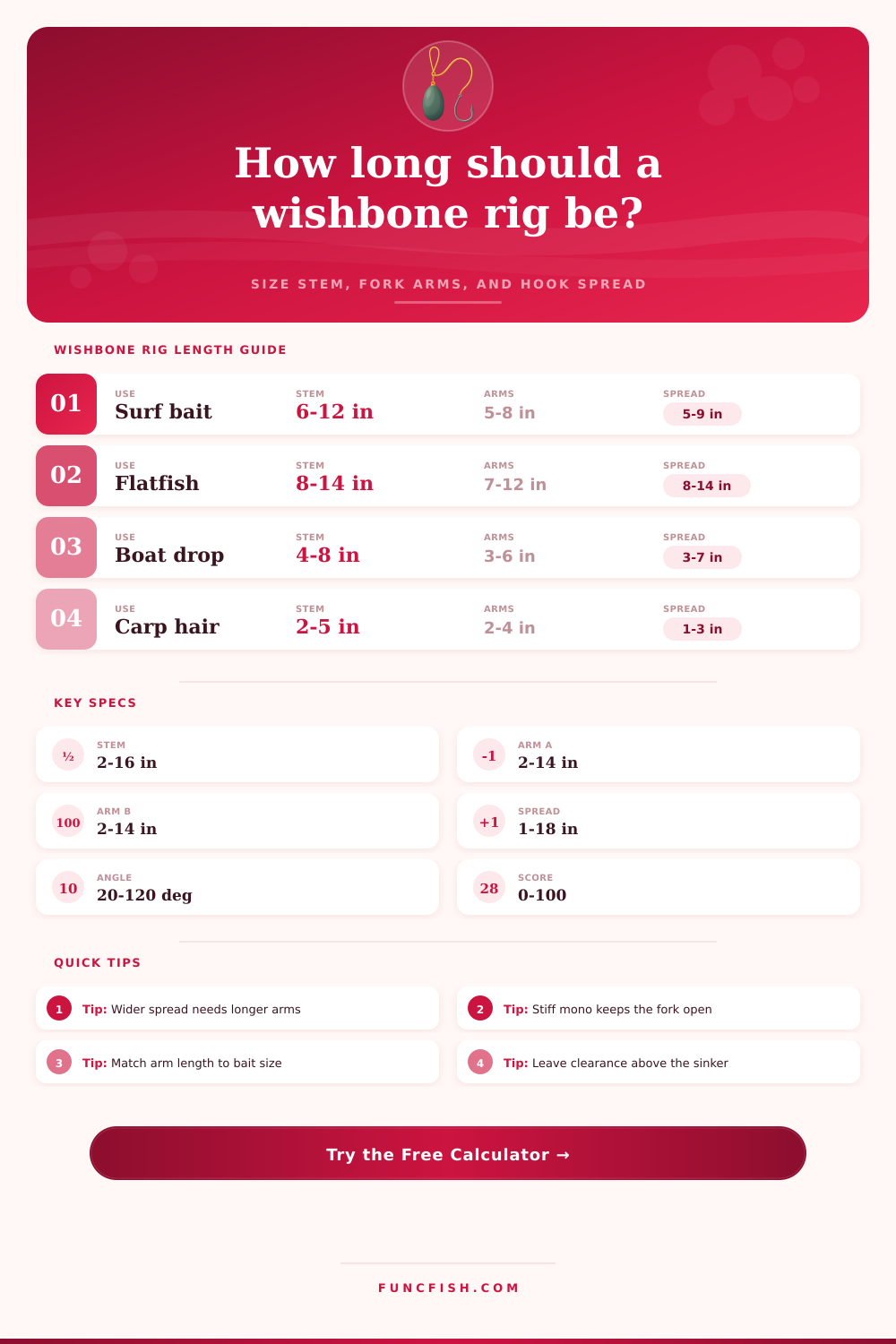
| Open surf wishbone | 6-12 in / 15-30 cm | 5-8 in / 13-20 cm | 5-9 in / 13-23 cm | Two baits moving naturally in surf |
| Clipped surf wishbone | 8-14 in / 20-36 cm | 6-10 in / 15-25 cm | 6-11 in / 15-28 cm | Distance casting with a bait clip |
| Flatfish dragging fork | 8-16 in / 20-41 cm | 8-14 in / 20-36 cm | 8-16 in / 20-41 cm | Long strip baits and bottom sweep |
| Boat dropper fork | 4-8 in / 10-20 cm | 3-6 in / 8-15 cm | 3-7 in / 8-18 cm | Compact vertical bottom fishing |
| Carp twin hair fork | 2-5 in / 5-13 cm | 2-4 in / 5-10 cm | 1-3 in / 3-8 cm | Twin boilies, snowman baits, or balanced baits |
| Target group | Hook group | Bait tail | Arm balance | Geometry note |
|---|---|---|---|---|
| Pompano / surfperch | #2 to 1/0 | 1-3 in / 3-8 cm | Equal arms | Moderate spread keeps baits apart in wash |
| Flounder / plaice | #1 to 2/0 | 3-6 in / 8-15 cm | Slight stagger | Longer arms var strips flutter without crossing |
| Porgy / sea bream | #4 to #1 | 1-2 in / 3-5 cm | Equal short arms | Compact spacing suits small bottom baits |
| Cod / bass | 1/0 to 4/0 | 3-7 in / 8-18 cm | Longer lower arm | Big baits need body and sinker clearance |
| Carp / tench | #4 to #8 | 0.5-1.5 in / 1-4 cm | Short equal hairs | Small spreads keep baits fishing as a pair |
| Condition | Spread add-on | Angle target | Material choice | Clearance check |
|---|---|---|---|---|
| Calm drop | 0-1 in / 0-3 cm | 25-60 deg | Soft or standard mono | Compact stem is usually enough |
| Normal surf | 1-3 in / 3-8 cm | 40-80 deg | 40-60 lb mono | Keep fork reach above sinker hardware |
| Strong tide | 3-6 in / 8-15 cm | 50-90 deg | Stiff mono or fluorocarbon | Shorten bait tails before adding hooks |
| Power cast | 4-8 in / 10-20 cm | 45-85 deg | Stiff mono or clipped setup | Use a bait clip if reach grows too long |
| Rough bottom | 3-6 in / 8-15 cm | 45-95 deg | Abrasion mono or fluoro | Raise the fork off debris and shells |
🚩Rig Length Notes
Fork geometry: The calculator treats the two arms and hook spread as a triangle. If the requested spread is wider than the arms can reach, it increases the recommended spread only as far as the arm lengths allow.
Body clearance: Total required body length includes top clearance, stem length, the longest arm, bait sweep, and lower sinker clearance so the fork can move without wrapping the lead link.
With twice the hooks comes double the potential for snarl-ups, unless you get the geometry right on this one. And then there’s the casting, the waiting, then reeling in a Gordian Knot of tangled line that takes you several minutes to unravel before you spot the fish. Tying two knots next to each other isn’t realy the point. It’s about managing how far apart hooks are, how long leader is, how weight moves through water, and how tight line is.
So how do you get that far apart? How do you ensure the hooks sits naturaly without interfering with one another? Too tight of an angle and too short of arms, and the baits will slap together as they fall. That’s not only scary to timid fish but also cause a snarl in current once you try to retrieve it. Make it wider than necessary to avoid snarling and you’ll sacrifice casting control and distance.
Why Getting the Rig Right Stops Tangles
The calculator do the trigonometry for you. It converts those intangible parameters (hook spread and arm length) into a tangible clearance number. So yeah, it lets you know if your design has enough room to breathe underwater.
Fork arm length isn’t everything. You also want to think about materials. Fluorocarbon or stiffer mono holds the Y shape open on strong tides. But soft monofilament have a more natural feel to the fish. A stiff fork keep the geometry in place, which means the hooks remain apart even under drag. That’s important because you don’t want one collapsing into another making two hooks fight for same real estate.
The table below provide a breakdown of common ranges by style. A general idea would be to think surf rigs will need larger spread with longer stems than a compact boat set up like this where vertical clearance is key.
Most anglers don’t think about body clearance until they has issues with it. In order for the forked section to have free movement, there has to be enough line between the sinker link and the main knot. The fork should of not touch either the swivel hardware or the lead weight. Too little slack allow each fish tug to send vibration directly back up the line. Worse yet, each tidal surge will twist leader in contact with the sinker.
The tool determine the minimum amount of slack needed by considering your largest bait and length of your long arm. Depending on expected water conditions, it tacks on a fudge factor as well. These sizes depends on targeted species. The longer arms allows a strip bait to flutter free. This mimics how a flatfish would behave if laid out on the bottom imitating dying prey.
On the other hand, with a carp rig, you want shorter hair rigs where being precise is more important then getting the right amount of spread. Knowing what behavior your targeted fish exhibit and matching arm size for those behaviors makes a generic rig more specific. Not only does it hold the bait but also presents it in a dynamic way.
Tweak one thing and another change as well. Maybe making the stem longer increase the clearance but throws off the balance so you need to widen the spread? These relationships are updated dynamically by the calculator. It will display the impact of changing the type of material on the recommended join angle. So, rather than guessing about the trade-offs, it removes the guesswork. No more wondering whether something is too tight, just know what makes it work.
Physics plays just as much a role as bait when it comes to fishing gear. Weight, water forces and a properly sized wishbone rig works with those forces. They make the mechanics work for you instead of fighting them. Having balanced arms, enough spread, and proper clearance eliminates tangles. Cast out, focus on what you need to do and wait in peace. A fish bites, the bait swings true, and the knot holds. That’s what happens when you get the length right.