Worm Portion Per Swim Calculator
Plan chopped worm and live worm portions for each swim, including starting feed, top-up rhythm, loose-feed dilution, reserve, and container equivalents.
📌Scenario presets
⚙Worm and swim inputs
Worm portion results
Full calculation breakdown
🧪Worm type data grid
Dendrobaena
Redworm
Lobworm
Mixed Worm
📊Species portion comparison
Roach and Dace
10-25gSmall opening portions with fine chop and cautious top-ups keep the swim working without overfeeding.
Perch
25-45gMedium to coarse chopped worm gives scent and visible pieces; frequent small top-ups suit active fish.
Bream and Tench
40-70gPositive starts can work when fish are settled, especially with soil or groundbait carrying the chopped worm.
Chub and Eel
15-60gClear rivers need restraint; night eel swims can take heavier lobworm portions with fewer feed rounds.
📋Starting portion guide
| Target or swim | Opening worm per swim | Top-up worm per round | Typical cadence | Best worm form |
|---|---|---|---|---|
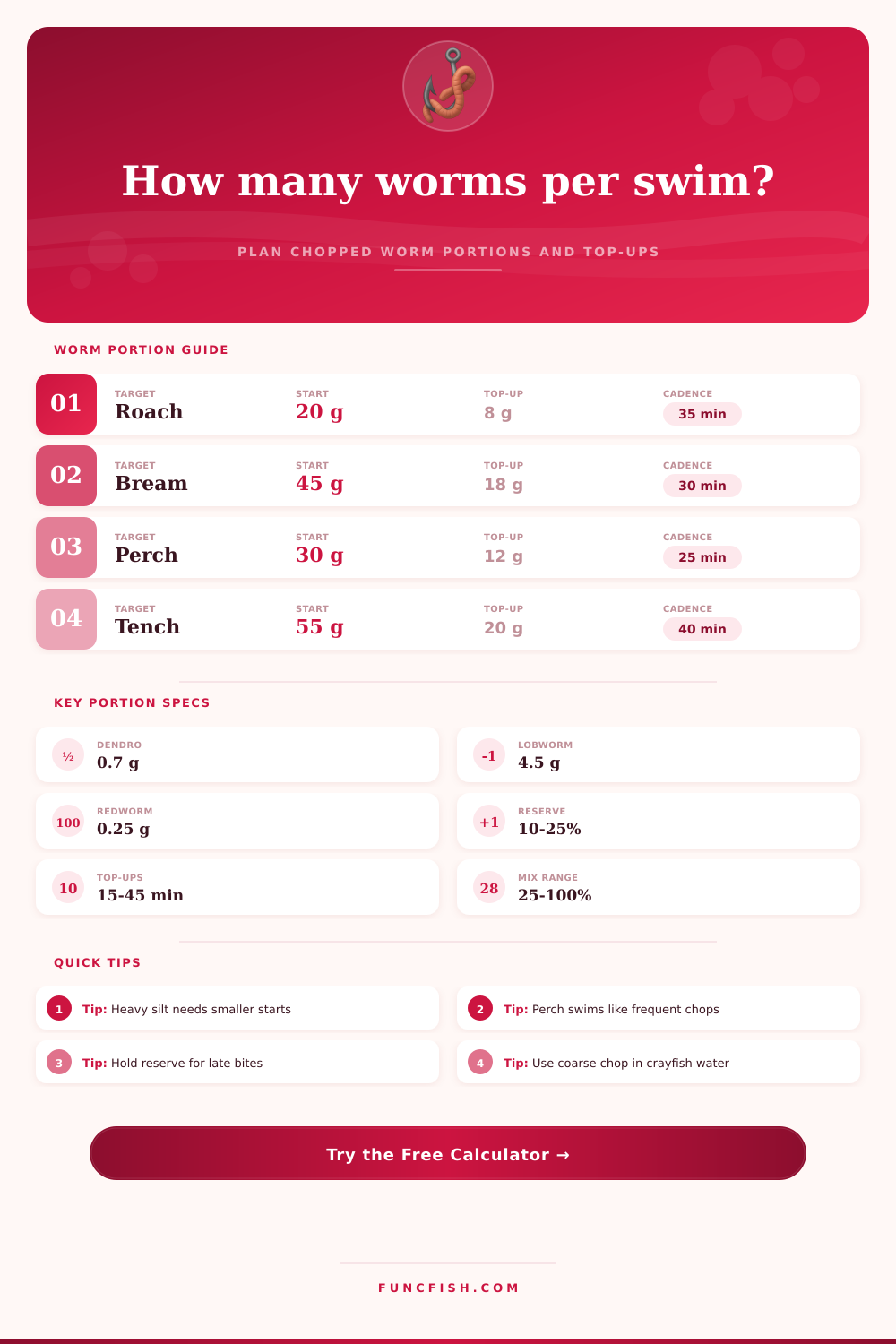
| Clear canal roach | 10-20 g / 0.35-0.7 oz | 4-8 g / 0.15-0.3 oz | 30-45 min | Fine redworm or micro chop |
| Skimmer lake | 25-40 g / 0.9-1.4 oz | 10-15 g / 0.35-0.55 oz | 25-35 min | Dendro and redworm mix |
| Bream shoal | 45-80 g / 1.6-2.8 oz | 15-30 g / 0.55-1.1 oz | 20-35 min | Medium chopped dendrobaena |
| Perch river | 20-45 g / 0.7-1.6 oz | 8-18 g / 0.3-0.65 oz | 15-30 min | Coarse dendro or lobworm |
| Tench silt swim | 40-70 g / 1.4-2.5 oz | 12-25 g / 0.4-0.9 oz | 35-55 min | Medium chop in damp soil |
| Winter chub | 8-20 g / 0.3-0.7 oz | 0-8 g / 0-0.3 oz | 45-90 min | Coarse pinch or halves |
📐Container and volume equivalents
| Worm weight | Approx volume | Dendro count | Redworm count | Lobworm count |
|---|---|---|---|---|
| 25 g / 0.9 oz | 35 ml / 0.15 cup | 36 worms | 100 worms | 6 worms |
| 50 g / 1.8 oz | 70 ml / 0.3 cup | 71 worms | 200 worms | 11 worms |
| 125 g / 4.4 oz | 175 ml / 0.75 cup | 179 worms | 500 worms | 28 worms |
| 250 g / 8.8 oz | 350 ml / 1.5 cup | 357 worms | 1000 worms | 56 worms |
| 500 g / 17.6 oz | 700 ml / 3 cups | 714 worms | 2000 worms | 111 worms |
⚖Chop style and feed behavior
| Chop style | Feed multiplier | Scent release | Particle selectivity | When to use |
|---|---|---|---|---|
| Fine chop | 0.90x | Very fast | Low | Cold water, silverfish, short sessions |
| Medium chop | 1.00x | Balanced | Medium | General bream, skimmer, and perch work |
| Coarse chop | 1.12x | Moderate | High | Bigger perch, tench, chub, nuisance fish present |
| Halved worms | 1.18x | Slower | High | Selective feeding or larger hook baits nearby |
| Mostly live | 1.25x | Slowest | Highest | Eels, chub, margin carp, clear water restraint |
🎣Swim management reference
| Situation | Opening adjustment | Top-up adjustment | Reserve advice | Calculator setting |
|---|---|---|---|---|
| Heavy silt | Reduce 10-20% | Use smaller balls | Keep 20% | Cold or pressured |
| Fast bites | Normal start | Shorten interval | Keep 15% | Active bites |
| Shoal arrives | Normal or +10% | Increase 20% | Keep 20-25% | Shoal present |
| Crayfish water | Reduce fine chop | Coarse only | Keep 25% | Nuisance fish |
| Clear winter river | Reduce 30% | Feed rarely | Keep 10% | Cold or pressured |
💡Portion planning notes
Keep the worm share honest: if chopped worm is only half of the carrier mix, double the total feed mix volume but do not double the worm weight.
Separate start and reserve: take the opening feed from the calculated per-swim ration first, then hold the reserve back until bites or fish movement justify it.
It will also calculate how many baits you need, so you never find yourself running out of worms mid day. We purchase baits based off volume and don’t take spillage or waste into account. This allows you to fill that gap from the shelf to the water.
It makes you think about your own pattern of hunger and what exactly it is you’re fishing with. It makes you think about carrier material and it keeps you from opening up your rod until you know how much you actualy need. It’s a race against the clock, it’s an exercise in managing a limited resource.
How to Plan Your Bait Supplies
First thing to ask of the tool is what fish do you have? Everything flows from there. A clear water canal with roach needs minimal bait. If it’s a weedy lake and it’s bream, then don’t let them kill the swim as they’ll rip off part of it before you know it.
Initial guesswork is taken care of through presets that offer suggestions for opening weights and top-up periods based on typical match conditions. These can be tweaked once underway but having a proven starting point eliminates overfeeding out of the blocks and running dry at the death.
The one confusing input is the percentage of worm in the feed mix. The calculator accounts for the fact that if it’s mixed from groundbait or soil and chopped dendrobaena then there will be more than just worm. It separates out amount of worm in the bait mix by weight compared to entire volume of the bait.
Why? Because while soil or hemp etc takes up space, they don’t deliver the instant bang of protein that a piece of worm do. Get this right and you won’t underestimate how much live bait you have to cram into every feeding ball. Two thirds of your bait is actualy food, which is a sixty percent worm share. You’ll require fewer containers for a five hour session.
The other big factor in consumption rate is chop style. Because fine chopped worms dissapears rapidly, they will need smaller regular top-up doses (but at higher frequency) to retain their appeal while not overfilling the fish stomach. Halved worms or those cut into coarse chops stays on view and provide some visible particles to entice bigger fish like tench or perch. The calculator factors in these variations with an effective feed mass.
A typical mistake with fine chop is feeding it in cold water when the scent cloud may be too overpowering for wary silverfish. By matching the way your fish behave with the physical presentation of your bait, the tool assists with this.
Where does experience really pay off? In reserve planning. When the shoal eventually breaks down and gets all crazy active, there will be flurries of activity, dead worms, wasted hooks, etc. The calculator adds a percentage buffer to account for this waste. Typically ten to twenty percent is enough although if you’re dealing with nuisance roach or fishing in crayfish water, it’s not bad to bump it up just to avoid any panic buying on the bank.
And let’s face it. Some worms are just going to die from the time they leave the shop until they hit the hook. Planning for this loss up front keeps your head in the game instead of worrying about inventory.
After entering the data, it spits out how many containers to purchase and even estimates how many individual worms you’ll need. This is where it helps see exactly how many worms there are. Chopping up three hundred dendrobaenas isn’t easy or quick work. Knowing that amount before you start lets you set yourself up to work as well as possible with your knife and board. No more wild guesses about if there is enough in the bag or not, just plan the station out precisely.
You only control what you control in fishing. You don’t control the fish mood, the water temperature or how much wind there is. You do however control how much of a bait ration you have. This planner takes the guessing out of managing supplies so you can concentrate on technique and presentation rather than whether you have sufficient feed to get through the final hour.
Often it’s getting the final top-up that makes all the difference between a good day and a great day. You should of used this earlier.