Years to Trophy Size Calculator
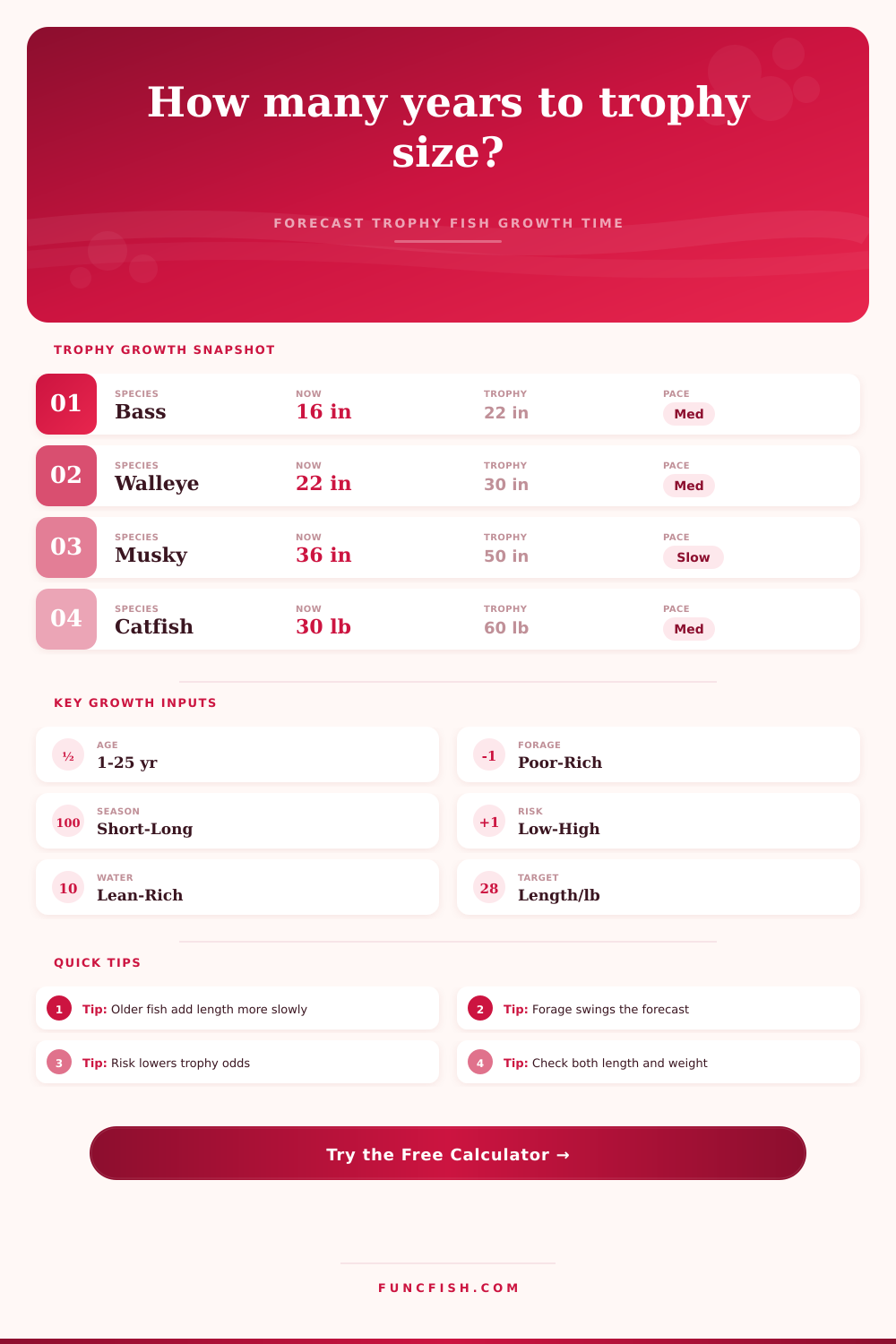
Estimate how many growing seasons a fish may need to reach a trophy length or weight after accounting for species growth, age, forage, water productivity, and survival risk.
📌Trophy species presets
⚙Growth forecast inputs
Trophy growth forecast
Full breakdown
📋Species comparison grid
Largemouth bass
Walleye
Muskellunge
Flathead catfish
Striped bass
Lake trout
Northern pike
Black crappie
📘Reference tables
| Species | Benchmark trophy size | Typical trophy age | Growth curve note |
|---|---|---|---|
| Largemouth bass | 22 in / 8 lb | 7-12 years | Forage and warm water matter heavily |
| Smallmouth bass | 21 in / 6 lb | 8-14 years | Often slower in clear northern lakes |
| Walleye | 30 in / 10 lb | 10-18 years | Length can continue after weight stalls |
| Muskellunge | 50 in / 35 lb | 12-20 years | Large maximum size with slow maturity |
| Northern pike | 40 in / 20 lb | 8-14 years | Fast early growth slows in older fish |
| Channel catfish | 36 in / 25 lb | 8-15 years | Weight gain improves with rich forage |
| Flathead catfish | 42 in / 50 lb | 12-22 years | Predator forage controls heavy fish |
| Striped bass | 40 in / 30 lb | 7-13 years | Open water bait supply drives growth |
| Forage condition | Growth factor | Weight condition | Forecast meaning |
|---|---|---|---|
| Thin forage base | 0.78x | Lean | Fish may add length without much weight |
| Fair forage | 0.92x | Average | Useful baseline for mixed natural prey |
| Good forage | 1.08x | Thick | Growth remains strong into mid age |
| Excellent forage | 1.22x | Exceptional | Best case for heavy trophy fish |
| Growing season | Season factor | Best fit | Growth warning |
|---|---|---|---|
| Short northern season | 0.82x | Cold lakes and high latitude waters | Age climbs before trophy size arrives |
| Moderate season | 1.00x | Balanced reservoirs and natural lakes | Use as the neutral starting point |
| Long warm season | 1.16x | Warm reservoirs and river backwaters | Risk may rise if harvest pressure is high |
| Extended southern season | 1.30x | Southern ponds and fertile systems | Weight depends on forage density |
| Risk or productivity setting | Calculator factor | Result affected | Interpretation |
|---|---|---|---|
| Low mortality risk | 0.94 survival | Trophy odds | More fish live through older age classes |
| High mortality risk | 0.72 survival | Trophy odds | Many fish disappear before trophy size |
| Lean clear water | 0.86 productivity | Growth pace | Healthy but often slower and lighter |
| Very rich water | 1.18 productivity | Growth pace | Fast growth if oxygen and forage hold |
💡Forecast checks
Tip: Treat a trophy forecast as a range, not a guarantee. A fish that is already old may add weight faster than length, especially when forage improves.
Tip: If length reaches the benchmark before weight, review body condition and forage. The calculator reports the slower target when both length and weight are active.
So there you are standing on the bank with a line in the water, staring at lake full of fish and wondering if any of them will ever be big enough for your wall. Every angler has had this thought before: Will I ever catch a trophy? Here is the answer.
Fish don’t grow in a vacuum. They depends on many factors to grow. These factors include food availability, water quality, temperature, and how much life they have left before dying of natural causes or being caught.
Why Fish Grow Slow
Once you input your own conditions, the calculator do all the mathematical work for you. You will not have to guess what biological coefficients might be. It converts your hazy hope into a concrete timeline. Now you can make an informed decision about staying here or heading elsewhere.
It doesn’t grow linearly A bass can jumps up to four inches in its first year and then barely an inch per year after eight years old. This is why it’s so important to know how close you are to being right or wrong with your current estimate of the fish’s age.
Because if you’re thinking you’re going after a four year old fish, you’re on one growth curve. But if you think you’re chasing a ten year old fish, you’re on another. Older fish adds girth without getting much longer. They become heavy, but rarely do they get any longer. So it adjusts the estimated gain based off the age you estimate. Overestimating the age will stretch it out. Underestimating it may make you happy to see optimistic results that never materialize.
It’s all a matter of honesty with yourself regarding size of fish you’ve actualy had on the end of your line.
The engine of growth is food. Give a guy lots of light and warm water and he’s gonna be small without any food. That’s why the calculator has forage input that adjusts for this reality.
If the forage base is thin, all they’re doing is competing for scraps. Everything slows down. If the forage base is good, they’ve got all the energy they need and food converts to flesh at a fast pace.
That’s how much the water produces. Oligotrophic lakes (clear) may be beautiful looking but starve the fish. They simply don’t have the nutrients to produce huge food chains. Eutrophic lakes (murky) may look ugly but produce food like crazy. If you want big fish, you gotta sacrifice aesthetics for biology.
Surprisingly, this has to do with the length of the season too. Up north, the growing window is limited; half the year the fish is shivering in cold water and under ice. They are barely eating. Down south the fish have ten months or more of feeding time. Add that time together over several years and it matters. A fish that takes fifteen years to reach fifty inches in a short season might reach that size in ten if the season were a little longer. The calculator use multipliers on those seasons based on actual metabolic conditions of the environment. Not just how hot the water gets, but how long does it stay warm enough to digest?
The silent killer of trophy dreams is risk. A fish may have the genetics to reach a large size but must live long enough to achieve it. Disease, predation and harvest pressure take their toll. The greater the risk, the lower the probability for each individual fish to survive and become a trophy. The calculation is done using survival probability; the tool adds up the risk over the number of years required to reach trophy size. It’s a harsh reminder that not only does it take time for a fish to grow large, but life is also dangerous.
Check out that species comparison grid on the page. Notice how a pike isn’t going to grow like a walleye. Each species grows at a different pace and has a differant height ceiling. For example, bass mature early and grow fast. Walleye grow slowly but have a long life span. Knowing what those curves look like allows you to know what to expect. Don’t expect your walleyes to be the size of a pike. If yours aren’t, don’t beat yourself up because you’re not failing. You could simply be fishing for the wrong species of fish in that body of water.
One last thing. A prediction is a prediction, it’s a range, not a promise. Mother nature is messy. A hot summer might stress the fish. A bad winter may wipe out the food supply. Take the numbers and use them as a guide, not a promise. Hope for three if the calculator shows four, but plan on five.
It isn’t about making a promise. It’s about managing your time and energy wisely. You don’t want to spend a decade chasing a fish because the biology says it will never show up. The data helps you see the hidden obstacles in the way of that trophy catch. Knowing when to quit is as important than knowing when to cast.