
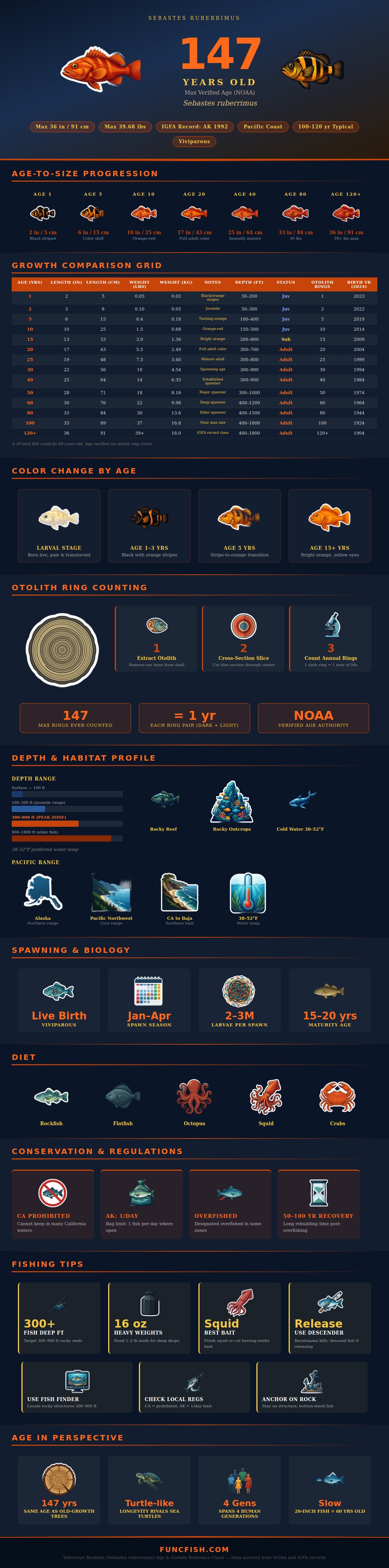
A Yelloweye rockfish is a fish that lives in deep water off the Pacific coast, lasts over a hundred years and then looks at you with big eyes when you reel him out of almost a thousand feet of water. A Yelloweye rockfish are the sort of slow growing, long living creature that makes it an oceanic contradiction. Catching one is less like fishing and more like stealing a piece of history.
For most fishermen a big fish is a trophy. But for a Yelloweye rockfish a big fish are a story told across four generations of people. Twenty-inches may not seem like much compared to the giant halibut we see, but that can be the equivalent of six decades of life. In many other species, size equals maturity and the two is linked. Rockfish are different because they defy all logic on this account. It will take almost two decades for their stripes to fade into an adult’s fully orange red. Not only are you fishing for something bigger but you’re also hoping they grows into something different.
Why Yelloweye Rockfish Are Special
Understanding this growth curve changes how you think about conserving these fish in the water. Because these fish don’t sexually mature until they’re 15-20 years old, taking out adults can really throw off the population cycle, something that other more rapidly reproducing species don’t bounce back from as easy. Instead of laying eggs, a single female birth millions of larvae live. The offspring then float near the surface for a few years before settling down. It’s a risky way to breed, so you need those adults to survives long enough to reproduce and do it all over again and again.
When targeting yelloweyes, depth becomes your primary navigation tool. These fish love cold water temperatures (between thirty-eight and fifty-two degrees Fahrenheit). As the season changes they pull back further. If the surface water temps warms up they dive down again. The juveniles may hang around in the first couple of hundred feet, while the real giants tends to find a home deep on rocky outcrops at about nine hundred feet. You’ll be using some heavy tackle and a lot of patience because in order for your bait to reach them fast enough without being carried by current overhead, you’re going to need to use a bunch of weight. Squid is far superior than other packaged baits because it looks like what is actualy found on the sea floor, such as the small fish and octopus that make up much of their diet.
Survival rate also becomes an issue when dealing with these deep-water giants. If you reel a rockfish up from roughly nine hundred feet, it undergo extreme barotrauma because the sudden drop in pressure causes its internal gases to expand and possibly burst its organs. If released, simply tossing them back into the water usually condemns them to death. That’s why having something like a descender device makes all the difference. It gives you the ability to slowly lower the fish back down to its normal depth and hopefully give it a fighting chance during the journey home.
It’s also wise to check your local regulations, as most waters in Alaska only allow one yelloweye per day and some even forbid anglers to keep them at all in California. The respect due this species begins with understanding when you’re best off keeping them underwater. Those glowing yellow eyes are staring back at you from the depths. You’re looking at a time-tested resident of the deep, having survived who knows how many environmental changes and predation events during his life. It’s not simply honorable; it’s an investment in hoping the next generation of anglers and divers get to experience ancient red giants lurking beneath their boat line.
You should of respected them from the start.