Fishing Budget Planner Calculator
Build a fishing trip budget from road fuel, boat fuel, launch fees, bait, meals, lodging, guide time, contingency, and weighted angler shares.
📌Scenario presets
⚙Trip settings
👥Share weights
Fishing budget forecast
Budget ledger
Calculation breakdown
📊Budget category reference
Road Fuel
Boat Fuel
Bait & Ice
Lodging
Launch Fees
Meals
Guide Fee
Other Fees
📋Planning reference tables
| Fishing trip type | Usual shared categories | Suggested buffer | Best share method |
|---|---|---|---|
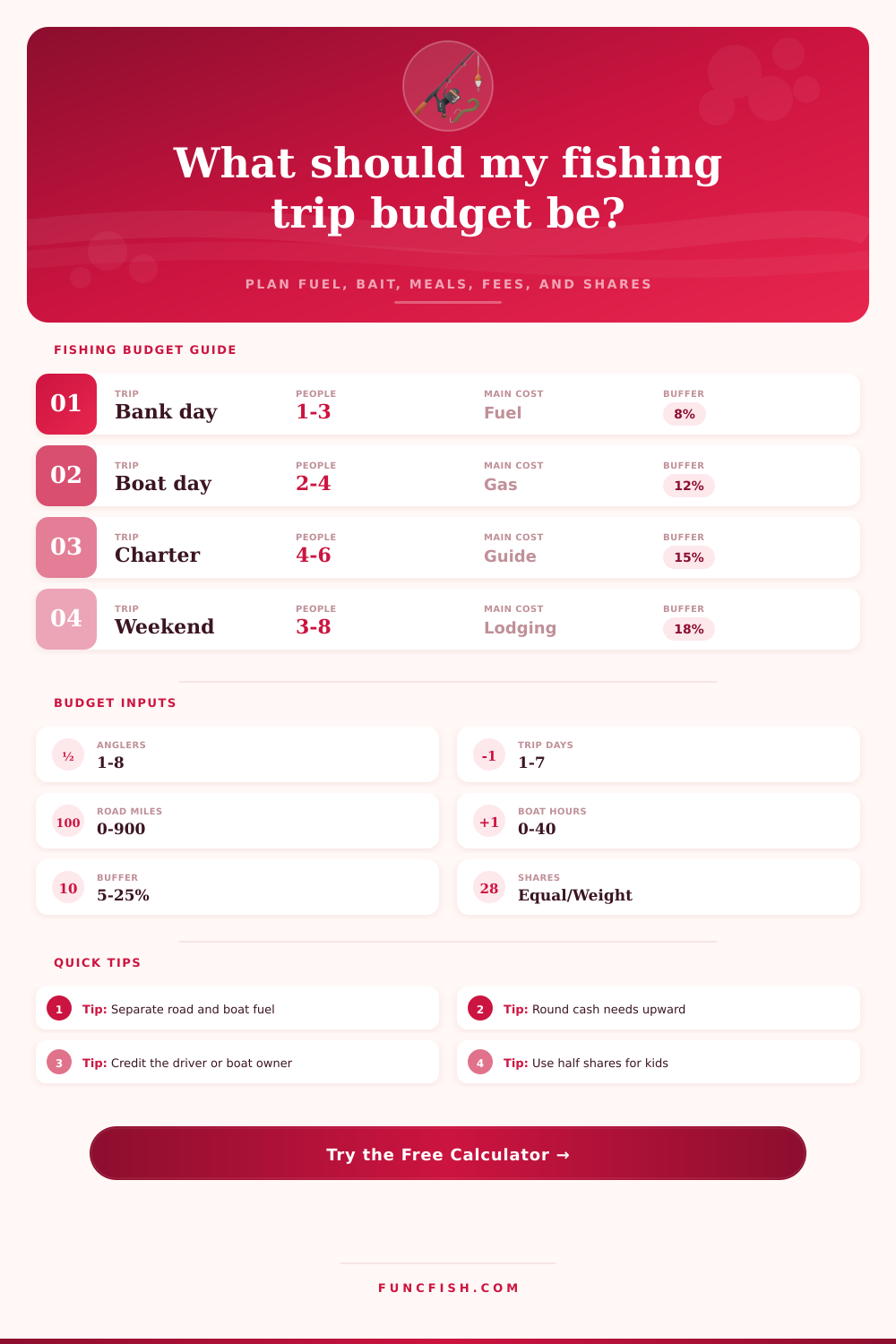
| Bank or pier day | Road fuel, bait, meals, access | 5-10% | Equal anglers |
| Kayak inshore | Road fuel, launch, bait, ice | 8-12% | Equal or weighted |
| Trailered boat | Road fuel, boat fuel, ramp, bait | 10-15% | Owner credit |
| Charter or guide | Guide fee, fuel surcharge, bait, meals | 12-18% | Per seat |
| Weekend cabin | Lodging, road fuel, meals, bait | 15-20% | Weighted shares |
| Remote water run | Fuel, spare ice, lodging, supplies | 18-25% | Weighted with reserve |
| Fuel input | Imperial formula | Metric formula | Calculator use |
|---|---|---|---|
| Road fuel | Miles / mpg | Km x L/100 km / 100 | Truck or car fuel line |
| Boat fuel | Hours x gal/hr | Hours x L/hr | Main motor running time |
| Fuel price | Price per gallon | Price per liter | Matches selected unit system |
| Fuel buffer | Included in contingency | Included in contingency | Weather and idle time cushion |
| Share item | Default weight | When to change it | Budget effect |
|---|---|---|---|
| Adult angler | 1.00 | Full participant | Standard share |
| Youth angler | 0.50 | Lower meal or bait usage | Half share |
| Guest rider | 0.75 | Does not use all supplies | Light share |
| Boat owner | 1.00 | Adjust when owner pays more | Credit or full share |
| Driver credit | Manual | Vehicle, tow, or gear use | Reduces amount due |
💡Budget checks
Tip: Keep vehicle fuel, boat fuel, and guide or rental costs separate. Those categories change for different crews and make settlements much clearer.
Tip: Enter deposits and prepaid shared purchases in the already paid field so the calculator shows the remaining amount to collect.
Planning a fishing trip require you to create a budget. Creating a budget is necesary for a fishing trip because there are many differance costs associated with a fishing trip. The costs of a fishing trip include transportation costs, food costs, equipment costs, and lodging costs.
When planning a fishing trip, you must take the time to calculate all of the cost that are associated with the fishing trip. Otherwise, the total cost of the fishing trip may come to more than you expect the cost of the fishing trip to be. Many groups have encountered problems during there fishing trips due to not having calculated the total cost of the fishing trip prior to the beginning of the fishing trip.
Make a Budget for Your Fishing Trip
By making a budget plan prior to leaving home, people can avoid these financial problem. Fuel costs are a major cost for most fishing trips and often the largest cost that people must plan for when creating a budget for their fishing trip. The fuel costs for a fishing trip include the fuel that is used for driving to the fishing spot and the fuel that is used for operating the fishing boat.
These are two separate cost, and they should be calculated separately. For instance, if some individuals are driving to the fishing spot with another individual that has a vehicle that gets 12 miles per gallon, they may use more fuel than an individual with a vehicle that gets 16 miles per gallon. By calculating each of these costs separately, the individual that is providing the vehicle or the fishing boat will know how much fuel they will be responsible for paying.
In addition to fuel costs, other costs that should be included in the budget for a fishing trip include the cost of bait, ice, tackle, food, lodging, and fishing guides. Costs for bait, ice, and tackle are typically smaller costs that are directly associated with the fishing trip. Food costs are often overlooked but are a cost that should be included in the budget.
Some individuals eat more than others, and therefore, everyone will not need to contribute the same amount to the cost of food. For instance, some groups will calculate the cost of food based off the age of the individual that is going fishing. An individual that is young and does not eat as much as an adult may be calculated differently than an older individual that eats more food.
Costs for lodging and fishing guides are a fixed cost that are typically included in fishing trip budgets. For instance, if the group is renting a cabin or hiring a charter captain for the fishing trip, the cost of these expenses is a fixed cost that must be accounted for and paid in advance. Other costs, such as tournament entry fees and fishing spot parking fees is a fixed cost that must also be accounted for prior to beginning the fishing trip.
In addition to calculating all of the individual costs, it is also important to include a contingency buffer for unexpected cost. A contingency buffer is an amount of money that can be included in the budget for situations where individuals may need to spend additional money beyond the planned cost of the fishing trip. For instance, if there are any weather delay or if there is the need for additional ice for the fishing trip, there may be costs associated with those situations.
In these instances, a fishing trip budget can include a contingency buffer of 12%. If the fishing trip is for multiple day or goes to a remote location, 18 or 20% may be needed to account for the unexpected variable of cost for these situations. By including a contingency buffer, people will ensure that the total cost of the fishing trip will be within the amount of money that each individual collected prior to going on the trip.
Determining how to divide the costs among each individual in the group is a final task prior to departure on the fishing trip. A split cost is a method that can be utilized to evenly divide the costs of the fishing trip among all individuals. This split cost may be used if everyone is expected to use the same amount of fishing supplies.
Another way to divide the costs is to use a weighted share. A weighted share allows for individuals to pay for the cost of the fishing trip in a way that reflects the expected use of supplies by each individual. For instance, young children may eat less food and use less bait than adults.
Giving the owner of the fishing boat credit for the cost of maintaining and insuring the boat will allow for the cost of the fishing trip to be more accurate in determining how much each individual must contribute to the trip. Additionally, by subtracting the amount of each cost that is paid for by an individual in the trip prior to calculating the cost for each individual to pay, the cost will not be calculated twice. Many individuals encounter problems planning their fishing trip budget because they have forgotten to include some cost categories within their budget.
For instance, some individuals may forget to include ramp fees, parking fees, and the cost of ice in their budget for the fishing trip. To avoid including a cost that is unknown to everyone going fishing, run the budget calculations twice. Calculate the cost of the fishing trip using optimistic numbers for the costs of the trip.
Then, calculate the cost of the fishing trip a second time with a contingency buffer included in the cost calculation. When the fishing trip budget is complete, the driver will calculate the total cost of the fishing trip and the cost for each individual prior to the beginning of the fishing trip. By knowing the total cost of the fishing trip prior to the beginning of the fishing trip, the driver will know how much cash to bring to the fishing spot.
Additionally, everyone else in the trip will be aware of how much money each individual must pay for the costs of the fishing trip. By knowing these costs prior to the fishing trip, there will be no confusion regarding who owes what money for the fishing trip costs. Additionally, by knowing the costs for a fishing trip prior to beginning to fish, it will be easy to plan the next fishing trip.