Annual Fishing Cost Calculator
Estimate yearly fishing cost from trips, drive fuel, boat fuel, access fees, bait, lodging, licenses, storage, maintenance, tackle wear, and gear depreciation.
📌Scenario presets
⚙Annual fishing inputs
Annual fishing cost estimate
Full cost breakdown
📊Cost category reference grid
Bank / Pier
Kayak
Bass Boat
Offshore
📋Annual cost planning tables
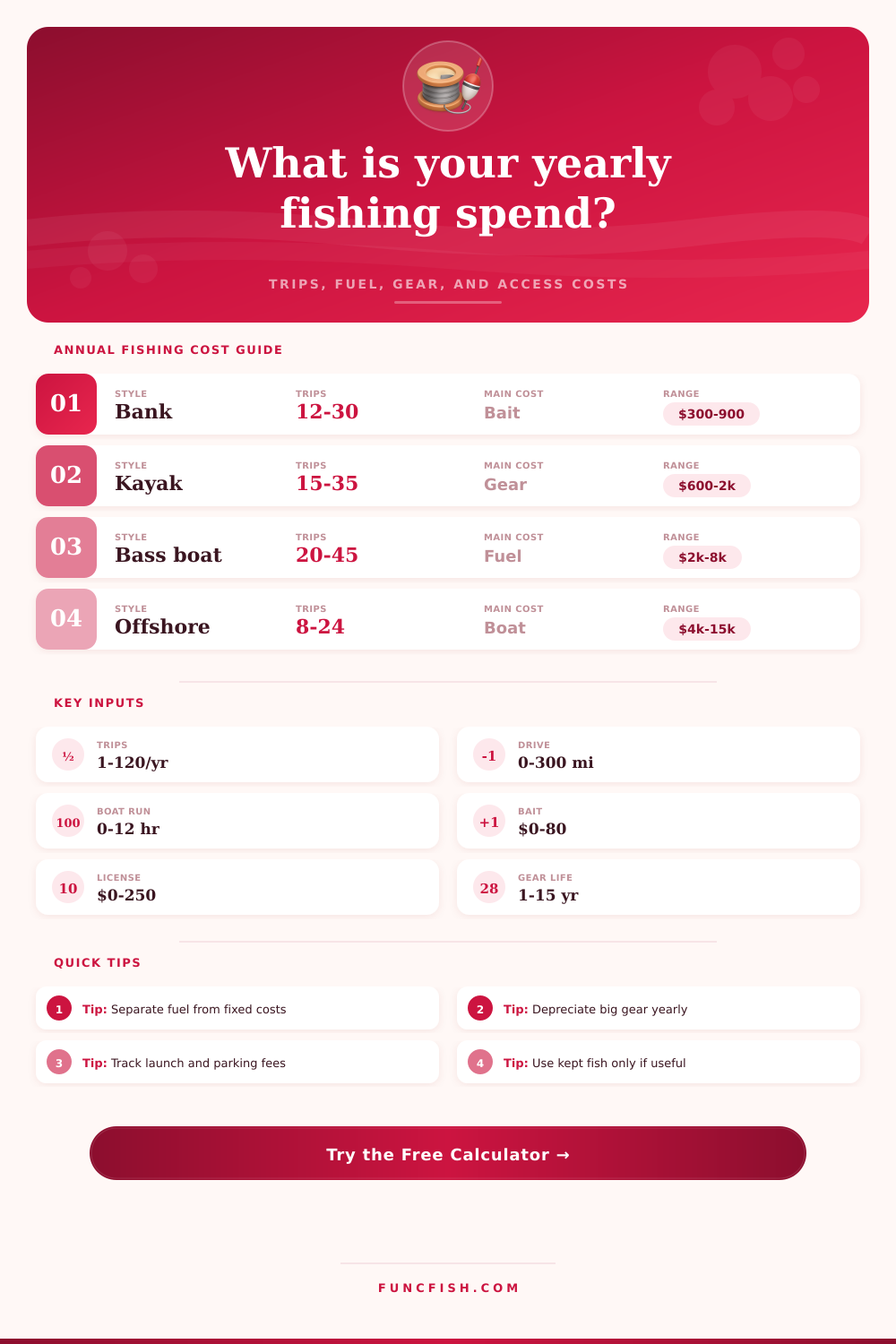
| Fishing style | Typical trips | Common fixed costs | Common variable costs |
|---|---|---|---|
| Bank / pier | 12 to 40 per year | License, rod, line | Bait, parking, food |
| Wade / stream | 10 to 35 per year | License, waders, boots | Fuel, flies, leaders |
| Kayak / canoe | 15 to 45 per year | Hull, PFD, rack, paddle | Fuel, launch, tackle |
| Bass boat | 20 to 55 per year | Storage, service, insurance | Boat fuel, tow fuel, lures |
| Offshore boat | 8 to 30 per year | Slip, service, safety gear | Fuel, bait, ice, crew split |
| Charter mix | 2 to 12 per year | License, personal tackle | Trip fee, travel, tip, food |
| Cost line | Recommended entry | Why it matters | Calculator treatment |
|---|---|---|---|
| Drive fuel | Round trip distance | Often the hidden repeat cost | Distance divided by economy |
| Boat fuel | Engine hours and burn | Dominates powerboat seasons | Hours times burn rate |
| Launch and parking | Per-trip local fee | Small fees compound quickly | Multiplied by trips |
| Gear depreciation | Current gear value and life | Shows true long-run cost | Value divided by years |
| Cash this year | Total minus depreciation | Useful for actual outlay | Reported separately |
| Target species | Cost pattern | Gear wear | Planning note |
|---|---|---|---|
| Panfish | Low fuel, low tackle | Light line | Watch bait and ice |
| Trout | Travel and license driven | Leaders and flies | Waders depreciate fast |
| Bass | Lures and boat fuel | Line and plastics | Track lost tackle |
| Walleye | Trolling fuel and bait | Leaders, jigs, line | Engine hours matter |
| Catfish | Bait, fuel, night supplies | Terminal tackle | Add batteries and lights |
| Offshore | Fuel, bait, ice, service | Heavy tackle | Separate crew-shared costs |
💡Calculation checks
Tip: Put shared ramp, fuel, bait, and ice costs into the trip fields, then use the sharing field to estimate your personal share. Keep fixed costs personal unless they are truly split.
Tip: Gear depreciation is not a bill, but it explains why a low-cash season can still be expensive when rods, electronics, motors, waders, or kayaks wear down.
Many anglers know there favorite fishing rods and many anglers know their favorite bodies of water, but many anglers do not know the exact total cost of fishing over a twelve-month period. There is a difference between the feeling of a hobby versus the cost of that hobby, and understanding the difference can help anglers make better decisions with there finances. For instance, an angler may feel that their total costs for the year while fishing are relatively low based on the money that they do put into the activity each season, but the total costs may be higher than they had expected of their fishing hobby.
The calculator included in this article handle the mathematical calculations necessary to determine the true cost of fishing for the year once the angler enters their driving distance, boat hours, bait spending, and annual costs. Each of these costs are important to include in the calculation of the total costs of fishing. For instance, driving distance and fuel prices are two different costs that must be accounted for in the calculation of the true cost of fishing.
How Much Does Fishing Cost Each Year
Anglers who take trips that include lodging or launch fees will encounter those costs each year, although not each trip may include those costs. Costs like fishing licenses is another example of costs that remain the same each year, regardless of the number of times that anglors go fishing each season. Many anglers may tend to underestimate costs that are considered to be fixed costs for each individual angler.
Costs like storage fees, insurance, and maintenance costs may seem like one-time fees when first beginning to own fishing gear, but those costs are actualy incurred each time that anglers go fishing each year. Additionally, anglers may also have costs related to depreciation of their fishing gear. For instance, anglers may not need to purchase new fishing gear each year, but rather the cost of the gear that they own can be divided by the length of time that those items is supposed to last, which can help to calculate the cost of gear depreciation for each year.
Another category of costs to consider are costs that may vary from year to year for each angler. Costs for bait, tackle, ice, and food are costs that will increase for anglers that fish more often each year. For instance, the inclusion of a field for anglers to enter the number of individual who will share in the trip can help to calculate the cost of fuel and ramp fees, which the number of individuals that will be sharing in the costs of the trip will divide by.
Additionally, anglers who pursue certain types of fish may find costs for bait and ice to be higher than anglers that pursue other types of fish. For instance, bass anglers may need to use more lures and line than anglers that pursue panfish. Offshore anglers may require more bait and ice than other types of anglers.
Costs like these may be accounted for in the calculator using fields for anglers to enter adjustments according to the type of fish that they pursue. Anglers tend to only focus upon the money that they do spend while they are fishing each year. Costs that are slowly accumulated over time or that anglers often forget may be the costs that an angler should of focusing upon instead.
For instance, low spending seasons may still accumulate a high true cost for those anglers each year due to the aging of their fishing gear or due to the costs of storage. While anglers that take many long trips each year might appear to have a high cost each year, those anglers may actually have a lower cost for each trip that they go on while fishing each year due to the distribution of those costs. While the reference tables included in the article can help anglers understand the costs that is associated with each type of fishing activity, anglers are not required to use any of those scenarios for their own fishing activities.
For instance, bank and pier anglers may have lower costs each year for trip-related fees, but may have higher costs each year for bait and parking costs. Kayak anglers may travel less distances on their boats, but may have higher costs related to the gear and storage of that gear. Bass boat owners may have costs for the boats that increase each year in relation to the number of engine hours that the boats accumulate or the costs of providing service to the boats.
Offshore boat owners tend to have the highest costs for fishing trips each year due to the costs of fuel, slips for boats, and safety equipment that is required for those types of fishing trips. One common mistake that anglers may make is the underestimation of costs related to gear, such as fuel costs or gear depreciation. While anglers may discuss fuel costs when they are enacting their fishing activities, costs related to gear purchases and gear depreciation are often just as high as the cost of fuel each year.
Another common mistake by anglers is to forget the difference between the costs that an angler needs to have this year versus their total costs for the year while fishing. The cost calculations separate these two different costs to make it easier for anglers to understand each of these costs separately. By understanding which costs are variable costs and which costs are fixed costs for anglers, individuals can begin to plan for their fishing season.
For example, the costs that are variable can be changed immediately, such as if anglers began to fish from locations that are closer to there homes, or if they began to fish with friends. Costs related to depreciation could be reduced if anglers began to take better care of their fishing gear; taking better care of fishing gear will not change the number of fishing trips that anglers go on each year. Anglers can also change the costs that they have each year by selecting different types of fish to fish for within their area.
For instance, some types of fish may require anglers to travel less distances from their homes than other types of fish, and anglers may require less specialized fishing tackle to pursue certain species of fish than others in their area. In general, the value of calculating each of these costs is to recognize the impact that changes to distance, boat hours, or gear replacement can have upon the total costs of an angler for the year. Once anglers understand which costs can be changed and which costs are fixed, anglers can manage their fishing season with ease as a single budget for the year.