Live Bait Cost Per Dozen Calculator
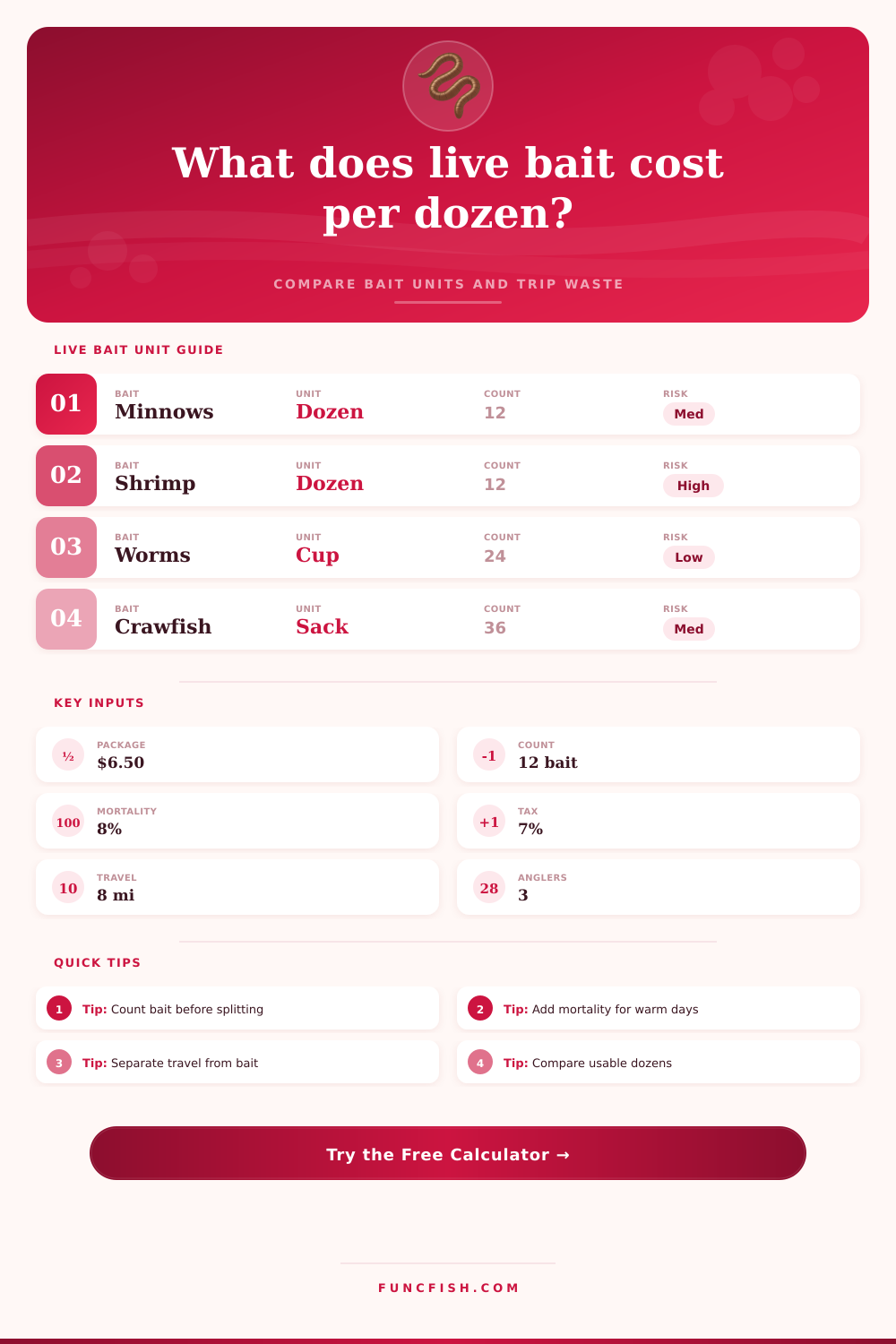
Compare live bait packages by true dozen, usable dozen, angler share, travel add-on, mortality loss, and leftover value before buying bait for a trip.
📌Scenario presets
⚙Bait purchase settings
⛽Travel add-on
Live bait cost forecast
Full breakdown
📋Live bait handling data
Fathead Minnows
Golden Shiners
Live Shrimp
Nightcrawlers
| Bait type | Typical package count | Base mortality range | Cost comparison note |
|---|---|---|---|
| Fathead minnows | 12 to 36 count | 3% to 12% | Cheap by count, sensitive to warm buckets |
| Golden shiners | 6 to 24 count | 6% to 18% | Higher sticker cost, often better size for bass |
| Threadfin shad | 12 to 50 count | 15% to 35% | Must include survival loss in the dozen math |
| Live shrimp | 12 to 50 count | 8% to 25% | Travel and aeration can change the real dozen cost |
| Nightcrawlers | 18 to 30 count | 1% to 6% | Often cheapest after leftovers are reused |
| Leeches | 12 to 24 count | 4% to 12% | Good candidate for multi-trip planning |
| Crawfish | 12 to 48 count | 5% to 18% | Count size carefully; large bait may fish slower |
| Pinfish | 6 to 24 count | 5% to 20% | Usually bought by count, then normalized to dozens |
| Holding condition | Mortality adjustment | Best for | Dozen math effect |
|---|---|---|---|
| Shop bucket only | 0 percentage points | Short drives and hardy bait | Use your entered mortality as-is |
| Aerated bucket | -3 percentage points | Minnows, shiners, shrimp | More usable bait per dozen bought |
| Cool livewell | -5 percentage points | Longer trips in warm weather | Lowers effective usable dozen cost |
| Warm bucket | +8 percentage points | Emergency holding only | Raises cost by shrinking usable count |
| Saltwater livewell | -4 percentage points | Shrimp, pinfish, croaker | Often worth adding aeration cost |
| Ice or bedding | -4 percentage points | Worms, bloodworms, leeches | Preserves leftovers for another trip |
| Comparison target | Formula | Use when | Watch-out |
|---|---|---|---|
| Sticker cost per dozen | Package total / gross dozens | Comparing shelf labels | Ignores dead bait and detour cost |
| Usable cost per dozen | Total cash / live dozens | Choosing fragile bait | Needs a realistic mortality estimate |
| Planned-fishing dozen | Total cash / planned use | Splitting with anglers | Leftovers can make it look too high |
| Per angler trip share | Total cash / anglers / trips | Settling up at the ramp | Only fair if everyone uses similar bait |
💡Practical checks
Tip: Compare gross dozen cost and usable dozen cost separately. A cheap tub can become expensive if a warm ride kills a large share before the first spot.
Tip: For group trips, split travel only when the bait shop stop is an extra detour. If it is already on the route, set travel allocation to ignore travel.
When you purchase live bait, you are buying your live bait from a store for an inventory that must survive many differents conditions. The live bait must survive the trip from the store to your home, and the live bait must survive while you are waiting upon the water’s location where the live bait will be use. The sticker price for the live bait packages reflect the cost of the live bait that the store purchases.
However, the sticker price for live bait packages dont reflect the cost of the live bait that dies during transportation and while waiting upon the water. Thus, because some of the live bait will die and some of the live bait will be left over, the true cost of a dozen of live bait that is successful in being used as bait for fish is more higher than the sticker price for that live bait. To understand how costly the live bait truly is, an angler should of calculate the cost of a dozen of live bait that will be used as fishing bait.
How to Find the Real Cost of Live Bait
The survival rate of the live bait can change based off the type of live bait and the environment. For instance, shrimp can die at a more higher rate than nightcrawlers when transported in live bait packages because the shrimp is often transported in thin plastic bags while the store stores the nightcrawlers in damp bedding. Thus, due to these differing rate of survival for live bait of the same type, the cost of a dozen of shrimp can be higher than the cost of a dozen of nightcrawlers.
Both these variables and others the live bait cost calculator will account for so that anglers can determine the actual cost of live bait of interest relative to other live bait alternatives. Anglers can also utilize the cost calculator to determine if more expensive live bait packages are actualy more cost-effective to purchase than cheaper live bait packages. The travel that is necessary to reach the live bait store also have an effect upon the total cost of the live bait.
While live bait stores located further from your home may be more costly to access, they may contain live bait that last longer because you may travel a greater distance to reach these stores without needing to purchase as many ice to keep the live bait alive or live bait that must be aerated to survive the trip from the store to the angler. Thus, the cost of travel to the live bait store can be accounted for within the live bait cost calculator because the cost of fuel is in fact an expense relative to the total cost of live bait. While many anglers do not consider travel cost to the live bait store as an expense, the fact that fuel costs money indicates that travel to a live bait store is an expense.
When live bait is purchased for a trip that include many anglers, the cost of live bait for each angler can seem low when the group purchases the live bait. However, if one angler utilize more live bait than the others on the fishing trip, the cost of live bait for each angler will be uneven. Thus, the live bait cost calculator will calculate the total cost of live bait divided by the number of anglers on the fishing trip so that each angler understands the fair cost of live bait for each individual angler.
Furthermore, the live bait cost calculator will also provide each angler with a recommended package count that include a safety buffer for the live bait so that each angler does not experience instances where their live bait package is depleted during the fishing trip. Finally, the way that live bait is held impact the mortality rate of the live bait. For example, using a shop bucket may be sufficient for live bait transportation for a short distance to the fishing trip, but the shop bucket may lead to increased mortality rate for live bait during the summer months when the live bait is held in the shop bucket during periods of long daylight hour.
Using an aerated bucket or livewells can reduce the mortality rate of the live bait, allowing anglers to have more live bait that is fishable during their fishing trip. Thus, the live bait cost calculator automatically adjust the mortality rate of the live bait when the anglers select their live bait holding method. Such adjustments ensure that the cost of live bait is calculated in a manner that is accurate for the live bait that each angler intend to use for fishing.
The amount of live bait that is left over after the fishing trip is another variable that can impact the total cost of live bait. Live bait packages that contain organisms like worms and leeches may be able to survive the fishing trip so that each angler can use the live bait once again on a future fishing trip. Live bait packages that contain organism like shrimp may not survive beyond the initial fishing trip.
Thus, each angler will need to account for the cost of the leftover live bait if they plan to use that live bait on a future fishing trip. The live bait cost calculator will individually calculate such costs so that each angler can decide whether purchasing live bait that may be left over after the fishing trip is a benefit to the angler or whether purchasing live bait for each fishing trip is a more beneficial alternative. Through calculating each of these variable, anglers will be able to understand how each variable has an effect upon the cost of the live bait.
For instance, each angler will be able to understand how the mortality rate and the use of live bait have a greater impact upon the cost of live bait than the initial price of the live bait package. Furthermore, live bait cost will change based upon the travel costs to the live bait store and taxes on live bait packages. Thus, by understanding how each of these variables can impact the cost of live bait packages, anglers will be able to make better decision regarding the purchasing of live bait for fishing trips.