Fishing Reel Braid Backing Knot Calculator
Plan how much backing to load under braid, how much space to reserve for the connection knot, how many wraps to tie, and what drag setting keeps the backing-to-braid connection inside its working range.
📌Scenario presets
⚙Spool, backing, braid, and knot inputs
Backing and knot plan
Calculation breakdown
🧵Line and knot data used
Mono backing
Dacron backing
8-carrier braid
Hollow braid
📊Backing and braid reference tables
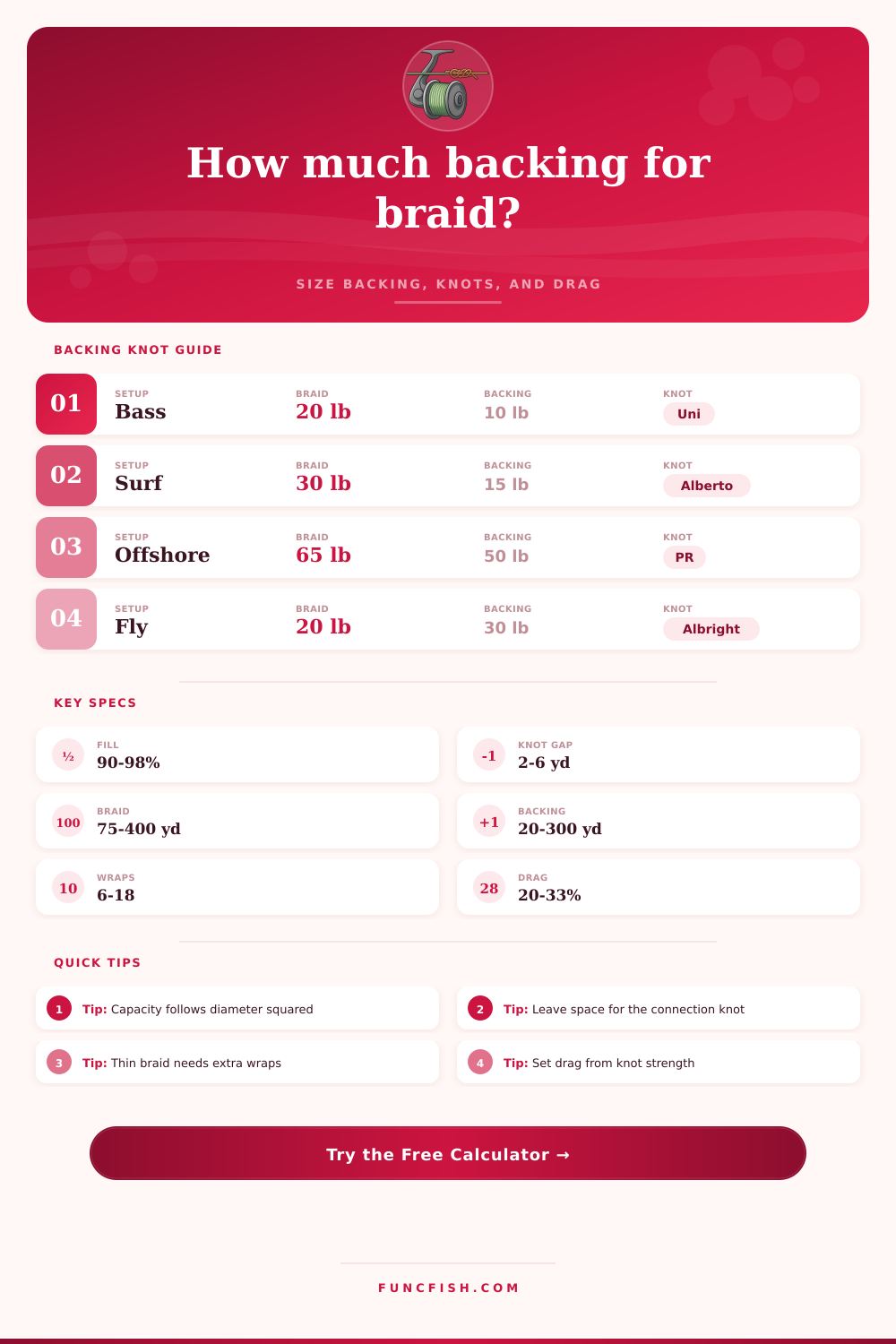
| Reel setup | Common braid | Backing choice | Backing target | Knot reserve |
|---|---|---|---|---|
| 1000-2500 spinning | 6-20 lb / 0.06-0.15 mm | 6-10 lb mono | 20-90 yd / 18-82 m | 2-4 yd |
| Bass baitcaster | 30-50 lb / 0.23-0.36 mm | 10-15 lb mono | 30-80 yd / 27-73 m | 2-5 yd |
| Surf spinning | 20-40 lb / 0.18-0.32 mm | 12-20 lb mono | 80-250 yd / 73-229 m | 4-8 yd |
| Offshore conventional | 50-100 lb / 0.36-0.55 mm | 30-80 lb braid | 100-500 yd / 91-457 m | 5-12 yd |
| Fly reel backing | Dacron or gel-spun | 20-30 lb Dacron | 50-250 yd / 46-229 m | 3-6 yd |
| Connection knot | Best use | Typical strength | Wrap range | Bulk rating |
|---|---|---|---|---|
| Double uni | Similar diameters, easy field tie | 68-78% | 5-10 per side | High |
| Alberto | Thin braid to thicker mono backing | 74-84% | 7-14 wraps | Medium |
| Albright | Backing loops and fly connections | 70-82% | 8-14 wraps | Medium |
| FG knot | Thin braid and compact connection | 82-90% | 14-22 hitches | Low |
| PR knot | Heavy jigging and offshore braid | 86-94% | 18-30 coils | Low |
| Hollow-core splice | Hollow braid systems | 90-98% | Needle splice | Very low |
🎣Scenario gear guide
| Species / use | Typical braid | Backing line | Drag target | Notes |
|---|---|---|---|---|
| Panfish / trout | 4-10 lb / 0.04-0.10 mm | 4-8 lb mono | 1-3 lb / 0.5-1.4 kg | Keep knots compact on small spools |
| Bass spinning | 10-20 lb / 0.10-0.18 mm | 8-12 lb mono | 2-5 lb / 0.9-2.3 kg | Leave lip clearance to limit wind knots |
| Walleye jigging | 10-15 lb / 0.10-0.15 mm | 8-10 lb mono | 2-4 lb / 0.9-1.8 kg | Accurate fill helps line counters |
| Inshore kayak | 15-30 lb / 0.15-0.25 mm | 10-15 lb mono | 4-8 lb / 1.8-3.6 kg | Use extra wraps around shell or dock fish |
| Surf casting | 20-40 lb / 0.18-0.32 mm | 12-20 lb mono | 5-10 lb / 2.3-4.5 kg | A low-bulk knot helps long cast lay |
| Offshore jigging | 50-100 lb / 0.36-0.55 mm | 50-80 lb braid | 12-28 lb / 5.4-12.7 kg | Splice or PR knot for compact strength |
✅Practical checks
Capacity check: Published reel ratings are usually based on monofilament diameter. When braid is much thinner, backing length changes quickly because spool volume scales with diameter squared.
Knot check: Put the backing-to-braid knot deep enough that it stays buried during normal casts, but not so deep that a hard run reaches the knot under maximum drag.
Braid is a type of fishing line that many angler use because braided lines can travel more farther than monofilament lines, feel more responsive than monofilament lines, and have more strength in a smaller diameter than monofilament lines. However, braided lines can slip on bare spool reels, so anglers must add a layer of backing between the braided line and the reel. This layer of backing will both protect the fishing reel and ensure that the braided line remain seated on the spool.
Anglers must determine the necessary length of backing for their reel. They must also determine the effect that the knot between the backing and the braided line have on the capacity of the reel. Finally, anglers must determine the drag setting of the reel to protect the connection between the backing and the braided line.
How to Set Up Braided Line: Backing, Knots, and Drag
Using the calculator, anglers can determine the exact amount of backing that is necessary to allow for proper line capacity and reduce the likelihood of the connection between the backing and braided line sitting too close at the lip of the spool. Fishing lines come in a variety of backing types. Each type of backing have different properties that will affect the lines performance when being fished.
For example, monofilament lines has a great grip on the arbor of the spinning reels and provide some shock absorption for the fish but increase the diameter of the spool rapid. Dacron lines are thinner than monofilament lines of the same strength but compress less when exposed to tension. Many fly angliers and offshore fishing crews use dacron lines.
Eight-carrier braided line backing has the same slick feel as braided lines but may require additional turns around the arbor or a rubber band to prevent the line from spinning on the spool. The calculator accounts for the different types of backing by adjusting the amount of space that is left on the spool for the main braided line. The type of knot used between the backing and the braided line is also important.
Anglers can use a double uni knot for its simplicity and reliability but lose some of the benefits of braided lines because this knot creates bulk within the line and has a tendency to catch on fish. An Alberto knot or an FG knot will create less bulk within the line and be stronger than a double uni knot but require more wraps of the line to achieve the apropriate connection. Offshore anglers that use hollow braid lines use a splice to connect the backing to the braided line to remove almost all of the bulk from the connection.
Each of the available knots for this connection create a different amount of space within the line on the spool. Each of the available knots also create a different number of wraps of the line for which the line must be wound around the arbor of the fishing reel. The drag setting on a fishing reel is the point on the line where the line meet the fish.
The drag should be set to the percentage of the adjusted strength of the knot rather than the full test strength of the line. For example, if the strength of the knot is seventy-five percent of the full strength of the line but the drag is set at thirty percent of the seventy-five percent strength of the line, then the drag setting will keep the connection between the line and the fish within its working load even when the fish pulls on the line. This drag adjustment feature on the reel is also adjusted by the calculator to provide a scenario bias for situations where the fish are likely to exhibit jigging or when the fish are likely to be caught in heavy cover.
In addition to the factors accounted for in the calculator, there are other variables in the real world that may affect how well the line is spooled onto the fishing reel. Factors like the tension of the line, how the line is wound around the reel spool, and the humidity in the air can all impact the amount of line that can be wound on the spool. A machine wound spool will hold more line on the spool than a line wound by hand.
Additionally, line may become wound in a loose fashion around the spool, creating “wind knots.” Anglers may leave a small lip reserve on the spool to provide a buffer for the line between the lip of the spool and the area where the line is secured to the reel. The calculator allows anglers to enter the amount of this lip reserve so that the calculation by the calculator accounts for this buffer. There is also a test that anglers can use to ensure that the line is properly spooled onto the reel.
After the line is spooled onto the reel, the angler should pull on the line until the connection between the backing and the braided line until it become visible. The connection should be several turns below the lip of the spool. If the connection is not several turns below the lip of the spool, then the angler should shorten the length of the braid or reduce the target fill amount of the braided line that is to be used when fishing.
If the connection between the line elements does not appear during a full cast with the reel, then the line has too much capacity on the spool. The connection between the backing and the braided line should feel secure when set at the drag setting that the angler use when fishing. These three factors, the length of the backing, the bulk of the connection between the backing and the braided line, and the drag setting of the fishing reel, are all connected to each other.
If the angler gets each of these three elements correct in relation to each other, the reel will remain balanced when being used and the connection between the backing and the braided line will remain protected. When these three elements are correctly incorporated into the creation of the fishing reel setup, the only thing that will limit the anglers fight with the fish is the line itself.