Fishing Reel Handle Rotation Distance Calculator
Estimate handle-knob travel, line retrieved per turn, total pickup, crank cadence, and target handle turns from reel style, handle length, gear ratio, spool diameter, fill, and line load.
📌Scenario presets
⚙Reel, handle, and retrieve inputs
Handle rotation distance estimate
Results update when you change the inputs.
Calculation breakdown
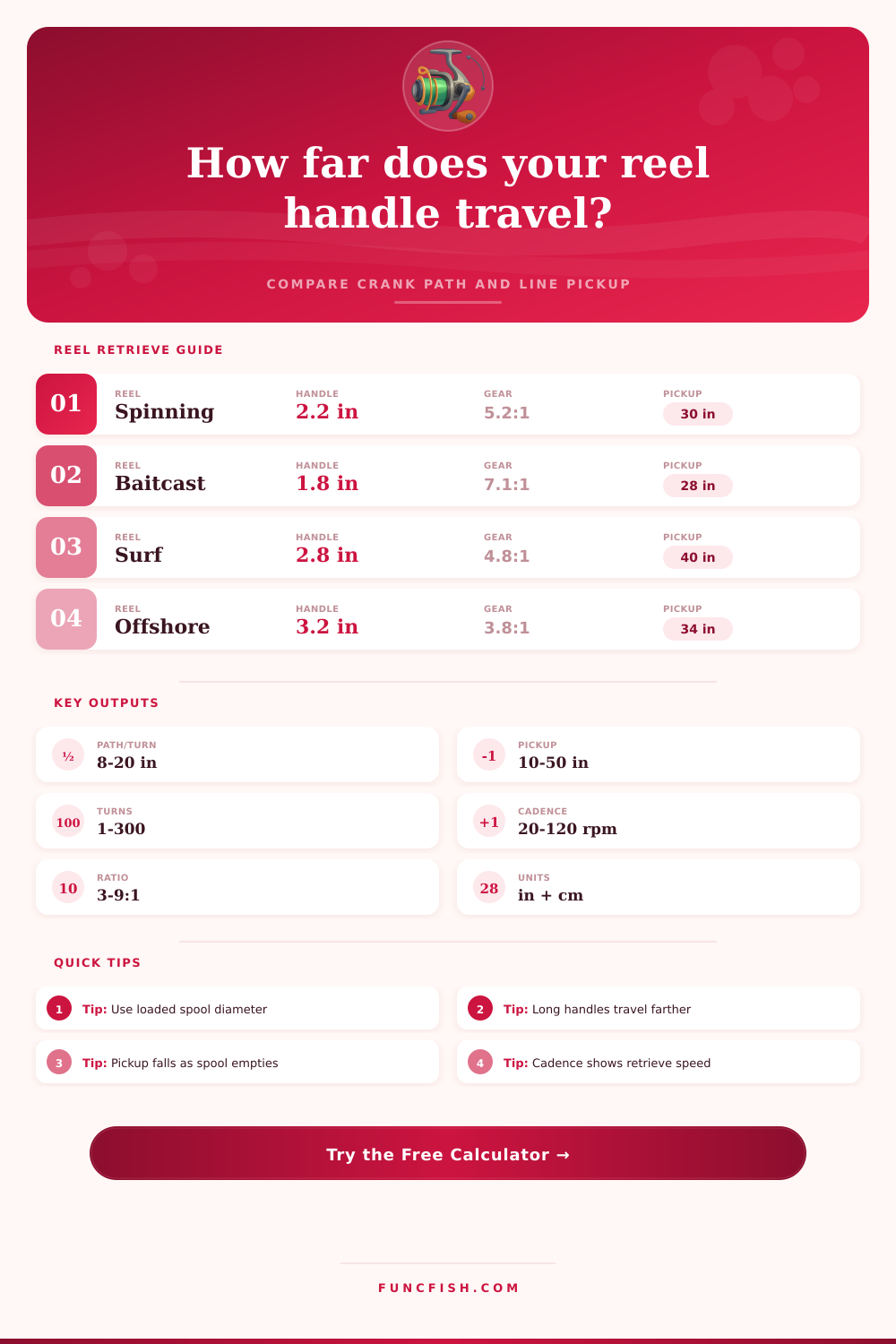
🔧Handle and reel reference cards
Finesse spinning
Bass baitcaster
Surf spinning
Offshore power
Card pickup values are typical inches per turn at a filled spool. Actual pickup changes as spool diameter changes during a cast, drop, or run.
📊Reference tables
| Reel class | Common handle radius | Typical gear ratio | Loaded spool diameter | Typical pickup |
|---|---|---|---|---|
| 1000-2500 spinning | 1.65-2.15 in / 4.2-5.5 cm | 5.0:1 to 6.2:1 | 1.2-1.8 in / 3.0-4.6 cm | 20-33 in / 51-84 cm |
| Low-profile baitcaster | 1.45-1.95 in / 3.7-5.0 cm | 6.3:1 to 8.5:1 | 0.95-1.35 in / 2.4-3.4 cm | 23-36 in / 58-91 cm |
| Surf spinning | 2.35-3.10 in / 6.0-7.9 cm | 4.3:1 to 5.7:1 | 2.1-3.0 in / 5.3-7.6 cm | 35-50 in / 89-127 cm |
| Round casting | 1.85-2.45 in / 4.7-6.2 cm | 4.7:1 to 6.4:1 | 1.25-1.85 in / 3.2-4.7 cm | 20-34 in / 51-86 cm |
| Conventional offshore | 2.60-3.80 in / 6.6-9.7 cm | 2.0:1 to 5.1:1 | 2.2-4.2 in / 5.6-10.7 cm | 25-48 in / 64-122 cm |
| Technique | Cadence range | Useful pickup | Handle feel | Calculation note |
|---|---|---|---|---|
| Finesse slack pickup | 35-60 turns/min | 18-30 in/turn | Light and controlled | Efficiency drops when line is slack |
| Burning spinnerbait | 70-110 turns/min | 26-38 in/turn | Short fast handle | High cadence raises hand travel fast |
| Vertical jigging | 25-55 turns/min | 22-34 in/turn | Smooth pickup | Line load and spool fill matter |
| Surf line recovery | 45-80 turns/min | 35-50 in/turn | Long crank arc | Pickup falls late in the cast |
| Offshore winching | 18-45 turns/min | 24-42 in/turn | Long power handle | Load can reduce practical pickup |
| Line type | Pack effect | Slip/load effect | Spool fill behavior | Best use in calculator |
|---|---|---|---|---|
| Nylon monofilament | Baseline | Moderate stretch | Diameter builds quickly | General retrieve estimate |
| Fluorocarbon | Slightly lower | Stiffer under load | Memory can reduce smooth pickup | Jigs, leaders, clear water |
| 4-carrier braid | Slightly higher | Low stretch | Can dig under high load | Heavy cover and round reels |
| 8-carrier braid | Higher and smooth | Low stretch | Packs tightly on spinning reels | Finesse, surf, long cast |
| Wire or lead core | Lower and stiff | High load penalty | Needs level lay | Trolling and offshore recovery |
💡Calculation notes
A longer power handle does not automatically retrieve more line per turn. It increases the distance your hand travels and usually improves leverage under load.
Line pickup per turn is based on the loaded spool circumference, gear ratio, line pack, fill level, and practical efficiency under fishing load.
After a long cast or deep drop, the effective spool diameter is smaller, so real inches per turn may be below the full-spool catalog value.
Turns per minute lets the calculator estimate hand travel speed, line recovery speed, and time needed to regain a cast or drop.
When you use a fishing reel, two different distance occur at the same time as a result of the two different motion that are required for the functioning of the fishing reel. One distance is the length of the circular path that your hand travels around the handle shaft of the reel, and the other distance is the length of the fishing lines that the spool of the fishing reel brings onto the reel. While many anglers may focus upon the distance that their hands travel in relation to the fishing reel, it is necessary to understand both distances in order to determine if a fishing reel is considered to be fast or powerfully.
Understanding these distances allows anglers to determine if they will become tired when using the reel for long periods, as well as to determine if the fishing line will be retrieved at a fast enough rate to prevent the fish from reaching cover. The radius of the handle of the fishing reel will determine the distance of the circular path that the anglors hand travel. While a longer handle will not increase the amount of fishing line that the spool of the reel retrieves with each turn of the handle, the longer handle will increase the distance of the travel of the hand.
How Handle Travel and Spool Size Change Line Retrieval Speed
The increased distance with which the handle can travel provides the angler with more leverage when reeling in a particularly heavy fish. Handles that is shorter than those with a longer travel distance for the hand will feel as if they are moving at a faster rate, but will provide less torque to the fishing line than longer handles. A calculator can be used to enter the handle radius of the fishing reel being evaluated, as well as the gear ratio of the fishing reel, to determine whether the increased travel of the handle is worth the additional leverage that the longer handle will provide.
The diameter of the spool will affect the distance of the fishing line that the fishing reel retrieves with each turn of the handle. The length of fishing line that is currently on the spool will have a major effect upon the distance of the line that the fishing reel retrieves. Should the fishing reel have a full spool of line, the circumference of that spool will be the greatest.
Because the circumference of a circle is equal to pi times the diameter of the circle times two, a greater circumference will result in a greater distance of fishing line being retrieved by the spool of the fishing reel. However, as the fishing line is removed from the spool, the circumference of the spool will decrease. A decreased circumference will result in a decreased distance of fishing line that is retrieved by the fishing reel.
For instance, a fishing reel may be rated to retrieve thirty inches of fishing line with each turn of the handle when the spool is full of line. As the line is removed from the spool, however, the fishing reel will retrieve less than thirty inches of line with each turn of the handle. The percentage of the line that is filled into the spool can be adjusted in the calculator to reflect how the line retrieval distance will change if the fishing line is not filled to the top of the spool.
The type of fishing line that the angler is utilizing with the reel will impact the performance of that fishing reel. Braided fishing lines pack more tightly around the spool of the fishing reel than do monofilament fishing lines. Additionally, the amount of drag that is set on the fishing reel will change the way that the fishing line is compressed around the spool.
The fishing line may become compressed with heavy drag settings on the fishing reel. The different fishing techniques that are to be utilized will also change how the fishing reel will perform with relation to the amount of line that is retrieved with each turn of the handle. For instance, techniques like vertical jigging or finesse fishing will involve the use of a light load on the fishing line.
In contrast, techniques like winching in heavy cover or trolling offshore will involve the fishing line with a heavy load. These different techniques can be entered into the calculator to ensure that the calculations reflect the way in which the fishing reel will perform in the specified fishing situations. Cadence refers to the number of turns of the handle that are made in a minute.
Cadence can be used to turn the distances of the handle to a speed of the fishing line that is being reeled in. For instance, a high cadence of turns of the handle will result in the fishing line being retrieved at a faster rate then if the angler utilized a slow cadence. The cadence can be entered into the calculator to determine the rate at which the fishing reel will retrieve the fishing line, as well as the speed at which the anglers handle must travel in order to achieve that rate of line retrieval.
Knowing the rate at which the fishing line will be retrieved will allow the angler to determine whether the fishing reel will be able to keep up with the fastest of lure speeds, or whether it will work well when trolling for fish over a long period of time. The reference cards and tables that are provided on the calculator provide typical measurements of the different classes of fishing reels and the different fishing techniques. While these tables will not replace the measurements of the fishing lines or distances that an angler can personally measure, they do provide examples of the types of benefits that each handle style provides to anglors.
For instance, the tables indicate that a round power knob on a surf fishing reel will move a greater distance than a short paddle handle on a finesse spinning fishing reel. Additionally, the tables also indicate that surf fishing reels will typically have lower gear ratios than those of other types of fishing reels; lower gear ratios allow for a larger diameter of spool to be utilized with the fishing line. These tables provide a general overview of the benefits of each handle type and gear ratio.
The best value will be found in comparing two different setups of fishing reels that can be used in the same fishing situation. For instance, the calculator can be used to determine whether a fishing reel with a longer handle and lower gear ratio will require the angler to travel their hands a shorter distance than a fishing reel with a shorter handle and higher gear ratio. Additionally, the fishing line can be retrieved at a faster rate with a fishing reel with a shorter handle with a high cadence than with a fishing reel with a longer handle and low cadence; these factors can be evaluated with the calculator to allow the angler to decide which fishing reel will allow them to retrieve the fishing line faster and without tiring there arms.
It is difficult for an angler to compare each of these factors with feel alone; the diameter of the spool of the fishing line will change as the fish are reeled in, as will the load on the fishing line. The fact that each handle has a certain distance that its travel path will reach, and that the fishing line will be retrieved at a certain rate will allow anglors to understand why some fishing reels may appear to be more lively than others. While the geometry of the fishing reel is fixed, the conditions of the fishing environment will change with the movement of the fish in the water.
Anglers who can understand the travel of the handle and the line that is retrieved can make an informed decision about which type of fishing reel may be best suited to their fishing environment. They should of used the calculator to be sure.