Fishing Line Refraction Depth Calculator
Turn a sighted or camera-estimated water depth into true lure depth, then adjust the line setting for viewing angle, water type, line angle, sag, and bottom clearance.
📌Scenario presets
⚙Depth and line settings
Corrected depth and line setting
Full calculation breakdown
📋Line and water reference cards
Mono Float
Fluoro Jig
Braid Leader
Fly Dropper
📏Refraction correction tables
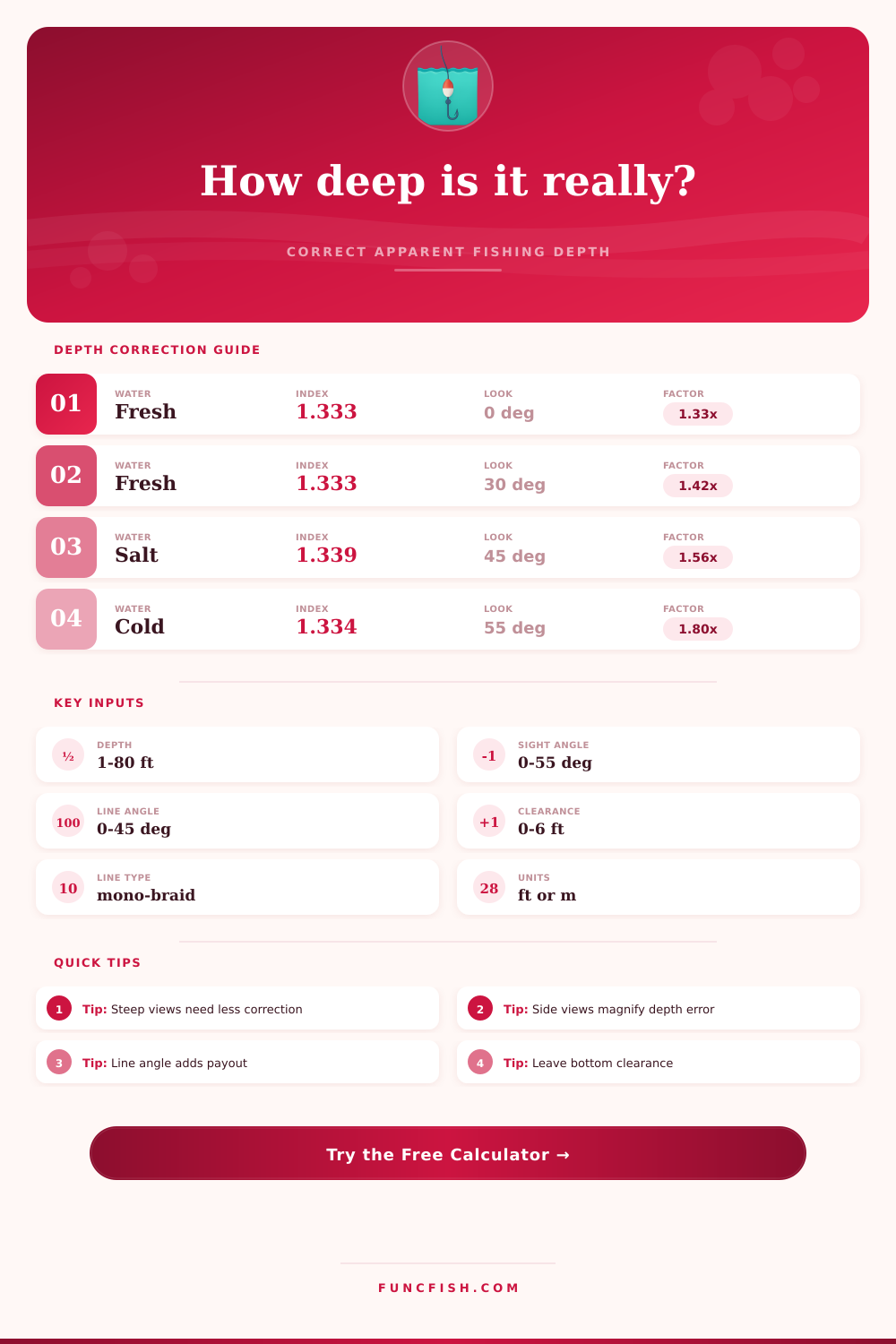
| Water type | Refractive index | Vertical apparent factor | Fishing note |
|---|---|---|---|
| Warm freshwater | 1.331 | 1.33x | Common ponds and shallow summer lakes |
| Freshwater 68 F | 1.333 | 1.33x | General clear lake and stream baseline |
| Cold freshwater | 1.334 | 1.33x | Trout water, ice edge, and spring-fed pools |
| Brackish water | 1.336 | 1.34x | Back bays, tidal rivers, and marsh drains |
| Saltwater | 1.339 | 1.34x | Flats, surf troughs, and clear inshore water |
| Ice or camera window | 1.315 | 1.31x | Reduced correction through a window or ice hole |
| Air sight angle | Freshwater factor | Saltwater factor | How to use it |
|---|---|---|---|
| 0 degrees | 1.33x | 1.34x | Looking almost straight down |
| 15 degrees | 1.35x | 1.36x | Common boat or dock view |
| 30 degrees | 1.42x | 1.43x | Sight casting across a pool |
| 45 degrees | 1.56x | 1.57x | Bank, flat, or shallow-water side view |
| 55 degrees | 1.78x | 1.79x | Very low viewing angle; use with caution |
| Line angle under water | Line multiplier | Typical use | Adjustment cue |
|---|---|---|---|
| 0 degrees | 1.00x | Vertical drop shot or ice jig | Depth mark equals target depth |
| 10 degrees | 1.02x | Slow drift or light float swing | Add a small amount of line |
| 20 degrees | 1.06x | Moderate cast or current belly | Line mark starts to matter |
| 30 degrees | 1.15x | Bank float or cross-current drift | Use a deeper stop setting |
| 45 degrees | 1.41x | Long cast, surf pull, or fast drift | Re-check with bottom contact |
💡Practical checks
Tip: Refraction makes bottom and fish look shallower than they are. The side-view correction grows faster than the straight-down correction.
Tip: A float stop, dropper, or leader mark should use true depth minus clearance, then add line angle and current sag.
When light passes from air to a more dense medium, such as water, it bend and compresses the area visualy between your eyes and the bottom of river. You are viewing what appears to be a three-foot depth when your lure scrapes rock within seconds. It is not bad luck; it is physics. It’s an optical illusion and knowing why helps prevent damage to equipment and keep you on fish.
While there’s a calculator out there that can do the math for you, knowing how it happens will save both your tackle and your time. Most anglers relies on memory or rough estimates when setting their line stops. Most do it based off experience and a rough estimate. They think four feet of water means four feet of line, that’s not accounting for how light bends in the water.
Why Water Looks Shallower Than It Is
In freshwater, the refractive index equals approximately 1.33; things appear approximately one-quarter shallower then they really are. If you’re looking directly down, the fix is easy… Simply multiply by a factor. But most people don’t fish vertically. Instead, most casts originates from some type of cover (bank, pier, boat) and your vision is angled toward the surface.
As this sight angle widens, the refraction exaggerates. What appears to be right at the bottom may actualy be above the bottom, which necessitate longer line to enter his strike zone. To account for that, the tool allow you to enter how steeply down you can see. In other words, imagine you are wading into a trout stream and peering out over the current at an angle. Maybe it’s 30-degrees off vertical. That would reduce your perceived depth even more, and the calculator accounts for that too. It explains that what you saw was really about three feet, but is actualy something like four and a half actual feet.
And that makes all the difference when trying to deliver a jig or fly exactly to a tight window where the fish is positioned. Too shallow and it catches on the wood; too high and it won’t get the bite.
The dynamics of the line add another dimension: A float floating in a strong current will behave very different than a perfectly vertical drop shot. In current, the line doesn’t hang as plumb as a plumb bob, instead, it form a belly that increases true length between your rod tip and your lure. To calculate this payout, you can enter the current strength and the angle of the line into the calculator. Monofilament has more sag than braid, which runs tight to itself. Heavy leaders and wire forms drag profiles of their own. Choosing the right rig type in the tool help close the gap between what is theoretically possible and what you are able to present.
Other moddern subtle factors include water temperature and salinity, as cold water is a bit denser than warmer water, thereby slightly changing refraction. Minerals in salt water give it a higher refractive index compared to fresh water. So all of this changes the correction coefficients by small amounts, but when you’re looking at precise fishing those details matter. Every inch matters if you are fishing for bonefish on shallow flats. The tool comes with some reference tables that break out the variations so you can adjust what you expect based on whether you are fishing a warm saltwater marsh or a cold, spring-fed creek.
The last factor that distinguishes a clean presentation from a rat’s nest is clearance. Unless you’re targeting a species like carp or catfish with the idea of bottom fishing, you don’t want your bait lying flat on the bottom. For most actively feeding fish, they’ll hit it when it’s hanging just off the bottom, so the calculator will give you a little wiggle room to deduct a safety margin that keeps your float or marker stopping at the right height and still has your bait in the strike zone but not rubbing against cover. The net effect of this change is avoiding being fooled into thinking you got a bite because your lure touched some vegetation or rock.
You should of known this. If you can master those variables, it turns fishing from a guessing game into geometry. It teaches you to see the water less as a surface and more as a volume of space with measurable features. After you internalize this refraction distortion on your vision, you no longer trust what your eyes are telling you; instead, you begin to trust what your calculations is saying. And when you look down at that seemingly shallow pool the next time, you’ll know exactly how far back to let out your line until the hook is touching down.