Wind Adjusted Casting Distance Calculator
Estimate practical lure carry, wind loss or gain, crosswind drift, and upwind aim correction from your calm-water casting distance, wind direction, lure shape, line, rod, and release angle.
📌Scenario presets
⚙Casting and wind inputs
Wind-adjusted casting results
Calculation breakdown
🎣Wind and casting profile grid
Thin Braid
Mono Main Line
Metal Spoon
Spinnerbait
Surf Rod
Fly Line
Topwater Plug
Jig Head
📊Gear and species comparison grid
Bass
70-140 ftMedium rod, 10-17 lb line, compact jigs or moving baits. Crosswind drift often matters more than raw carry.
Trout
35-90 ftLight line and small spoons lose carry quickly in gusts. Lower casts help keep the lure under surface wind.
Surf Species
180-420 ftHeavy rods and dense metals handle wind best. Quartering wind can still move the rig several yards sideways.
Inshore Redfish
60-150 ftKayak height shortens flight time but crosswind line bow can pull soft plastics off the target lane.
Catfish
80-220 ftBait rigs carry well when sinker weight is high, but heavy mono and bait profile increase headwind loss.
Walleye
55-130 ftJig and braid setups cut crosswind well. Aim upwind when drifting jigs along riprap or current seams.
Pike
80-170 ftSpoons fly better than big bucktails. Steel leaders and bulky lures add tumble and reduce calm baseline.
Fly Streamer
35-85 ftWind correction is mostly accuracy based because the fly line has high drag and long visible air time.
🌬Wind direction reference
| Wind direction | Range effect | Drift effect | Release angle adjustment | Field correction |
|---|---|---|---|---|
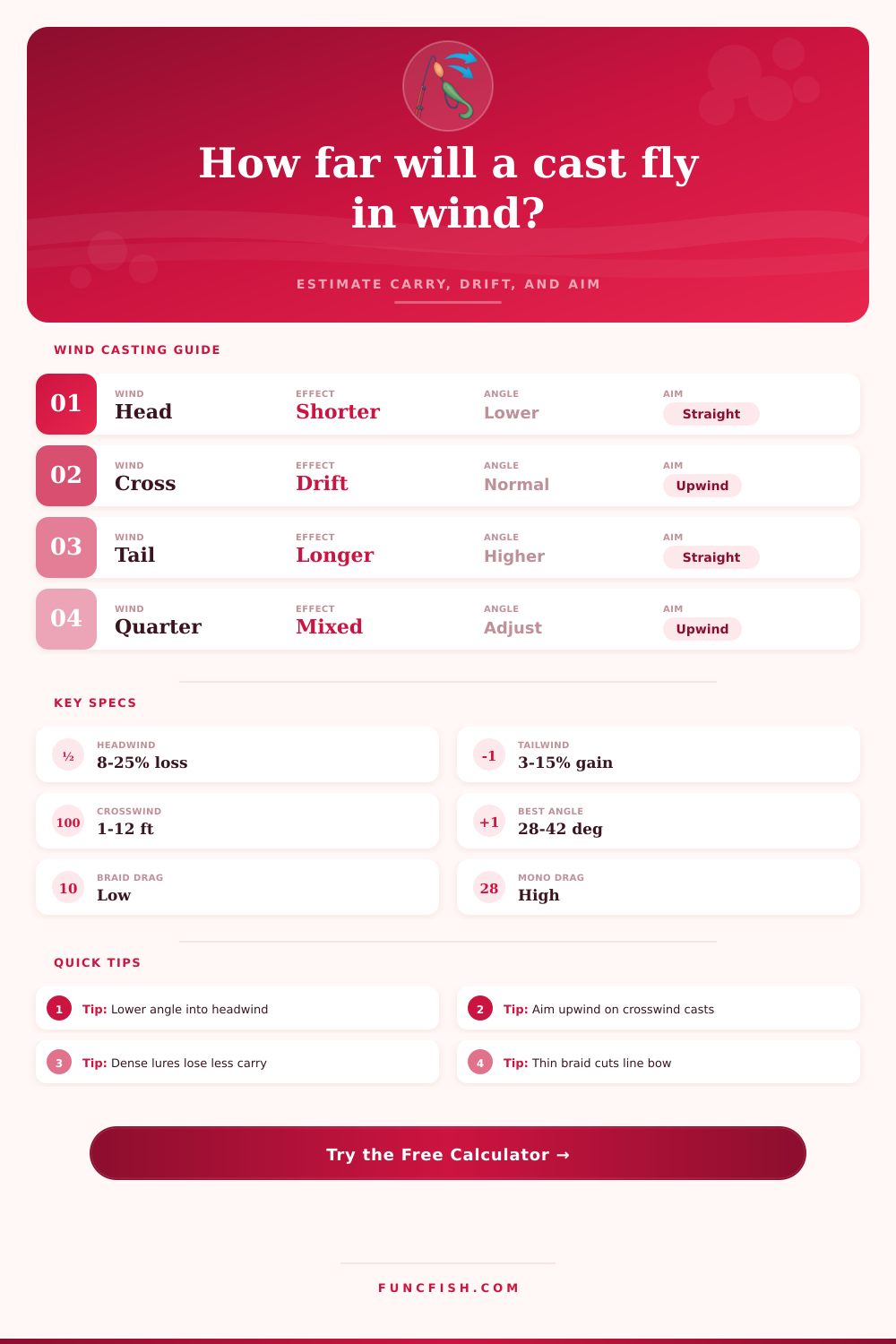
| Direct headwind | Large distance loss | Low sideways drift | Drop 4 to 8 degrees | Use denser lure or shorter target |
| Quartering headwind | Moderate to large loss | Moderate sideways drift | Drop 3 to 6 degrees | Aim upwind and reduce high loops |
| Pure crosswind | Small range loss | Largest sideways drift | Keep normal angle | Start the cast on the upwind edge |
| Quartering tailwind | Small to moderate gain | Moderate sideways drift | Raise 1 to 3 degrees | Guard against overshooting cover |
| Direct tailwind | Largest distance gain | Low sideways drift | Raise 2 to 5 degrees | Feather the spool before splashdown |
📏Lure profile wind table
| Lure or rig profile | Ballistic factor | Crosswind coupling | Usual release angle | Wind note |
|---|---|---|---|---|
| Compact metal spoon | 1.24 | Low | 32 to 38 degrees | Best dense profile for hard wind |
| Jig head or swimbait | 1.10 | Low-medium | 30 to 36 degrees | Good crosswind control on braid |
| Spinnerbait or chatterbait | 0.78 | High | 26 to 34 degrees | Blade lift causes short headwind casts |
| Crankbait or jerkbait | 0.92 | Medium-high | 28 to 36 degrees | Bill and hooks increase tumble |
| Topwater plug | 0.86 | High | 26 to 34 degrees | Buoyant body rides high in gusts |
| Bait rig with sinker | 1.06 | Medium | 32 to 42 degrees | Sinker carries; bait adds drag |
| Surf plug or pencil | 1.16 | Medium | 34 to 42 degrees | Good tailwind carry, watch tumble |
| Weighted fly streamer | 0.64 | Very high | 24 to 32 degrees | Fly line dominates wind correction |
💪Rod and line matching table
| Setup | Typical lure range | Line range | Wind advantage | Distance caution |
|---|---|---|---|---|
| Ultralight fast | 1/64 to 1/8 oz | 2 to 6 lb | Fine accuracy in light wind | Small lures lose speed quickly |
| Light fast | 1/16 to 1/4 oz | 4 to 10 lb | Good trout and panfish control | Crosswind float rigs bow badly |
| Medium fast | 1/4 to 3/4 oz | 8 to 17 lb | Balanced bass distance | Bulky lures need lower release |
| Medium-heavy fast | 3/8 to 1 oz | 12 to 25 lb | Drives jigs through wind | Heavy line reduces fine lure carry |
| Surf heavy | 2 to 6 oz | 20 to 50 lb | Best long-cast leverage | Too much angle balloons line |
| Saltwater heavy | 1 to 4 oz | 30 to 80 lb | Strong plug launch speed | Big plugs can tumble in gusts |
| 6 wt fly rod | Streamer to WF6 | Fly line | Good under 10 mph | High line drag limits carry |
| 8 wt fly rod | Streamer to WF8 | Fly line | Handles heavier wind flies | Accuracy drops before distance |
🐟Species casting reference
| Target species | Typical practical cast | Common wind-sensitive lure | Preferred correction | Useful line choice |
|---|---|---|---|---|
| Largemouth bass | 70 to 140 ft / 21 to 43 m | Spinnerbait | Lower angle into wind | 10 to 30 lb braid or 12 to 17 lb mono |
| Stream trout | 35 to 90 ft / 11 to 27 m | Small spoon | Shorter target windows | 4 to 8 lb mono or braid leader system |
| Striped bass surf | 180 to 420 ft / 55 to 128 m | Surf plug | Dense lures and controlled arc | 30 to 50 lb braid with shock leader |
| Redfish | 60 to 150 ft / 18 to 46 m | Paddle tail jig | Aim upwind of potholes | 10 to 20 lb braid with fluoro leader |
| Channel catfish | 80 to 220 ft / 24 to 67 m | Bait and sinker | Use weight to beat headwind | 15 to 30 lb mono or braid |
| Walleye | 55 to 130 ft / 17 to 40 m | Jig head | Compensate crosswind drift | 8 to 15 lb braid with leader |
| Northern pike | 80 to 170 ft / 24 to 52 m | Spoon or jerkbait | Choose compact spoon in gusts | 20 to 40 lb braid plus bite leader |
| Streamer trout | 35 to 85 ft / 11 to 26 m | Weighted streamer | Open loop less, drive low | WF6 to WF8 line, short leader |
💡Calculation notes
Distance model: The calculator starts with your measured calm-water carry, adjusts it for rod loading, lure weight fit, line drag, release angle, and skill, then applies headwind, tailwind, crosswind, and turbulence factors.
Drift model: Crosswind drift uses estimated lure flight time and an aerodynamic coupling factor from lure profile and line type, so high-drag lures and fly lines need larger upwind aim corrections.
The rod loads perfectly. It was the cast of a lifetime. It is a clean release. You know the lure will be heading exactly where you intended for a split second. And then you realize you’re not there anymore. That gust grabs the belly of your lure, slows its forward motion and pull it out wide left toward those reeds instead of that clear water channel.
Every angler have experienced this while standing on an open shore or a windy bank. Understanding how wind and physics work together often make the difference between success and frustration. Intuition usually won’t get the math right when air resistance is fighting you.
Casting in the Wind: Tips and Tools
In a headwind, most of us have an intuitive response: We crank up our casting strength. “I gotta overpower this wind,” seems like good sense. But more often, we’ll end up throwing with lower speed and higher arc different than how well our lure cuts through the air; thus backing ourselves into corners.
The calculator can help measure this trade-off: How do wind direction, speed and line type all interact to alter your true cast placement? Start by entering your calm-water baseline (this sets your individual power ceiling), and tweak your settings based off current conditions. Because braid is thinner and mono is thicker, the tool models air drag for different line types. It also accounts for your lure profile (a big topwater plug won’t fly like a small metal spoon).
Why does that matter? Your aerodynamics are dictated by what you’re using, so if you’re throwing a dense jig head, you might be able to keep your accuracy and speed at increased winds. Besides wind speed, which we all know is a factor, wind direction can make a big difference. If you’re getting direct tailwinds, you’ll be able to push the boat out 15 percent or more further. That sounds good until you consider that it’s also going to have you overshooting the target zone by that same margin. That’s accounted for in the calculator so you can dial back your power instead of overshooting.
But wind blowing against you absolutely ruins high trajectory casts. Lowering your release angle by a few degrees keep the lure in a flatter, faster path that retains momentum longer. And while you may not give it much thought at the time of launch, a mere five-degree adjustment to the curve could of being the difference between catching one and missing the window completely. The tool calculates the adjusted carry distance so you can tell if your maximum effort will actualy hit the target area where the fish is positioned.
A third type of wind is crosswind. Crosswinds introduces a lateral challenge that pure head or tail winds do not present. They will actually push the lure to the side as it’s flying along, requiring an adjustment toward your target well before ever finishing your backswing. It’s all about the aerodynamics and how long the lure stays airborne. With fly lines, their large surface areas catches wind for seconds at a time. A heavy jigging setup descends fast with very little line bow, meaning it is pushed much further off course by crosswinds. Knowing this drift mechanism allows you to determine if you should aim upcurrent or simply tweak your rod tip angle. The page’s reference grids help break down these profiles and explain what makes some lures naturaly wind-resistant and others requires careful handling.
Of course, there’s also the skill element. Some of the variance that throws a beginner for a loop gets lessened by a practiced angler who times things well. Still, when an expert falls back on pure muscle memory, it doesn’t help him read air as well. That said, the calculator won’t substitute for feel. What it will do is ground your gut instincts in the real world of physics. It’ll tell you how far something will travel, how off-target you’ll likely be, and which angle tweaks make sense based on your own rig set-up.
Yes, you’re still casting. But now you know where the target is headed. Wind casting has nothing to do with throwing harder. Wind casting has everything to do with throwing smarter. Aim at the breeze, lower your arc, adjust your gear and you’ve just turned a hostile element into a manageable variable. You missed that channel from up above. You’ll hit it next time. This time, you are calculating the air long before lifting that rod.