Levelwind Travel Per Turn Calculator
Estimate line guide travel per handle turn, full-spool traverse turns, lay pitch per spool revolution, and guide cross angle from worm gear lead, reel ratio, drive train ratio, and endpoint dwell.
📌Levelwind worm gear presets
⚙Reel and worm gear settings
Use measured spool width between flanges and working diameter near the fill level you actually fish. If you already know direct guide travel per worm revolution, enter it as pitch and set starts to 1.
Levelwind travel results
Calculation breakdown
📊Worm gear reference data
Fine baitcast worm
Standard round reel
Coarse trolling worm
Slow wireline worm
📐Levelwind travel targets by reel type
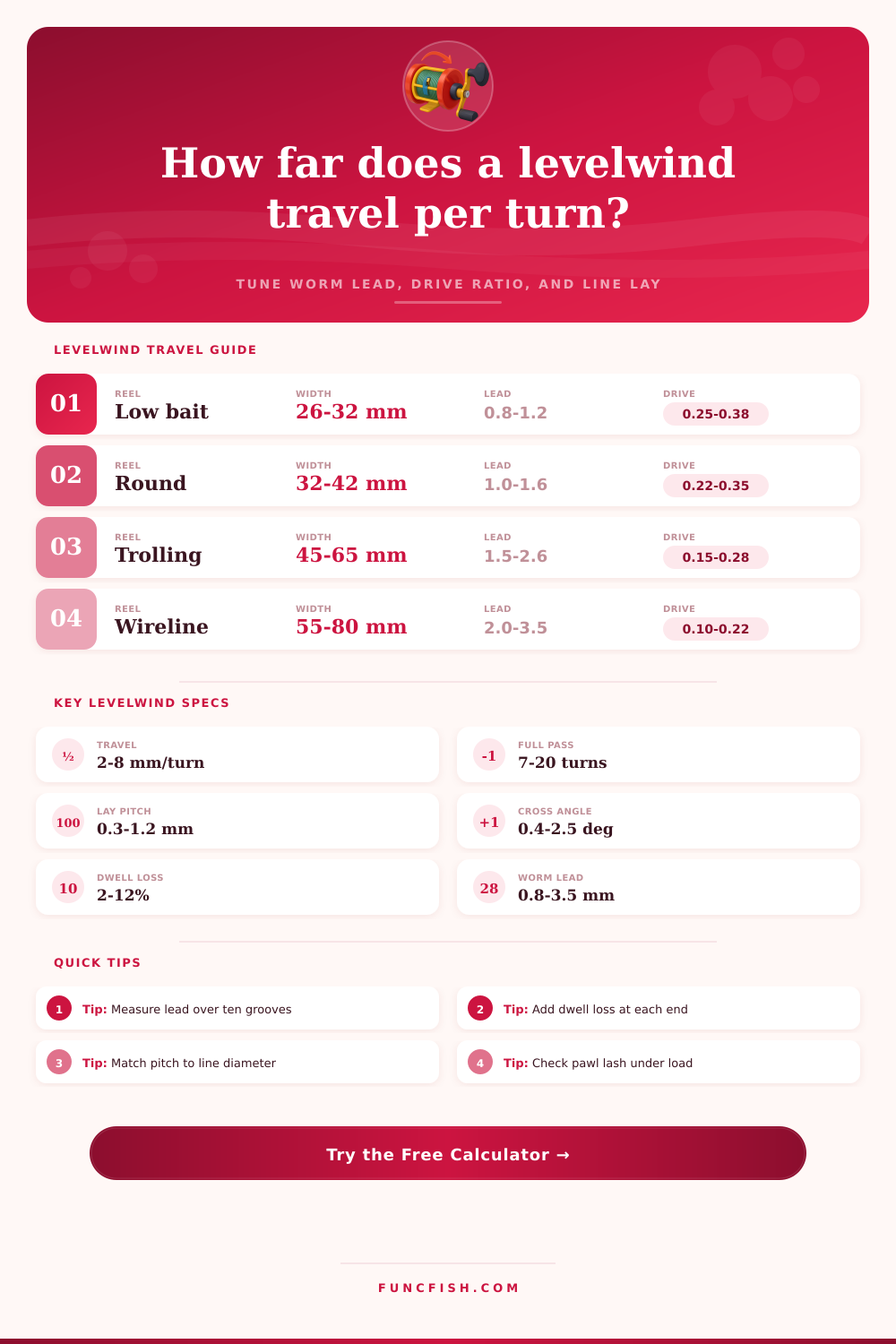
| Reel type | Usable spool width | Typical worm lead | Worm drive ratio | Travel per handle turn | Traverse target |
|---|---|---|---|---|---|
| Low-profile baitcaster | 26-32 mm / 1.02-1.26 in | 0.8-1.2 mm / 0.031-0.047 in | 0.25-0.38 worm rev per spool rev | 1.3-2.9 mm / 0.05-0.11 in | 10-18 handle turns |
| Round freshwater reel | 32-42 mm / 1.26-1.65 in | 1.0-1.6 mm / 0.039-0.063 in | 0.22-0.35 worm rev per spool rev | 1.6-3.8 mm / 0.06-0.15 in | 9-20 handle turns |
| Line-counter trolling | 40-58 mm / 1.57-2.28 in | 1.5-2.4 mm / 0.059-0.094 in | 0.15-0.28 worm rev per spool rev | 1.5-4.0 mm / 0.06-0.16 in | 12-26 handle turns |
| Saltwater conventional levelwind | 45-70 mm / 1.77-2.76 in | 1.8-3.0 mm / 0.071-0.118 in | 0.14-0.25 worm rev per spool rev | 1.8-4.7 mm / 0.07-0.19 in | 13-32 handle turns |
| Wireline or copper trolling | 55-80 mm / 2.17-3.15 in | 2.0-3.5 mm / 0.079-0.138 in | 0.10-0.22 worm rev per spool rev | 1.2-3.6 mm / 0.05-0.14 in | 18-45 handle turns |
🧵Line diameter and lay pitch match
| Line class | Common diameter | Suggested lay pitch | Pitch to diameter ratio | Pack behavior | Calculator note |
|---|---|---|---|---|---|
| 10-20 lb braid | 0.15-0.23 mm / 0.006-0.009 in | 0.25-0.55 mm / 0.010-0.022 in | 1.7x-2.7x | Firm, low stretch, can dig | Favor balanced or tight braid bias |
| 30-50 lb braid | 0.28-0.36 mm / 0.011-0.014 in | 0.45-0.85 mm / 0.018-0.033 in | 1.6x-2.4x | Stable casting pack | Watch edge buildup on narrow spools |
| 12-25 lb mono | 0.30-0.48 mm / 0.012-0.019 in | 0.60-1.10 mm / 0.024-0.043 in | 2.0x-2.6x | Softer coils and memory | Use loose mono bias for smooth fill |
| 30-60 lb mono | 0.55-0.80 mm / 0.022-0.031 in | 0.90-1.60 mm / 0.035-0.063 in | 1.8x-2.4x | Large coils need space | Coarser lead helps avoid ridges |
| Wire or copper | 0.35-0.70 mm / 0.014-0.028 in | 0.35-0.90 mm / 0.014-0.035 in | 1.0x-1.5x | Hard line, low nesting | Keep cross angle low and steady |
🎣Gear and species comparison grid
| Target use | Common reel class | Line diameter focus | Good travel per turn | Cross angle goal | Levelwind priority |
|---|---|---|---|---|---|
| Bass pitching and casting | Low-profile 6.3:1 to 8.1:1 | 0.15-0.33 mm braid or fluoro | 2-4 mm / 0.08-0.16 in | 0.5-1.5 degrees | Even edge fill with quick retrieve |
| Muskie bucktails | Wide round reel 5.1:1 to 6.4:1 | 0.36-0.48 mm braid | 2.5-5 mm / 0.10-0.20 in | 0.7-1.8 degrees | Hard pull stability and pawl life |
| Walleye trolling | Line-counter 4.2:1 to 5.1:1 | 0.33-0.45 mm mono | 1.8-4 mm / 0.07-0.16 in | 0.4-1.3 degrees | Repeatable counter feel and flat pack |
| Salmon downrigger | Medium trolling 4.0:1 to 5.3:1 | 0.45-0.60 mm mono | 2.2-4.8 mm / 0.09-0.19 in | 0.5-1.5 degrees | Loose enough for heavy mono memory |
| Catfish bait soaking | Round levelwind 4.7:1 to 6.0:1 | 0.50-0.80 mm mono | 2.5-5.5 mm / 0.10-0.22 in | 0.6-1.7 degrees | Heavy line clearance at guide and edges |
| Wireline lake trolling | Wide trolling reel 3.8:1 to 4.8:1 | 0.40-0.70 mm wire or copper | 1.4-3.5 mm / 0.06-0.14 in | 0.25-0.9 degrees | Slow flat lay with minimal kink angle |
⚖Drive ratio and dwell reference
| Measurement point | How to measure | Normal range | Effect on result | When to adjust |
|---|---|---|---|---|
| Worm drive ratio | Mark spool and worm, rotate spool ten times | 0.10-0.38 worm rev per spool rev | Directly scales lay pitch and travel per crank | After gear swaps or idler changes |
| Worm lead | Measure axial guide movement per worm revolution | 0.8-3.5 mm / 0.031-0.138 in | Directly scales all travel values | When changing worm shaft or pawl carrier |
| Endpoint dwell loss | Compare average middle travel to full-cycle travel | 2-12 percent | Reduces usable average travel | When guide pauses at flanges |
| Working diameter | Measure line pack diameter at fishing fill level | 25-75 mm / 1.0-3.0 in | Sets cross angle only | When comparing empty and full spool behavior |
💡Levelwind calculation tips
Measure the guide, not just the threads. Reversing levelwind worms can look like a standard screw, but the pawl follows a crossed groove. For the cleanest input, turn the worm one full revolution in the middle of the stroke and measure actual line guide movement.
Use spool diameter at the fill level you fish. Cross angle is small on a full spool and steeper near the arbor, so the same worm and gear train can feel smooth near capacity but stack unevenly when backing is low.
The second consideration is how the line lay on the spool. Most guys looks at line capacity and drag systems when buying a new reel. Few ever think about mechanics of the levelwind.
Hard ridges forms on the spool and gouge into one another during use because the reel’s overall drive ratio do not match the lead in the worm gear. Enter the worm dimensions and the calculator will take care of all math for you. What it does is tell you exactly how much distance the guide move with every handle turn. You don’t have to estimate how much each turn moves the mechanism and affects line lay.
How the Level Wind Affects Line Lay
The second factor in addressing a messy spool fill is understanding what goes into it. The worm lead refers to how much the guide moves during a complete turn of the worm shaft. The drive ratio indicates how many times the worm turns for each spool turn. Multiply these two and you has the line shift (pitch) per crank. This is referred to as lay pitch.
When this lays out too widely in relation to your line size, the guides will not pack well leaving a gap. On the other hand, if they are placed too close together, the lines will nest into each other and cause friction when casting. You want them set so the line has good firm contact without digging into itself.
The page has reference table that pairs reel type with common travel range. For example, a slow-retrieving trolling reel is fine with a more coarse lead as it only travels around the spool so many times when it’s reeled in (fewer times then a faster spinning reel). A low profile bass baitcaster with a fast gear ratio want the lead to be finer to pack tightly against the spool so that thin braids lay well. Match fishery with the mechanism of the reel.
Trolling reels should of have a very smooth pack so that big wireline or mono will slide off cleanly without slippage while making hard runs. Casting reels wants a tighter pack so there is no line twist and the line come back out smoothly each time. And don’t forget about spool diameter. As it fills with line, the circumference increases and the cross angle does too. The amount of travel on the guides for each turn remains the same but the overall shape of the spool are different.
What appears to be a great lay close to the arbor may be too shallow near the flanges, or vice versa. Most manufacturers measure at a working fill level, not empty. Why? Because as layers accumulate, the line stack’s shape change a lot. Your goal should be a stable lay from top to bottom of the spool, not merely at one point along the way.
The other variable is endpoint dwell. That is the amount of time the guide pauses when reversing direction, which reduces your actual travel distance. Good levelwind designs minimize the amount of wasted time here. However, some of the old ones will burn off multiple percent of their cycle on either end of a full sweep. Enter that time lost during dwell into the tool, and it feeds those last numbers back to account for real world results instead of perfect physics.
Small difference, but it accounts for why you might have seen two identically spec’d reels differ so greatly in packing line up after only a season or two. The rest of it is just figuring out which one to use. If you’re fishing something with a lot of memory (like heavy monofilament), it coils up on itself; so you don’t want as much wrap or lay. If you’re using fluorocarbon, which is pretty stiff, you need some space between wraps so it doesn’t bind. Finally, braid needs a tighter pack because it is very slick and thin; fewer wraps mean less bulk.
So, again, this makes it easy to picture those trade-offs without even having a lure tied on yet. You can play around with it. Make the lead bigger or smaller, change the drive ratio, and watch the output move. It gives you concrete advice about keeping your line nice and neat based off ideas of mechanical theory.
Good geometry produces good casting. Good geometry means that everything from the handle speed to the pawl to the worm shaft interact correctly. That’s why the bail arm clicks exactly each time, because the underlying geometry is true to form. After realizing that travel per turn determines the health of your line pack, you stop regarding the levelwind as a black box. Instead, you begin recognizing it for what it is: a precision instrumen worthy of equal consideration with the lure or even the hook.