Two-Speed Reel Ratio Calculator
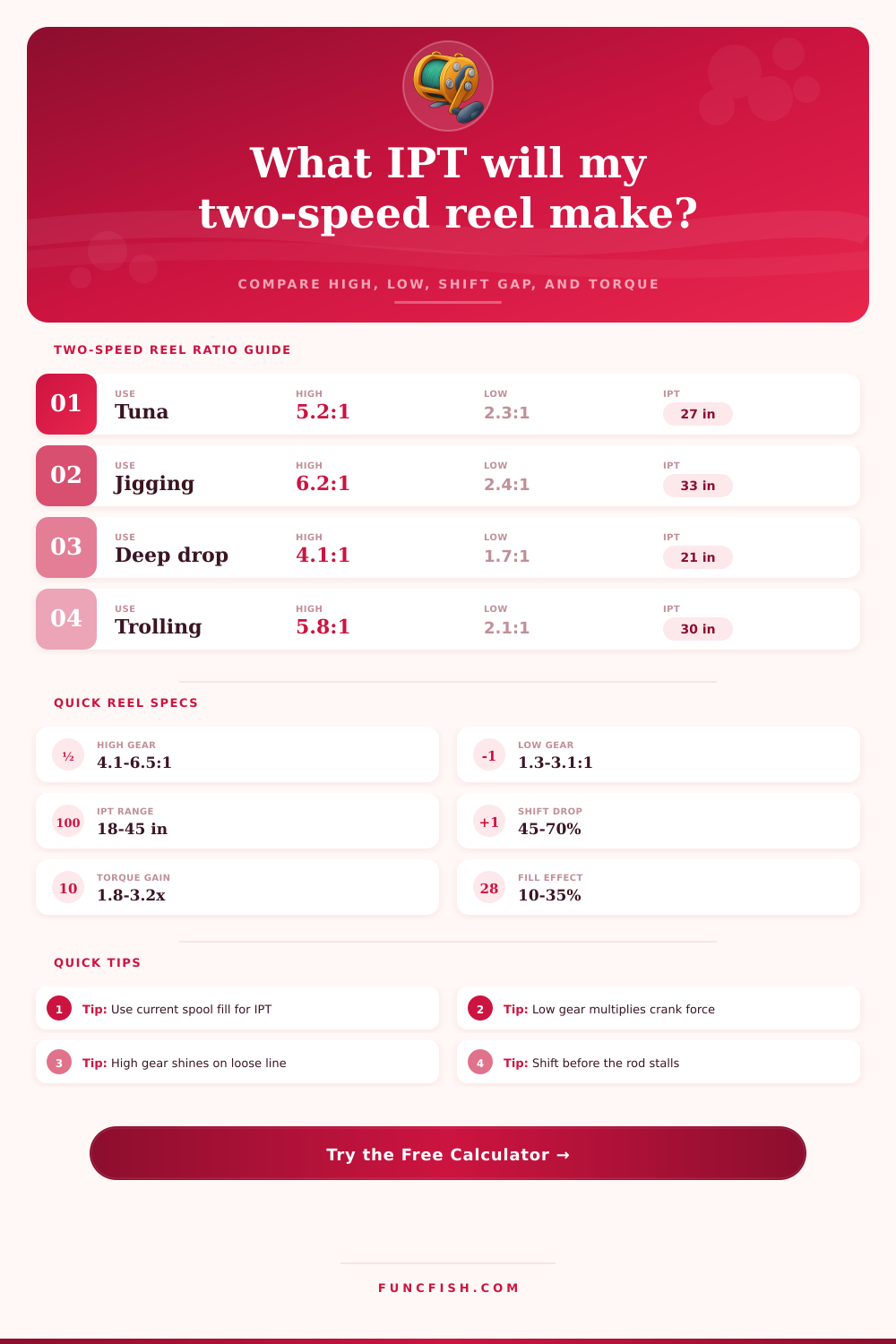
Compare high and low gear retrieve, current spool IPT, speed drop after shifting, line recovery per minute, and low-gear torque gain for offshore conventional and lever-drag reels.
📌Two-speed reel presets
⚙Reel ratio and spool settings
High gear is the fast retrieve mode used to clear slack, work lures, and gain line while the fish is not loaded hard.
Low gear trades retrieve speed for mechanical advantage when drag load and rod angle make cranking difficult.
IPT drops as line leaves the spool because each revolution wraps a smaller circumference.
Use 90-96% for normal line lay and handle stroke loss; 100% shows theoretical IPT.
Two-speed retrieve forecast
Calculation breakdown
🎣Common two-speed gear families
Light Lever Drag
Medium Offshore
Heavy Big Game
Deep Drop
📊Gear ratio, spool size, and IPT table
| Reel class | Common high gear | Common low gear | Approx full spool diameter | High gear IPT estimate |
|---|---|---|---|---|
| Narrow jigging two-speed | 5.8-6.5:1 | 2.4-3.1:1 | 1.6-1.9 in / 4.1-4.8 cm | 28-38 in / 71-97 cm |
| 25-40 class lever drag | 4.8-5.8:1 | 1.8-2.4:1 | 1.8-2.2 in / 4.6-5.6 cm | 26-38 in / 66-97 cm |
| 50-80 class offshore | 3.8-5.0:1 | 1.3-2.0:1 | 2.2-2.8 in / 5.6-7.1 cm | 28-42 in / 71-107 cm |
| Wide trolling or kite reel | 4.5-5.8:1 | 1.7-2.4:1 | 2.0-2.6 in / 5.1-6.6 cm | 30-45 in / 76-114 cm |
| Deep drop conventional | 3.5-4.6:1 | 1.5-2.0:1 | 1.9-2.5 in / 4.8-6.4 cm | 22-34 in / 56-86 cm |
🐟Gear and species comparison grid
| Target or technique | Useful high gear behavior | Useful low gear behavior | Recommended shift moment | Typical drag load |
|---|---|---|---|---|
| School tuna and dorado | Fast slack pickup after a run or direction change | Short low-gear bursts near color | When the rod stops gaining on high gear | 12-22 lb / 5.4-10 kg |
| Bluefin tuna on rail rod | Line recovery while walking fish up | Sustained crank power under high drag | Before high gear forces handle stalls | 25-45 lb / 11-20 kg |
| Vertical jigging amberjack | Fast lure reset and tight-line jig cadence | Power through the first vertical dive | As soon as the fish pins the rod down | 15-30 lb / 6.8-14 kg |
| Grouper or wreck bottom fishing | Quick line pickup before the first dive | Maximum lift when clearing structure | Immediately after hookset pressure loads | 18-35 lb / 8.2-16 kg |
| Swordfish and deep drop | Retrieve long drops when unloaded | Steady turns with heavy sinker and fish load | When weight plus fish overloads high gear | 10-25 lb / 4.5-11 kg |
| Shark, halibut, and heavy bait | Take up belly in current or surf | Slow, controlled lift against steady mass | When line angle goes steep or drag rises | 20-40 lb / 9.1-18 kg |
📏Spool fill effect on IPT
| Spool fill | Diameter assumption | IPT change vs full | Fishing impact |
|---|---|---|---|
| 100% | Full outside diameter | Baseline | Fastest retrieve; usually the catalog IPT condition |
| 85% | Upper working fill | About 5-12% slower | Typical after short runs or modest bait drops |
| 65% | Mid-spool fight level | About 15-25% slower | High gear feels less fast but low gear gains control |
| 45% | Deep into backing or spool core | About 25-40% slower | Useful to shift earlier because handle load climbs |
🔧Shift ratio interpretation table
| High to low ratio gap | Torque gain range | Speed drop range | Best use case |
|---|---|---|---|
| Mild split, 1.6-2.0x | Moderate leverage | 38-50% | Light jigging, fast recovery, smaller offshore reels |
| Standard split, 2.0-2.6x | Balanced leverage | 50-62% | Tuna live bait, trolling, all-around lever drags |
| Deep split, 2.6-3.3x | Strong crank power | 62-70% | Rail rods, grouper, deep drop, heavy current |
| Extreme split, 3.3x+ | Maximum winch feel | 70%+ | Specialized big-game reels and very high drag settings |
💡Two-speed calculation tips
Measure the real spool diameter: catalog IPT is normally taken near a full spool. If a tuna strips half the reel, both high and low gear IPT fall because the spool circumference is smaller.
Shift before the handle stalls: low gear is most helpful before the angler loses rhythm. A smooth low-gear cadence often gains more line than forced high-gear half turns.
Your drag is set to 30 pounds. The line comes off your reel at full bore, and the fish peels out. You’re thinking, “OK, time to go to low gear.” But you hold back. You don’t want to change gears, that’s like giving up, right? Wrong. It has nothing to do with quitting; it has everything to do with physics. When you have more line than you can comfortabley crank, the trade-off in power vs. Speed create a mechanical issue that your bicep alone cannot overcome. Knowing this alters your approach to fighting every big fish you catch for the rest of your life.
If you’re a math nerd like me, go ahead and punch in some numbers into the calculator at the top of the page to see exactly how many inches per turn you’ll get. But where the magic happens is knowing what all that means in terms of choosing gear and knowing how much your arms is going to ache.
Why You Should Use Low Gear
Your low gear ratio is your power mode; it multiplies your cranking force and lets you keep constant tension on the fish without blowing out your arm or wrecking your reel’s gears. Your high gear is your recovery mode. It eats up any line slack. It resets your lures and takes up any belly caused by current pulling line away from your rod tip. That transition point; where one ratio kicks over to another; is what create the difference in feel. A shallow split provides a mild bump in torque while maintaining a fairly fast retrieve. A deep split slows your pick-up dramaticly but allows you to really lever the fish when they pin the rod.
The spool is full. The reason is that when the reels retrieve quickest, at full spool diameter, the specs in catalogs is inches per turn. However, a wahoo or tuna will chew through line fast, reducing your effective spool diameter significently (think 20% or more). No matter what gear you’re on, that reduced circumference translates to each handle turn pulling up less line. If you’re battling a fish off an almost empty spool, you’ll have to crank faster then you did at the start. You must do this to keep up with the fish forward momentum. And that’s why you see seasoned fighters shifting early and often instead of waiting till their arms give out.
It’s also important to remember that while gear ratio is one thing, handle length is another very big factor in what actualy comes out of the handle in terms of torque. Longer handles provide more leverage, so by the time you engage the low gear reduction you’ll have less strain on your forearm. While short handles may seem snappier, you’ll need to exert more force for each turn, which can lead to fatigue if fighting fish for long periods of time.
Think of your arm as an engine and the reel as a transmission. Rather than making the engine struggle at idle or reach its limit under a load, you’d prefer to have a gear range that keeps it in its power band. This is what many people miss when they get too hung up on having super-high gear ratios without taking into account their own physical limitations.
For those who vertical jig, it requires quick bursts of speed and then power right after that. Use high gear when working your jigs down through the water column. As soon as an amberjack or king mackerel hits, you must immediately switch to low gear to pull up against weight of the fish and the weight of the jig. The problem with this is if your low gear ratio is not deep enough, or if your shift is clunky, you’ll lose your momentum and depth and most times you lose the fish. Looking at reference table on the page you can see how reel sizes vary based off situation and notice how jigging reels are not wide like heavy offshore lever drags. Trolling reels focus more on line pickup where drop rigs for deep fishing focus on power.
Your gear strategy will be affected by drag settings too. The higher the drag setting, the more the spool surface resist turning. So high gear will resist turning as easily. If you are fighting a shark or marlin with high drag, it can cause you to shift into a lower gear much sooner than you expect. This happens because other forces in the system, like drag plate pressure and line friction in the guides, overwhelm what you’re trying to do when turning. It is not just about the fish pulling hard but the total system resistance. Keep the fight under control instead of chaotic and preserve your rhythm by shifting before the rod stalls.
In short, a two-speed reel decision is all about personal cranking style and the type of fish that will be targeted. Do you need a lot of torque to get them out of their deep runs? But at the same time do you want to have as much speed as possible to compete? The calculator really helps illustrate this trade-off by clearly displaying how many feet (or inches) of line are gained/lost with each switch. It then converts those abstract mechanics of gearing into concrete inches per minute so you can see if a reel is “too fast” for groupers, or “too slow” for tuna. Keep ‘em coming towards you while not breaking anything…including your own arms. That’s what cranking in circles is all about in the first place.