Fishing Reel Mono Backing Depth Calculator
Estimate mono backing length, radial backing depth, braid top-shot space, lip clearance, and capacity balance from published reel capacity or measured spool dimensions.
📌Scenario presets
⚙Backing and spool inputs
Backing fill result
Calculation breakdown
📊Line and spool reference cards
Typical 10-50 lb braid range. Thin braid takes less volume, so more mono backing is needed.
Common 4-30 lb mono backing. Thicker mono builds depth quickly and shortens backing length.
Spinning reels usually cast cleanly below the lip, while trolling reels can run fuller.
Leave extra for arbor wraps, splice knots, tension changes, and final leveling on the spool.
📐Backing depth reference tables
| Reel and use | Useful fill target | Typical braid top-shot | Backing approach | Depth check |
|---|---|---|---|---|
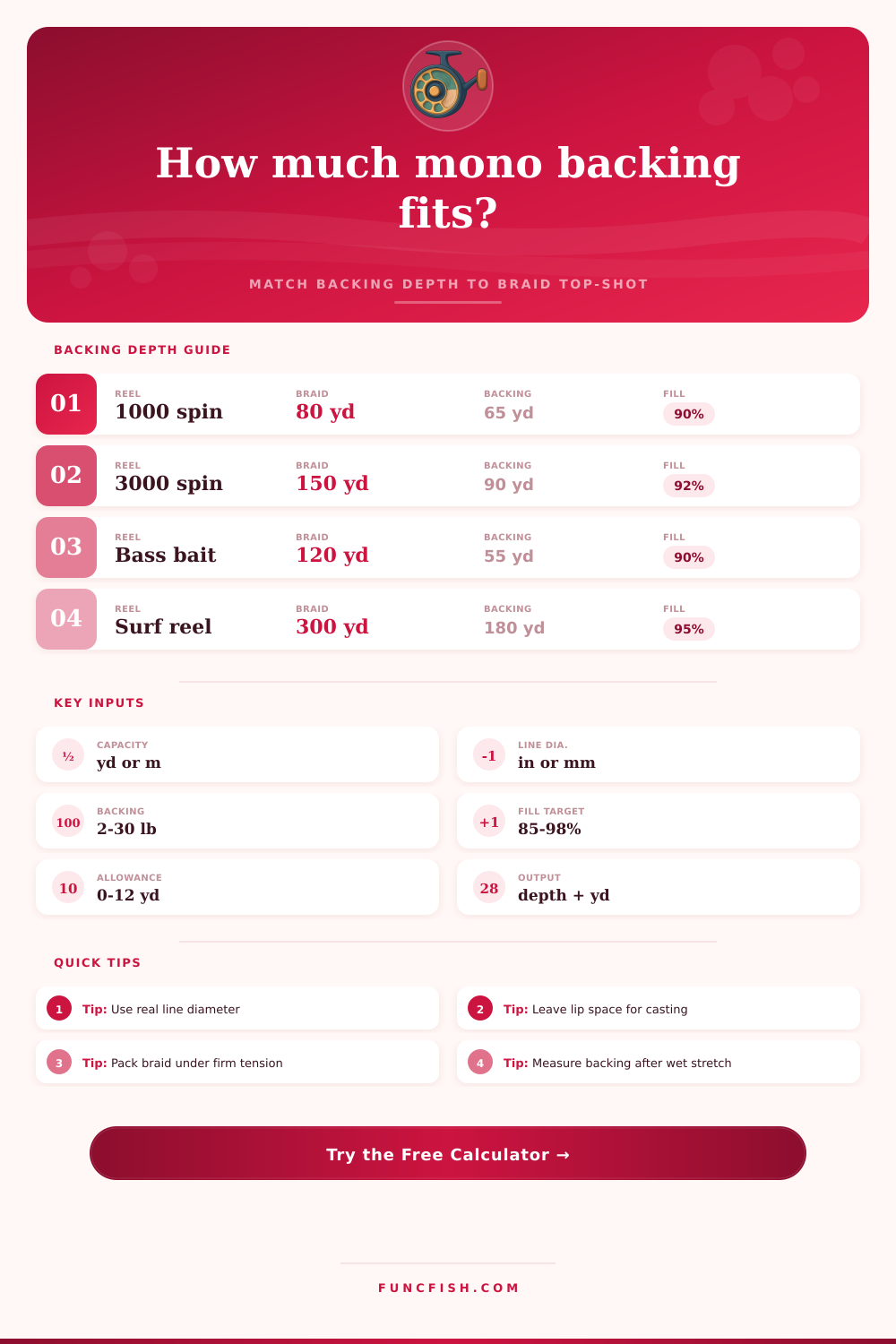
| 1000-2000 spinning, trout and panfish | 88-92% of lip | 60-100 yd / 55-90 m | 4-8 lb mono backing | Small arbor changes depth fast |
| 2500-4000 spinning, bass and walleye | 90-94% of lip | 120-180 yd / 110-165 m | 8-12 lb mono backing | Keep braid just under front lip |
| Low-profile baitcaster, bass cover | 85-90% of lip | 80-130 yd / 70-120 m | 10-15 lb mono backing | Avoid overfill for braking control |
| Surf spinning reel, long casts | 94-97% of lip | 250-350 yd / 230-320 m | 15-25 lb mono backing | Measure lip clearance carefully |
| Conventional trolling reel | 92-98% of lip | 200-500 yd / 180-460 m | Mono or Dacron backing | Allow space for level-wind stacking |
| Line material | Packing behavior | Diameter effect | Backing note | Calculator adjustment |
|---|---|---|---|---|
| 8-strand braid | Dense and smooth under firm tension | Very low volume per yard | Needs more backing than mono top-shot | High packing factor |
| 4-strand braid | Slightly rougher lay | Often thicker than 8-strand | Back off fill on baitcasters | Medium-high packing factor |
| Nylon mono | Compresses and stretches | Builds depth predictably | Good backing for braid grip | Normal packing factor |
| Fluorocarbon | Stiffer and springier | Higher volume than braid | Use less fill margin on spinning reels | Lower packing factor |
| Dacron backing | Soft but bulky | Builds arbor diameter quickly | Useful on trolling and fly-style setups | Bulky backing factor |
Capacity-label check: If the reel lists multiple mono capacities, use the one closest to your actual mono backing diameter. Diameter squared drives the estimate, so small label differences matter.
Spool-depth check: Measure bare arbor, lip diameter, and usable width with calipers when possible. This catches shallow-spool reels where published capacity can overstate usable backing depth.
Mono backing refers to a layer of line that you place on a reel spool before adding your main line. Mono backing provide a foundational layer upon which the main fishing line will rest. If you dont add enough mono backing, the main fishing line will sit too low on the spool.
This can create problem while casting the line. If you add too much mono backing, the main fishing line will sit too high on the spool close to the lip. This can create issue with the main line getting caught on the wind or the line slipping off the spool while casting.
How Much Mono Backing Do You Need for a Spinning Reel
You must find a balance between too little mono backing and too much mono backing to allow the main line to sit at the correct height on the spool. Mono backing will increase the arbor diameter of the spinning reel. This increased diameter will allow the main fishing line to occupy a correct amount of space on the line.
The thickness of the mono backing will determine how much space remains for the braid or fluorocarbon lines. Changes to the thickness of mono backing will change the amount of space that the main line will occupy on the reel spool. Thus, you must consider the thickness of mono backing when preparing the fishing reel with main line.
The line fill calculator will require some inputs from an angler. The angler will need to select the reel class because spinning reels of different sizes has different lip clearance. The angler will need to select the top-shot type because braids will pack more tight onto the reel spool than mono.
The angler will select the type of mono backing because soft mono will pack more into the reel than stiff fluorocarbon lines. The calculation will consider the packing tension and the fishing scenario. Packing tension will affect the fill percentage of the reel.
Different fishing scenarios will require different fill percentage for the main line on the reel. Based off the calculation, there will be several output that will allow the angler to understand the measurements of the reel that will be used. The length of the mono backing will be provided for cutting.
The radial depth will show the thickness of the mono backing above the bare arbor. The calculator will calculate the top-shot layer depth and the lip clearance to ensure that the line will cast cleanly when reeling in the caught fish. Should the indicated lip clearance be close to the minimum indicated for that reel, adding any more main line to the reel may cause the line to sit above the lip of the reel.
In the real world, there are several variables that may come into play while spooling lines that a line fill calculator may not always be able to account for. The mono may stretch when wet and settle back into a lower position on the spool when the mono line has dried. The knot that is used to join the mono and the main line may create a ridge in that area that will cause the line to not lay even on the reel.
Some anglers may choose to wind the line with a crosswind while others may use tight parallel wraps when winding the reel. The reference tables will provide recommendations for various sizes of fishing reels. These recommendations is a starting point for the angler when winding their fishing reel.
For instance, spinning reels of size 3000 may require 80 to 100 yard of mono backing while surf fishing reels of the same size may require nearly twice as much mono backing to achieve the same percentage of fill in the reel. These recommendations are established due to the consistent size of the spinning reels and lines. The angler may change the guess for the amount of mono backing that should be used for filling the reel to a precise measurement by measuring the actual dimension of the reel.
The measurements of the lip diameter, bare arbor diameter and the usable width of the reel spool will allow the line fill calculator to provide an answer that takes into consideration the shape of the reel spool. This is especially useful for aftermarket fishing reels where the manufacturer’s rating may no longer apply. It is natural for many angler to make the mistake of assuming that the numbers that are published for the capacity of the reels are accurate.
The manufacturer may have published the numbers for a specific diameter of line and with a specific packing factor for the main line. By allowing the angler to override the reference line diameter and packing factor, the line fill calculator accounts for any changes to the thickness of the mono backing. The angler should also use the allowance field to avoid making a mistake while winding the line onto the reel.
The allowance field accounts for any space that may be used up by the arbor tape, the knot that joins the mono backing to the main line and the trimming of the line once it comes off the reel. If this field is skipped, the main line may sit above the lip of the reel. A properly filled spinning reel will provide consistent tension when the line is being cast and when a fish is pulling on the main line.
The main line will sit in the area where the bail or level-wind of the reel expects the line to sit. This will prevent any loop from forming in the main fishing line. The advantages of a properly filled spinning reel will aid the angler during a long day of fishing.
Finally, the line fill calculator allows the angler to calculate the amount of mono backing that will be required to properly fill the spinning reel prior to beginning to wind the line onto the reel. It’s also important to realize that you’re gonna need a lot of patience to get the tension right. You should of checked the spool width first.
This will help you avoid making many more mistakes than you’ve already made.