Sea Bass Rig Hook Spacing Calculator
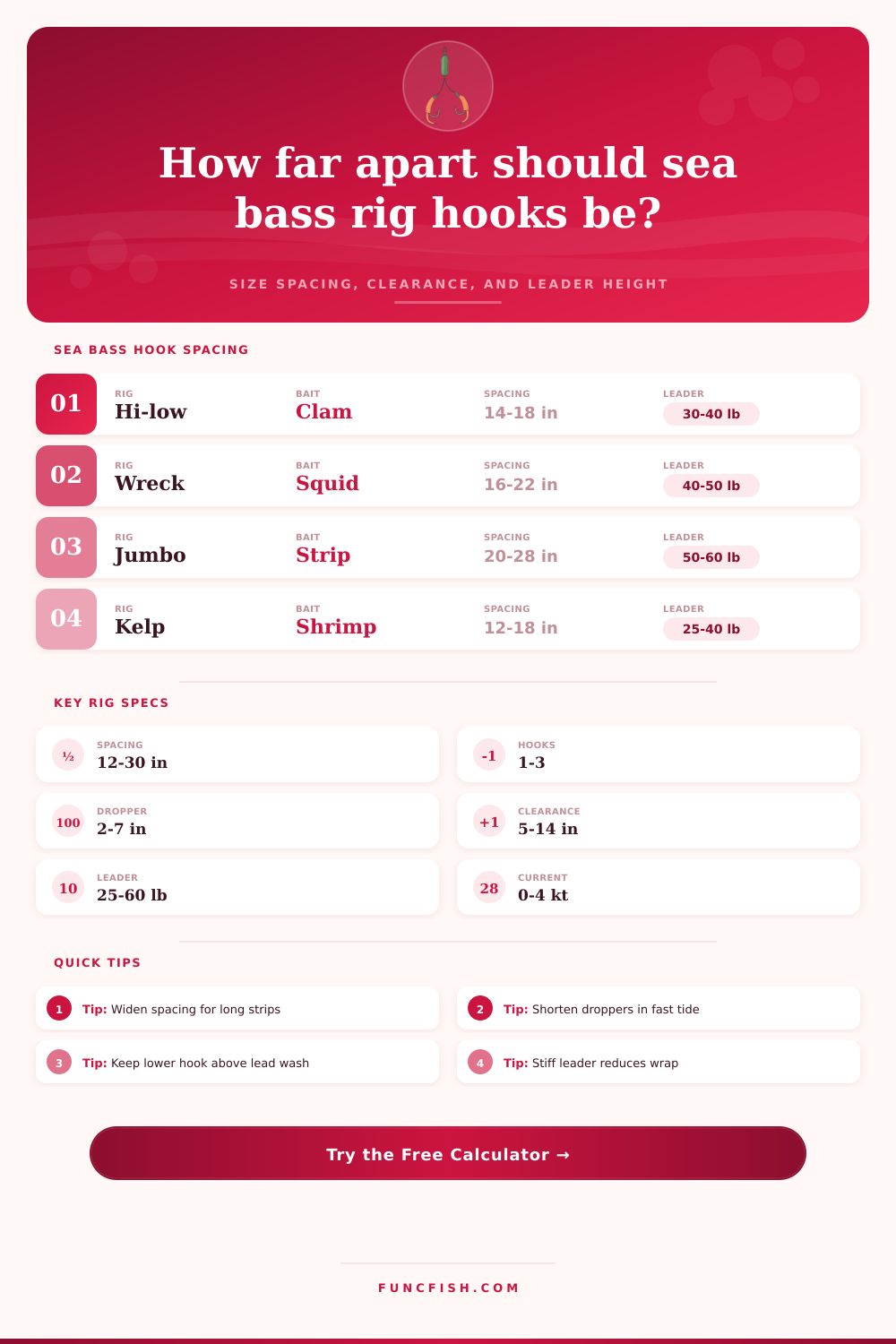
Estimate hook-to-hook spacing, bottom hook clearance, dropper swing room, leader height, and wrap risk for black sea bass high-low rigs, wreck rigs, reef rigs, and drift rigs.
📌Sea bass rig presets
⚙Rig spacing settings
Use the longest bait tail or strip that can swing from the hook bend.
Measure from the main leader body to the hook eye after tying.
Sea bass rig spacing results
Calculation breakdown
🛠Gear and sea bass comparison grid
Keeper Black Sea Bass
Jumbo Wreck Bass
Mixed Sea Bass
Kelp and Sand Bass
📏Hook spacing reference by bait and current
| Bait profile | Slack to light current | Moderate current | Strong current | Best rig note |
|---|---|---|---|---|
| Small clam strip, 1-2 in | 12-15 in / 30-38 cm | 14-17 in / 36-43 cm | 16-20 in / 41-51 cm | Short high-low rig |
| Standard clam or squid, 2-4 in | 14-18 in / 36-46 cm | 16-22 in / 41-56 cm | 20-25 in / 51-64 cm | Two-hook wreck rig |
| Long squid strip, 4-7 in | 18-24 in / 46-61 cm | 22-28 in / 56-71 cm | 26-32 in / 66-81 cm | Wide-spaced double rig |
| Soft plastic teaser, 3-5 in | 15-20 in / 38-51 cm | 18-24 in / 46-61 cm | 22-28 in / 56-71 cm | Teaser over bait |
| Live bait or fresh strip, 4-6 in | 20-28 in / 51-71 cm | 24-32 in / 61-81 cm | 28-36 in / 71-91 cm | Single or tandem only |
🪝Hook and dropper geometry table
| Hook size | Approx gap | Typical sea bass bait | Minimum branch | Spacing caution |
|---|---|---|---|---|
| 1/0 octopus | 14 mm / 0.55 in | Small clam, shrimp, teaser | 2.0 in / 5.1 cm | Works with 12-16 in spacing |
| 2/0 baitholder | 16 mm / 0.63 in | Clam strip, squid tip | 2.5 in / 6.4 cm | Good all-around high-low hook |
| 3/0 octopus | 19 mm / 0.75 in | Clam, squid, small strip | 3.0 in / 7.6 cm | Leave extra room in tide |
| 4/0 bait hook | 22 mm / 0.87 in | Squid strip, cut bait | 3.5 in / 8.9 cm | Better with 18 in or more |
| 5/0 circle | 26 mm / 1.02 in | Jumbo clam, strip bait | 4.0 in / 10.2 cm | Use wide spacing or one hook |
| 6/0 circle | 30 mm / 1.18 in | Large squid, live bait | 4.5 in / 11.4 cm | Avoid crowded three-hook rigs |
🧵Leader material spacing behavior
| Leader material | Typical strength | Stiffness effect | Knot use | Spacing adjustment |
|---|---|---|---|---|
| 30 lb nylon mono | 30 lb / 13.6 kg | Medium-soft branch | 1.1 in / 2.8 cm | Add 1-2 in in current |
| 40 lb nylon mono | 40 lb / 18.1 kg | Balanced for party rigs | 1.2 in / 3.0 cm | Baseline sea bass spacing |
| 40 lb fluorocarbon | 40 lb / 18.1 kg | Stiffer than mono | 1.3 in / 3.3 cm | Can hold shorter branches |
| 50 lb fluorocarbon | 50 lb / 22.7 kg | Good wreck stiffness | 1.5 in / 3.8 cm | Reduces wrap on short droppers |
| 60 lb hard mono | 60 lb / 27.2 kg | Very stiff branch | 1.7 in / 4.3 cm | Useful near rough structure |
| Soft braid branch | 80 lb / 36.3 kg | Very flexible swing | 0.8 in / 2.0 cm | Needs wider spacing |
🗂Rig layout comparison
| Rig layout | Hook count | Default spacing | Bottom clearance | Best use |
|---|---|---|---|---|
| Classic high-low | 2 | 16 in / 41 cm | 7-10 in / 18-25 cm | General black sea bass bait rig |
| Short wreck rig | 2 | 18 in / 46 cm | 8-12 in / 20-30 cm | Rubble, wreck edge, and fast drops |
| Three-hook party rig | 3 | 14 in / 36 cm | 6-9 in / 15-23 cm | Small bait and light current only |
| Single jumbo dropper | 1 | Not needed | 8-14 in / 20-36 cm | Large strip bait or heavy structure |
| Teaser above bait | 2 | 18 in / 46 cm | 7-11 in / 18-28 cm | Artificial teaser over clam or squid |
| Kelp bass dropper | 1-2 | 15 in / 38 cm | 5-8 in / 13-20 cm | Kelp line and boiler rock drops |
💡Spacing notes
Spacing formula note: The calculator treats each hook as a swing envelope, then adds current, bait profile, hook gap, bottom, and leader stiffness buffers. Long squid strips and soft branch materials need more vertical separation than short clam baits.
Clearance note: If the lower hook hangs too close to the sinker, it can sit in lead wash, bottom debris, or wreck edges. Raise the lower dropper before widening the entire rig when the total leader is already long.
Often your rig will get hung up before it hits bottom The hooks will knot up as if you are wearing a twisted necklace around your neck. Many angler have dealt with this. Many charters has lost fish due to incorrect guessing when it comes to leader spacing. Inches of lead can mean the difference in a full cooler or an empty boat.
Leave plenty of space so your bait can move freely without hitting its own tail. And then there’s physics: When you have current flowing around and through the rig, each hook want to be in his own column of water. If they’re crowded, they’ll collide with each other’s turbulence. That results in drag which lowers the rig more quickley. And that covers up your bait presentation. One hook may be in the shadow of another. A finicky bass hunkered down on edge of a reef won’t see him. You need some separation to get clean presentations from each bait.
How to Space Your Rig for Better Fishing
For your rig, it crunches the numbers. It eliminates the need to guess if that 4 feet of leader is too long or not long enough for this day’s tidal action. When you see the answer you can understand what it’s doing and have confidence in its output.
Why does it produce those numbers? Because the game is crazy out there with all the different sea bass rigs. Does a long squid tentacle behave like a clam strip? Nope. The one flop around; the other sits stationary. Put a flopper on a tight leader and expect tangles. This tool change the suggested length depending on bait swing.
The leader also matter a lot. A lot of guys go to a heavier fluorocarbon assuming it makes them stealthy. It helps with stealth…a bit. But it affects the overall geometry of your rig. The stiffer the leader, the less susceptible it will be to bending and wrapping around itself in current. You’ll often find that you can space it out a little tighter with a stiffer fluoro than you can with a softer nylon mono. Keep this in mind when you’re fishing in heavy cover. Tangles are far more likely to cost you time then increase or decrease your chances of getting bit.
Another overlooked variable is bottom clearance. How far do you allow for distance from your lower hook to your sinker? Do you want your bait dragging on brush and muddling along in the mud? No, because black sea bass feed on the bottom. A dirty bait isn’t going to get eaten. The hook count and dropper length come into play with this one too.
The calculator estimate the height above the weight that your lowest bait is going to hang. If what you see is really small clearance, consider shortening your droppers. Or maybe don’t widen the separation any more but decrease the size of the sinker instead. Current strength dictates everything else. You’ll be able to use more tightly rigged leaders in slack water. No one’s forcing those branch tips to clasp together. However, as it begins to pick up, there will be increasing lateral pressure on your dropper loops and it goes up very fast from there. Depending upon the level of current, the calculator will adjust accordingly for you. What was a great-looking rig in a protected cove turns into a mess of a ball in an open channel flow.
This is where the reference table comes into play. For each bait profile, it clearly lays out how much more space those long strips require versus compact chunks. You must keep those gaps much wider on a teaser setup than on a regular old two-hook clam rig. And that’s what it all boils down to, presentation clarity. You’re trying to get the fish to focus on one clear target at a time. It is not some confusing bundle of protein and line.
Rig tying is a learned skill. It’s going to take some time and you’re going to make errors. You’ll lop-off a few good leaders. That’s why having a baseline helps avoid the worst errors. Use the measured-out distance as a starting point. From there, tweak according to tip-of-the-rod feel. Use more space if the rig seems sluggish or wrapped. Use shorter spacing if it looks great but nobody’s biting. The second way keeps those baits a little tighter for the strike zone. These little tweaks will turn an exercise in frustration into a money-maker.
They remove the guesswork from the knot. This gives you more time to find the fish and read the structure, and less time messing with knots and tangled lines. Keep those hooks clean and keep that bait clean by keeping that space between them. You should of spent less time untangling and more time fishing.