Umbrella Rig Arm Spacing Calculator
Estimate A-rig arm gap, outside spread, bait clearance, stagger depth, wire angle, and load margin for castable and trolling umbrella rigs.
📌Umbrella rig presets
⚙Rig spacing inputs
Use the outside spread as the widest measured distance between the outer arm tips after you fan the wires into fishing position.
Umbrella rig spacing results
Calculation breakdown
🔧Frame and bait data grid
Finesse Bass
Standard Bass
Striper Cast
Trolling Rig
📏Arm spacing reference table
| Rig type | Typical arms | Outside spread | Tip gap target | Best use |
|---|---|---|---|---|
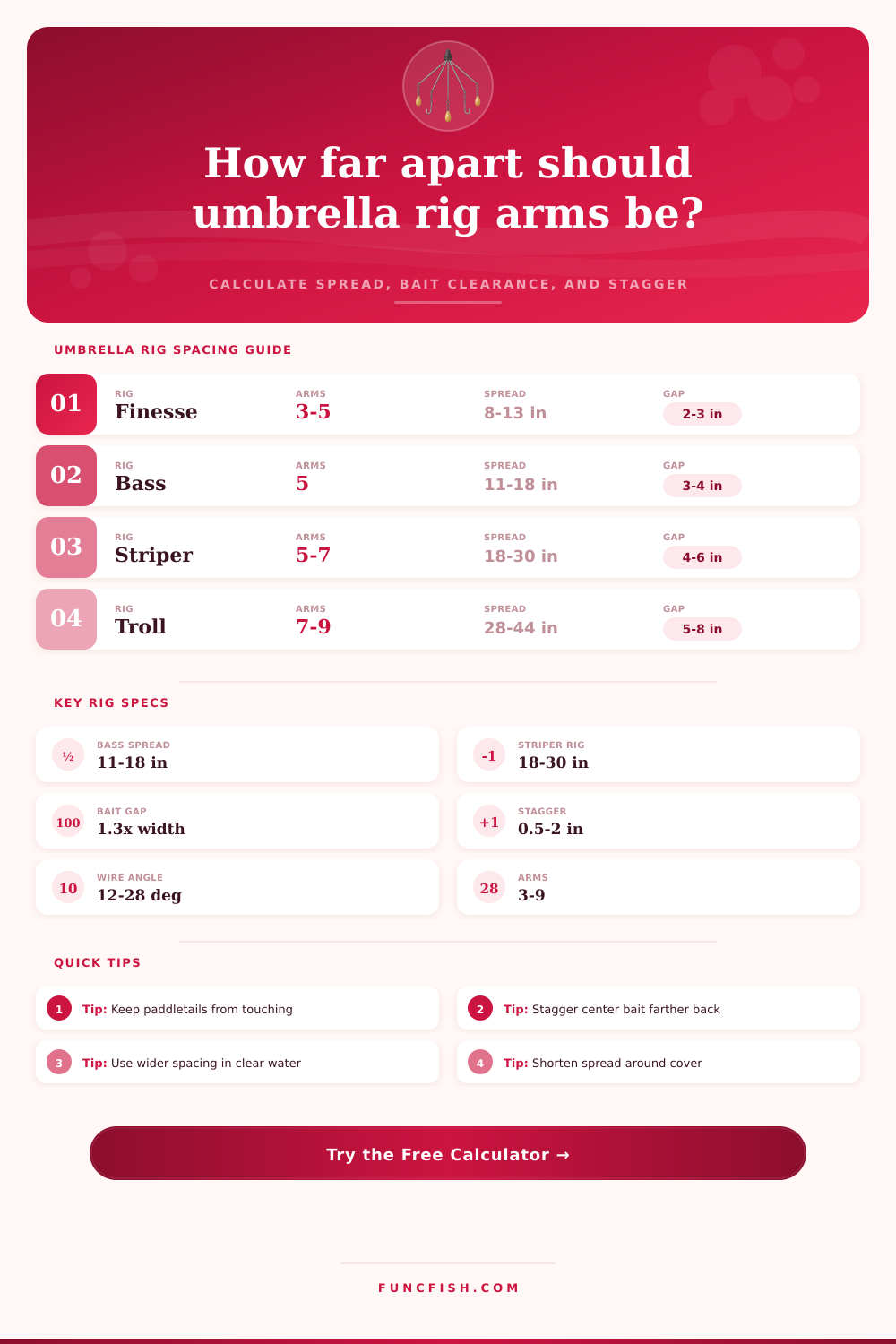
| Compact castable A-rig | 3-5 | 8-13 in / 20-33 cm | 2.0-3.2 in / 5-8 cm | Docks, brush, pressured bass |
| Standard bass umbrella rig | 5 | 11-18 in / 28-46 cm | 2.8-4.5 in / 7-11 cm | Shad schools, points, flats |
| Wide clear-water cast rig | 5-7 | 16-26 in / 41-66 cm | 3.5-5.0 in / 9-13 cm | Suspended fish and clear water |
| Striper or hybrid rig | 5-7 | 18-30 in / 46-76 cm | 4.0-6.0 in / 10-15 cm | Open-water stripers and hybrids |
| Heavy trolling umbrella | 7-9 | 28-44 in / 71-112 cm | 5.0-8.0 in / 13-20 cm | Trolling lanes and deep bait balls |
🎣Species and gear comparison grid
| Species | Arm spacing | Bait size | Frame choice | Line class |
|---|---|---|---|---|
| Largemouth bass | 2.8-4.2 in / 7-11 cm | 3.0-4.0 in / 8-10 cm | 0.035 in stainless or titanium | 17-25 lb fluoro or 50 lb braid |
| Smallmouth bass | 2.2-3.5 in / 6-9 cm | 2.8-3.5 in / 7-9 cm | Light stainless or compact titanium | 10-17 lb fluoro or 30 lb braid |
| Striped bass | 4.0-6.0 in / 10-15 cm | 4.5-6.5 in / 11-17 cm | 0.040 in stainless or heavy titanium | 30-50 lb braid |
| Muskie and pike | 5.0-8.0 in / 13-20 cm | 6.0-9.0 in / 15-23 cm | Heavy titanium or coated wire | 65-80 lb braid with leader |
| Bluefish and inshore | 4.0-7.0 in / 10-18 cm | 4.0-7.0 in / 10-18 cm | Coated saltwater wire | 30-50 lb braid with leader |
| White bass and hybrids | 2.5-4.5 in / 6-11 cm | 2.5-4.0 in / 6-10 cm | Standard stainless | 12-25 lb line |
⚖Wire load and angle table
| Wire or frame | Normal spread | Angle window | Load margin | Spacing note |
|---|---|---|---|---|
| Light 0.030 in stainless | 8-13 in / 20-33 cm | 10-20° | Low to medium | Keep small blades and short arms |
| Standard 0.035 in stainless | 11-20 in / 28-51 cm | 14-26° | Medium | Good for five 3.5 in swimbaits |
| Heavy 0.040 in stainless | 16-30 in / 41-76 cm | 16-30° | Medium high | Better with stripers and big blades |
| Spring titanium | 11-26 in / 28-66 cm | 14-28° | High recovery | Handles repeated casting flex well |
| Trolling 0.051 in stainless | 28-44 in / 71-112 cm | 18-35° | Very high | Use when pull and bait count are high |
🐟Bait clearance and stagger table
| Bait profile | Clearance factor | Stagger range | When to widen | When to tighten |
|---|---|---|---|---|
| Small paddletail | 1.25x tail swing | 0.5-1.0 in / 1-3 cm | Fast retrieve or clear water | Brush, docks, small baitfish |
| Standard paddletail | 1.35x tail swing | 0.8-1.5 in / 2-4 cm | Wide thump tails or blades | Cold water and slow rolling |
| Large swimbait | 1.55x body width | 1.5-3.0 in / 4-8 cm | Big tails or high-speed pull | Short casts around cover |
| Fluke or soft jerkbait | 1.15x body width | 0.5-1.2 in / 1-3 cm | Erratic rod snaps | Subtle schooling presentation |
| Hair jig or bucktail | 1.10x skirt width | 0.5-1.5 in / 1-4 cm | Long fibers or current | Cold-water slow troll |
💡Spacing tips
Clearance check: after setting the fan, pull the rig through water beside the boat or bank. If two bait tails pulse into each other, widen the outside arms or shorten the inner baits before changing hook size.
Stagger check: the center bait usually fishes best slightly behind the outer baits. Add more setback for larger swimbaits, trolling pull, or fish that slash from behind the bait ball.
When everything lines up right on an umbrella rig, it’s like that magic hush falls over you. It is not that kind of silence. No more crazy casts, no more line tangles, no more knot-tying. That happen when you space out your arms to match the conditions.
After entering your desired bait profile and target species into the calculator (above), it do the rest of the work for you. You no longer have to guess if your wire will bend or break under weight.
How to Set Up Your Umbrella Rig
You may think that all umbrella rigs is created equal, but they’re not. A seven arm rig meant for deep water trollings for stripers or walleye isn’t going to behave like a five arm version made for targeting largemouth bass. Every variable introduce a different set of geometry.
First, consider how many arms and what kind of frame wire you are using. You might think more arms mean more fish, but they also means more drag and higher stress on the hardware. Stainless steel is good all around and thirty-five thousandths of an inch thick is about right for open water bass. It spring back after a cast but won’t be stressed out if it catches too big of a fish.
You can go to thicker trolling wire or even heavy titanium, but you gain durability at the cost of sensitivity. That’s where the tool makes its math for the recommended gap and spread depending off the flexibility of the material.
The big mistake most people are making is bait clearance. You don’t want them so far away that you aren’t getting the school effect but you also don’t want them so tight together that the tails of the baits knocks into each other. If the tail knocks into another paddle tail it stops swimming. The tip to tip gives idea of how much space should be between baits so they can move freely. So it would say keep more distance on a larger musky swimbait then a small finesse jig. Makes sense because the larger baits has further swings and need more space to pulse from side to side.
Another slight lever you can pull is stagger. Often moving the middle bait back just an inch or two will get more bites. In my experience, fish often move in from behind a school. Setting the bait back a little bit more closely mimic how they move in. There is a staggered plan too on the tool depending on water clarity and your retrieve speed. If you’re fishing in clear water you may want to tighten it all up. If you are fishing in stained water with strong current, widen out the spread and allow the rig to open up against the current flow.
The calculator will show you a load margin on your set-up as well and this isn’t so much a matter of the wire snapping but of the rig maintaining itself through the retrieve. Adding big soft plastics and big blades to a light frame will cause the wires to collapses inward under drag. This results in a collapsed spread that looks more like a single bait than a school. So the load check lets you know if your hardware can handle the physics of what you’ve added to it.
If you’re planning a fishing trip and want to have an idea of what you’ll encounter with various species, you can use the reference table on the page as a guide for typical ranges. Just don’t view them as hard and fast rules. The conditions in the water fluctuate from day-to-day. Something that will work in six feet of clear water may not work in thirty feet of current.
Run the tool to establish a starting point and tweak to match what you observe in-person. You should of checked the depth first. Ultimately, it’s all about observing and adapting to what works best.
This calculator provides you with a baseline for the physics of wire tension, bait swing, and hydrodynamic drag. It takes the guessing out of the set up process so you can concentrate on the holding areas for the fish. When the rig runs clean, there are no more tangles. And when there are no more tangles you may discover something else waiting for you at the other end of the line, that sweet sound of silence.