Fishing Rod Grip Circumference Calculator
Size a fishing rod grip by hand fit, blank diameter, handle material, oval shape, tape buildup, overwrap thickness, compression, and technique-specific comfort targets.
📌Grip sizing presets
⚙Rod grip inputs
Rod grip sizing results
Calculation breakdown
🛠Grip material data
Firm, warm feel; common target for bass, trout, walleye, and fly rods.
Softer palm fill; often sizes slightly larger before squeeze correction.
Dense offshore grip material with durable traction and moderate give.
Hard shell feel; circumference reads close to actual caliper size.
Paracord, seine twine, or leather lace can add grip and diameter quickly.
Heat-shrink tubing raises circumference while keeping a tough outer skin.
Best sized closer to the lower target because it does not compress much.
Check each hand contact point when grip, seat, and blank are exposed.
📊Grip comparison grid
Lower circumference-to-hand ratio for light lure feel, finger contact, and quick wrist motion.
Middle range for most casting, spinning, and jigging rods with relaxed hand closure.
Fuller handle for heavy hooksets, big lures, fighting pressure, and two-hand leverage.
Adds clearance for gloves or cold fingers while avoiding a cramped squeeze around the rod.
📋Reference tables
| Hand size | Hand wrap | Typical target circumference | Round diameter equivalent | Best fit notes |
|---|---|---|---|---|
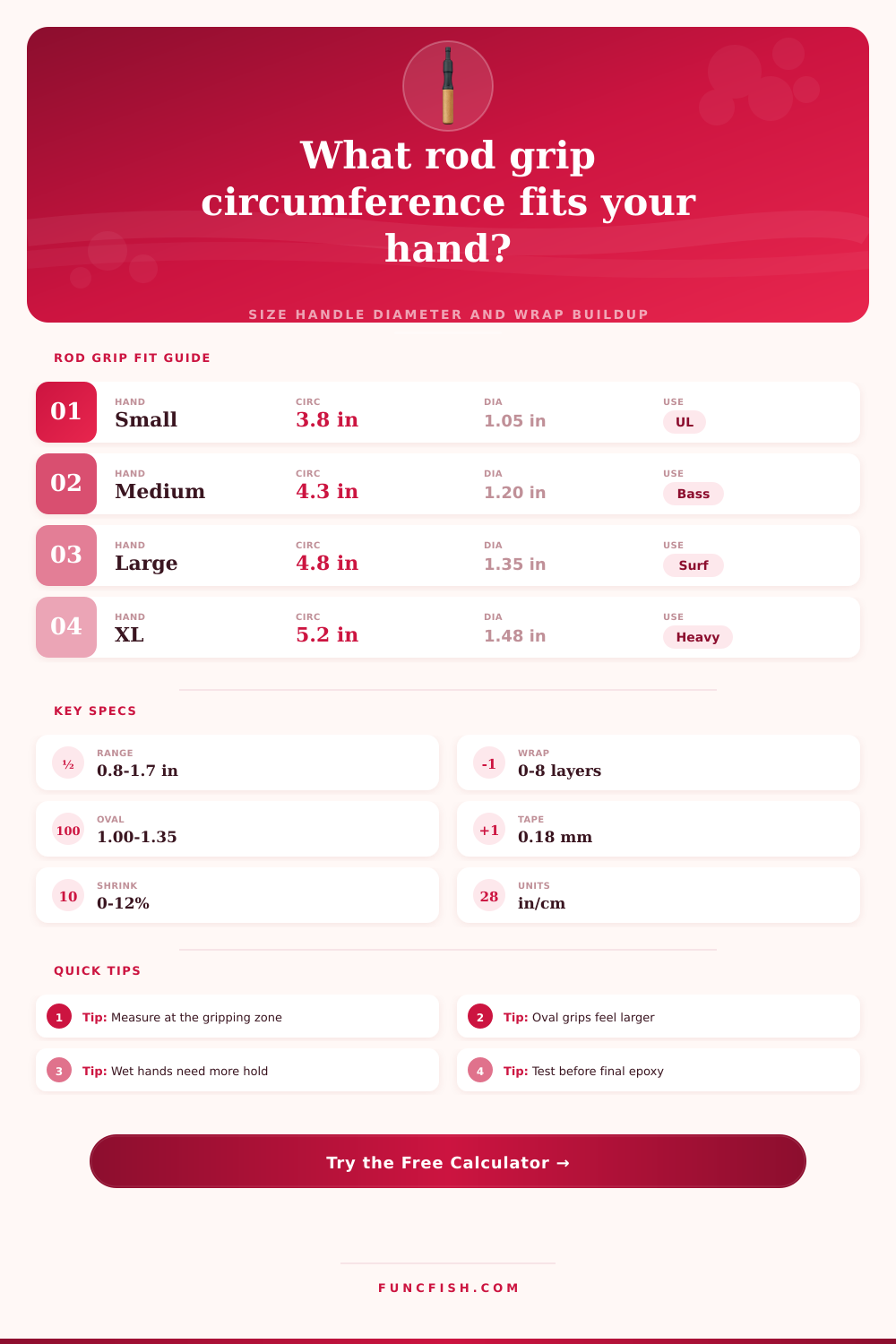
| Small adult | 7.0-7.7 in / 17.8-19.6 cm | 3.45-3.95 in / 8.8-10.0 cm | 1.10-1.26 in / 28-32 mm | Good for ultralight, trout, fly, and compact split grips. |
| Medium adult | 7.8-8.6 in / 19.8-21.8 cm | 3.95-4.55 in / 10.0-11.6 cm | 1.26-1.45 in / 32-37 mm | Common bass, walleye, inshore, and general spinning range. |
| Large adult | 8.7-9.5 in / 22.1-24.1 cm | 4.45-5.10 in / 11.3-13.0 cm | 1.42-1.62 in / 36-41 mm | Useful for surf, pike, catfish, and power casting handles. |
| Extra large | 9.6-10.5 in / 24.4-26.7 cm | 4.95-5.65 in / 12.6-14.4 cm | 1.58-1.80 in / 40-46 mm | Often needs palm swell, oval shaping, or raised rear grip zones. |
| Technique | Grip feel target | Typical diameter | Oval ratio | Reasoning |
|---|---|---|---|---|
| Trout stream spinning | Light control | 0.95-1.15 in / 24-29 mm | 1.00-1.08 | Small lures and wrist casts benefit from a lower fill ratio. |
| Bass casting | Balanced | 1.10-1.35 in / 28-34 mm | 1.00-1.16 | Enough palm support for hooksets without losing blank feedback. |
| Walleye jigging | Finesse balanced | 1.00-1.25 in / 25-32 mm | 1.00-1.10 | Finger contact and low fatigue matter during repeated jig strokes. |
| Catfish or pike | Power hold | 1.25-1.55 in / 32-39 mm | 1.08-1.25 | Fuller grips spread pressure during hard pulls and big hooksets. |
| Surf casting | Two-hand leverage | 1.35-1.70 in / 34-43 mm | 1.10-1.35 | Large rear grips help locked-hand casting and wet traction. |
| Offshore jigging | Fatigue buffer | 1.30-1.65 in / 33-42 mm | 1.08-1.25 | Dense material plus larger circumference reduces pressure points. |
| Build-up material | One-side thickness | Diameter gain per layer | Circumference gain per layer | Use case |
|---|---|---|---|---|
| Masking tape arbor | 0.004-0.006 in / 0.10-0.15 mm | 0.008-0.012 in / 0.20-0.30 mm | 0.025-0.038 in / 0.64-0.96 mm | Fine adjustment under cork, EVA, or reel seat sleeves. |
| Fiberglass mesh tape | 0.007-0.010 in / 0.18-0.25 mm | 0.014-0.020 in / 0.36-0.51 mm | 0.044-0.063 in / 1.12-1.60 mm | Fast buildup where epoxy fill is acceptable. |
| Cord wrap | 0.020-0.055 in / 0.5-1.4 mm | 0.040-0.110 in / 1.0-2.8 mm | 0.126-0.346 in / 3.2-8.8 mm | Traction over hard tubes, surf handles, and gaff-style grips. |
| Heat-shrink tube | 0.020-0.060 in / 0.5-1.5 mm | 0.040-0.120 in / 1.0-3.0 mm | 0.126-0.377 in / 3.2-9.6 mm | Durable outer skin over EVA, cork, carbon, or old handles. |
| Thin leather wrap | 0.025-0.045 in / 0.6-1.1 mm | 0.050-0.090 in / 1.3-2.3 mm | 0.157-0.283 in / 4.0-7.2 mm | Traditional feel with noticeable circumference gain. |
| Species or setup | Rod power | Grip zone | Target feel | Typical circumference |
|---|---|---|---|---|
| Panfish and creek trout | UL to light | Short rear or cigar grip | Fingertip control | 3.0-3.8 in / 7.6-9.7 cm |
| Bass and walleye | Medium to medium heavy | Split rear and foregrip | Balanced closure | 3.7-4.6 in / 9.4-11.7 cm |
| Inshore redfish or snook | Medium heavy | EVA rear grip | Wet-hand hold | 4.1-5.0 in / 10.4-12.7 cm |
| Catfish, pike, musky | Heavy | Full rear grip | Power leverage | 4.4-5.4 in / 11.2-13.7 cm |
| Surf and offshore | Heavy to extra heavy | Long rear or foregrip | Fatigue spread | 4.7-5.8 in / 11.9-14.7 cm |
💡Grip sizing tips
You set the hook; the fish grabs the bait and you’re cinching down, but your hand are cramping up. Sound familiar? It’s happened to all of us at the worst time. You feel tired rather than having any strength and the next thing you know, the rod want to come away from you.
Most folks will point the finger at blank action or their casting style. But more times than not, the issue begin with handle size (circumference) vs. It is about hand size. Too small of a grip squish your fingers into a painful position. Too large of a grip becomes an arm wrestling match each time you hit the trigger. It’s not about strength, it’s about geometry.
Why the Right Rod Handle Size Matters
Once you know which materials you want and what your hands measure, plugging them into the calculator above will do the rest. You won’t have to guess how many rolls of buildup tape to order. Getting accurate measurements of your hand is the challenge.
With fingers relaxed, wrap a soft tape measure snugly over the knuckles. Fingers aren’t tightly curled nor are they spread open as far as possible. This measurement represents the largest size you’ll have room to comfortabley hold. If you don’t own a pair of calipers, compare diameter of your current favorite rod. You can then work backward from that number to find your size.
Don’t forget about the details of material science that the raw numbers can’t cover. Cork transmits vibration well and has some inherent firmness. But cork also compress very little under pressure. EVA foam gives a bit when compressed. An inch-diameter handle may feel more like three-quarters of an inch once your palm wrap around it. So the tool factors in that kind of compression to avoid having the feeling be too late to remedy.
Grips make things even more complex when it comes to size. For instance, oval grips contour to the natural shape of your palm. More surface area mean more power without adding any vertical height at finger contact points. The oval ratio shows how much wider the palm area is different than the fingertip area. This is key when you think about offshore jigging and surf casting. In both cases, you want a solid foundation for two-handed leverage.
That’s why the page has a reference table laying out general targets. For example, a bass rod may aim for a middle ground. A catfish rod shift to a bigger, more full grip. Ultimately, think about what you fish. A finesse rod need light fingertip control. A heavy baitcasting setup needs something that spreads pressure over the entire hand so you don’t get tired during long fights.
You may need to repeat the process when building up a handle. One mistake we see too often is rushing it. Builders slap down layers of fiberglass mesh, or layers of masking tape, but never try the fit before it’s set in epoxy. By then they’ve overdone it and end up way off their mark. Instead, build slowly. Use temporary wraps to determine the circumference as you go. Don’t commit to the final finish until you know what it needs. The calculator will give you an idea of how many layers of what thickness tape will get you where you want to go. And this is where efficiency come into play. You’ll avoid wasting tape and have a nice clean wrap around the blank to grip.
Consider other environmental factors as well. A wet hand require more traction so sometimes a slightly bigger circumference helps keep things grippy. Gloves may require a little more room in cold weather. These things change the target number just enough to make a generic guess not realy work.
Everything we do is aimed at creating a smooth connection between the rod and the angler. If you feel like the grip is an extension of your arm instead of a foreign object, you will catch more fish. This isn’t necessarily because you are better, but because you have fewer chances to rely on luck. You forget you are even holding the grip. You are left free to concentrate on what is happening with the lure and the line. A well-sized grip eliminates any physical distractions and allows you to instantly respond to the moment when the bite occur. It’s a little thing that pays off huge in a long day on the water.
Begin with good measures and pay attention to the properties of materials. Test your creation while it is still pliable. Your hands will reward you when the big one finally bites.