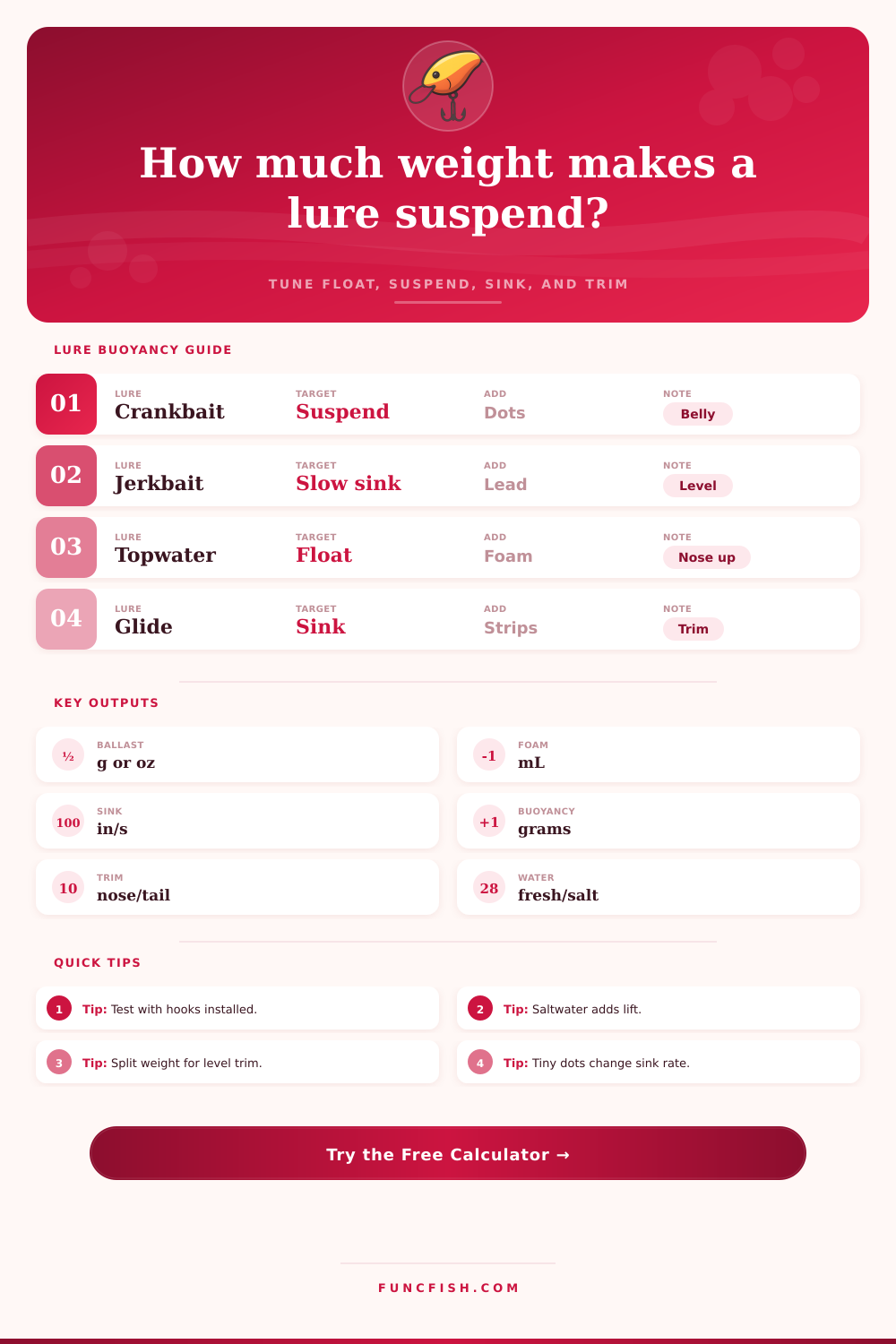
Lure Buoyancy Adjustment Calculator
Estimate ballast weight, foam volume, suspension margin, sink or rise rate, and nose-tail trim split from lure displacement, dressed weight, water density, body drag, hardware, and target action.
📌 Buoyancy tuning presets
⚙ Lure and water inputs
Buoyancy adjustment results
Calculation breakdown
📊 Live tuning comparison
Added mass needed to suspend in standard freshwater.
Saltwater lift often requires more ballast for the same lure.
Approximate ballast for a controlled countdown action.
Foam or volume needed when a lure is heavier than desired.
🧰 Tuning material grid
Good for crankbaits, jerkbaits, and tiny trim changes.
Useful when a slow float needs a clear countdown sink.
Adds volume with little mass for float recovery.
Often close to neutral, so hooks can dominate balance.
📋 Reference tables
| Lure type | Typical displacement clue | Drag coefficient range | Best tuning point |
|---|---|---|---|
| Rounded crankbait | High air cavity for size | 0.80 to 1.10 | Belly dot near hook hanger |
| Minnow jerkbait | Slim volume, long body | 0.65 to 0.95 | Split ballast fore and aft |
| Topwater popper | High flotation margin | 0.90 to 1.30 | Tail or belly trim for angle |
| Glide bait | Broad profile, large side area | 1.05 to 1.45 | Centerline ballast below hinge |
| Metal jig | Low displacement, heavy body | 0.45 to 0.80 | Foam is rarely enough for float |
| Target action | Net mass target | Practical rate | Use case |
|---|---|---|---|
| Positive float | 0.5 to 3 g light | Visible rise | Cover deflection and topwater recovery |
| Slow rise | 0.1 to 0.8 g light | 0.1 to 0.5 in/s | Cold jerkbait pauses |
| Dead suspend | Within 0.2 g neutral | Near zero | Pause presentations |
| Slow sink | 0.1 to 1.2 g heavy | 0.1 to 0.8 in/s | Countdown edges and grass tops |
| Fast sink | 2 g or more heavy | 1+ in/s | Deep pulls or bottom contact |
| Water condition | Density used | Effect on lure | Adjustment note |
|---|---|---|---|
| Warm freshwater | 0.997 g/mL | Least lift in common freshwater | May sink slightly faster in summer |
| Cool freshwater | 0.999 g/mL | Baseline freshwater tune | Good workshop reference |
| Brackish water | 1.010 g/mL | Moderate extra lift | Add small ballast to keep suspend |
| Average saltwater | 1.025 g/mL | Strong extra lift | Retune freshwater lures before use |
| Cold saltwater | 1.028 g/mL | Highest listed lift | Expect the slowest sink rate |
| Trim goal | Nose share | Tail share | Behavior tendency |
|---|---|---|---|
| Level suspend | 50% | 50% | Flat pause and balanced twitch |
| Nose-down dive | 65% | 35% | Sharper bill bite or glide entry |
| Tail-down pause | 35% | 65% | Popper stance or wounded minnow look |
| Belly-center stability | 50% | 50% | Lower center of gravity, less roll |
💡 Calculation tips
Buoyancy is not just about whether a lure floats or sinks. You purchase an expensive crankbait, but when you drop it in water, it sink instead of hovering over weeds. Because position of lure appears unnaturaly, the fish won’t touch it. This tuning process is something most anglers guess their way through by randomly adding hot glue and lead weights. When the lure dive down into mud, they becomes frustrated because they didn’t consider how much lift the treble hook provide.
The calculator converts displacement numbers into precise gram targets for foam or ballast. No more guessing what will work. Input volume of water your dressed lure displaces, its current weight, and environment you plan to fish in. Then the calculator lets you know precisely what amount of mass need to be added or removed to make it dead suspended, or hit a desired sink rate. It takes into consideration trim splits and drag factors so you know where to put the weights.
How to Fix Lure Buoyancy
The single biggest thing is measuring the displacement, which nobody do. You can’t tune what you don’t measure. Take your lures, fully dressed with hooks and paint. Immerse them in graduated cylinder filled with water and record change in amount of water. That’s your actualy data. Unless your lures are perfectly rectangular; and they never are, trying to eyeball the difference based off their measurements just doesn’t work. The tool accounts for that through its fullness factor; however, actual measurement trump theory every time.
“Buoyancy is altered by the density of the water. A lure might suspend in freshwater but could float in saltwater because salt adds lift. Cold water gives a lure lift and salt has lift to. Going from a lake in a summer to a river in October can cause a lure to act different than simply due to the change in water weight. The calculator automatically makes adjustments based on density so no need to memorize a table of specific gravities. Simply choose what environment it’s in and math does the rest.”
It will suspend level with the trim line. You don’t want bait diving on its nose, nor do you want it skipping across bottom. It has to look natural, which means level. And in clear water, sometimes you need that bait to pause tail down, which trigger strikes from fish suspicious of a flat profile. The tool figures out where to put the balance to keep it at correct angle. So if I want a glide bait to hold steady, I change the balance vs wanting a jerkbait to roll hard. In either case, that’s physics applied to fishing strategy.
A little goes a long way. A half-ounce dot will make big difference between a fast-sinking and slow rising lure. Resist urge to drill giant holes and scrape off big chunks of paint at once. You should of resisted the urge to ruin it. Before you head out on water, take lure for a spin in bucket. Still doesn’t feel right? Take away a little more foam or slap on an additional small weight.
Tuning takes time. Speed isn’t as important than accuracy. Milligrams make all difference between a miss or a catch. Knowing about how water density, drag and displacement work allows for working in concert with the equipement rather than against it. The bait goes where you want it to go. The fish sees what you want it to see. Once that bait hits strike zone, the battle is on.