Outboard RPM to Speed Calculator
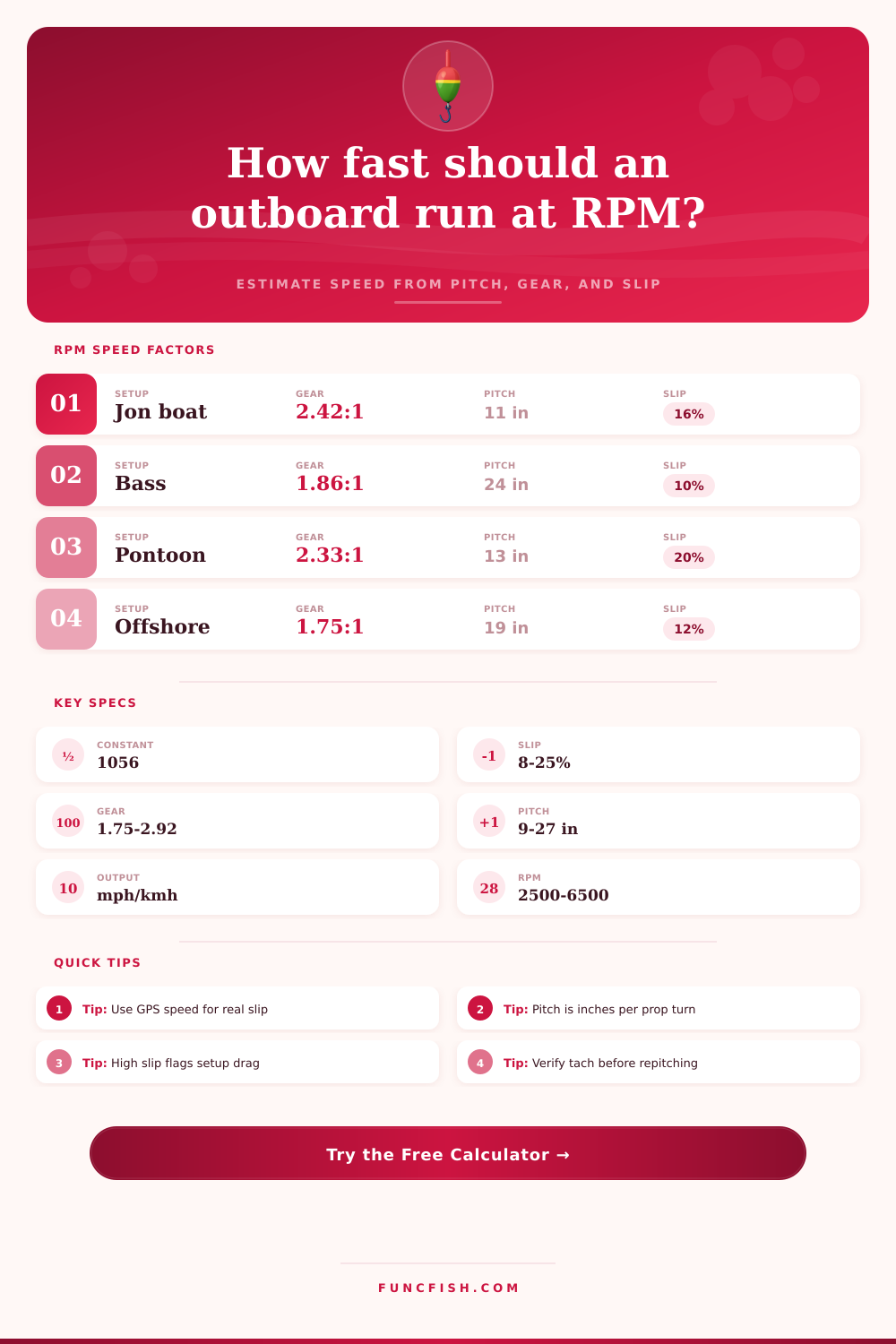
Estimate boat speed from engine RPM, lower-unit gear ratio, prop pitch, slip, tachometer error, and on-water allowances for fishing boats and outboard setups.
📌Outboard speed presets
⚙RPM, prop, and gear inputs
Calculated outboard speed
Formula breakdown
🔧Propeller equipment grid
Good baseline for small jon boats, pontoons, and light general fishing loads.
Often gives cleaner bite, less flex, and lower slip on faster bass or bay boats.
Useful for heavier fishing loads, stern lift, rough water, and improved hole shot.
Pairs with kickers, pontoons, and displacement speeds where grip matters more than top end.
🎣Gear and species comparison grid
Fast pad hulls often combine taller pitch with lower slip once properly trimmed.
Deep-V boats usually trade a little speed for bow control, load carrying, and rough-water bite.
Skiffs benefit from quick planing, shallow-water grip, and modest pitch rather than peak speed.
Center consoles need a balance of cruise efficiency, heavy fuel load, and offshore sea conditions.
📊Reference tables
| Formula item | Meaning | Imperial form | Metric equivalent |
|---|---|---|---|
| Theoretical speed | No-slip speed from prop pitch and shaft RPM | RPM x pitch / gear / 1056 | mph x 1.60934 = km/h |
| Prop shaft RPM | Engine revolutions divided by gear ratio | Engine RPM / gear ratio | Same ratio calculation |
| Actual speed | Theoretical speed after prop slip | Theory x (1 - slip) | Same multiplier |
| 1056 constant | Inches per mile divided by minutes per hour | 63360 / 60 | Used before mph to km/h conversion |
| Boat setup | Typical slip at speed | Common speed range | Reading the result |
|---|---|---|---|
| Pad-hull bass boat | 6% to 12% | 55 to 80 mph / 89 to 129 km/h | Higher slip may point to prop height, load, or damaged blades. |
| Deep-V fishing boat | 10% to 16% | 35 to 60 mph / 56 to 97 km/h | Moderate slip is normal when the hull carries more wetted surface. |
| Pontoon or work platform | 18% to 30% | 18 to 38 mph / 29 to 61 km/h | Large frontal area and tube drag make prop slip noticeably higher. |
| Kicker or displacement trolling | 25% to 50% | 2 to 8 mph / 3 to 13 km/h | At low speed, propeller slip is high because the hull is not planing. |
| Outboard class | Common gear ratios | Typical prop pitch | Fishing use |
|---|---|---|---|
| 9.9 to 25 HP | 2.08:1 to 2.92:1 | 7 to 12 in / 18 to 30 cm | Kickers, small aluminum boats, protected coves, and trolling passes. |
| 40 to 90 HP | 2.00:1 to 2.42:1 | 10 to 17 in / 25 to 43 cm | Jon boats, skiffs, pontoons, and lightweight inshore fishing. |
| 115 to 200 HP | 1.85:1 to 2.15:1 | 15 to 23 in / 38 to 58 cm | Bay boats, deep-V walleye rigs, multispecies boats, and family fishing hulls. |
| 225 to 300 HP | 1.62:1 to 1.86:1 | 19 to 28 in / 48 to 71 cm | High-performance bass boats and offshore single-engine center consoles. |
| Observed result | Likely cause | Input to check | Calculator use |
|---|---|---|---|
| RPM high, speed low | Too little pitch, excess slip, ventilation, or damaged prop | Pitch and slip | Raise slip until estimated speed matches GPS to quantify the loss. |
| RPM low, speed low | Too much pitch, heavy load, engine height, or hull drag | Pitch and trim efficiency | Compare one or two inches less pitch before changing hardware. |
| GPS varies by direction | Wind, tide, river current, or sea state | Current or wind allowance | Average opposite-direction passes for a cleaner baseline. |
| Theory far from GPS | Wrong gear ratio, tach error, or incorrect prop stamp | Gear and tach correction | Use a verified tach and manufacturer gear ratio before diagnosing slip. |
💡Calculation tips
It’s five thousand revolutions per minute as seen by your tachometer and you are pulling the throttle open, yet the boat barely gets up on plane. Your GPS displays twenty-eight miles per hour when it should of been thirty-five. Something isn’t right with either the hull or powerplant. The issue is typicaly found where slip intersects with gear reduction and propeller pitch.
Once you input your setup into the calculator, it do the math for you and tells you whether heavy seas or a bad prop is causing your lack of speed. Theoretical Prop Pitch refers to how far the prop would travel in a given direction (theoretically) during one complete rotation if there was no slippage when screwing through solid wood. If a prop has a 19 inch pitch then it should theoreticaly move 19 inches forward with each turn of the prop. Slippage occurs because water does not provide the same resistance as solid wood. The prop will not go as far as the theoretical amount. Most setup will have some slippage in the range of 8-25% depending on loading and hull type. That’s where this tool helps.
How Prop Slippage Works
You can adjust for tachometer error, trim efficiency, and your estimated slip rate. The other important factor is also related to gear ratio, the number of times the outboard turns the prop for each turn of its crankshaft is determined by how many gears are inside lower unit that slow down the output shaft to make it spin faster but have more torque. So if you’re running your outboard at 5,000 rpm and it has a two-to-one gear ratio, then the prop shaft is actually spinning just 2,500 rpm. That’s where the small props can grab the water better and not cavitate as much.
But again, the calculator’s formula find the true shaft speed by dividing the engine rpm by the gear ratio and then multiplying by the slip and pitch factors. So omitting that first step result in huge inaccuracies on final speeds calculated. These factors is different for various types of hulls. For instance, a pad-hull bass boat has very little surface area touching the water. This allows it to glide with extremely low slip rates. These rates are frequently below twelve percent at speeds in open water.
On the other hand, slip rates push up into the 20-30% range as resistance increases on a heavy displacement workboat or pontoon, which creates much higher drag for the same size engine and prop. While this is not necessarily bad, it makes the propeller work harder against resistance. To diagnose problems you want to consider actual GPS speed compared to theoretical maximum. If your slip is high but your real world speed is the same as what the calculators tell you for high slip then your set-up is normal for the type of hull.
Most anglers do not know how accurate their tachometers are, and believe it or not, even the ones from the factory gets thrown off several hundred rpms over time with magnetic interference and vibration. To correct for that you need a baseline correction factor that you can get using handheld scanner running a wide-open throttle. With the scanner you get a baseline correction factor that you can then enter into the tool, so instead of assuming the rpm is X number you now have a real rpm figure driving the equation. A five percent error in the rpm causes a big difference in the top-end speed calculation, so it is worth checking your data source instead of swapping out hardware.
Casual test results are skewed by environmental factors as well. Current and wind directly increase or decrease hull speed with minimal impact on engine loading. For example, running into a three mph river current requires that much more (3 mph) in propulsion force simply to stay in one place. There’s an allowance for such things in the calculator that allows you to adjust your test results. Taking multiple runs in opposing directions and then averaging them provides a result that is not affected by wind or current. This is a true measurement of propulsion efficiency.
It’s tempting when the speed numbers are low to repitch, but you don’t want to go through several props and get diminishing returns. For example, pitching up may increase rpms and decrease top speed because it forces the motor into its power band better, while pitching down will do the opposite. The goal is discovering the combination that puts engine at maximum torque without lugging or over-revving. Water temperature, cleanliness of the hull, and water density affect the final results so use the theoretical speeds as a guideline different than a promise. Knowing how your boat operates is far more important then running from one number to another on a spreadsheet.