Fishing Effort per Species Calculator
Allocate rod-hours across target species using catch-rate baselines, gear fit, water conditions, and a planning buffer for realistic trip expectations.
📌Effort presets
⚙Trip and species inputs
The calculator treats effort as rod-hours: active anglers x active rods x fishable hours after search time. Catch-rate estimates are planning baselines, not guarantees.
Effort allocation forecast
Calculation breakdown
🎣Species and gear grid
Panfish
Trout
Black bass
Walleye
Catfish
Inshore red
Surf striper
Offshore tuna
📊Species effort reference
| Species | Planning catch rate | Typical session gear | Effort notes |
|---|---|---|---|
| Panfish | 1.20 fish per rod-hour | Ultralight spinning, small jigs | High-volume target when fish are grouped |
| Trout | 0.65 fish per rod-hour | 4-6 wt fly or light spinning | Sensitive to water clarity and approach |
| Black bass | 0.45 fish per rod-hour | Medium casting or spinning | Pattern strength changes effort quickly |
| Walleye | 0.35 fish per rod-hour | Jigging spinning setup | Dawn, dusk, and contour contact matter |
| Catfish | 0.25 fish per rod-hour | Medium-heavy bottom rig | Multiple legal rods can raise rod-hours |
| Northern pike | 0.22 fish per rod-hour | Medium-heavy casting with leader | Cover and lure size affect encounter rate |
| Redfish | 0.28 fish per rod-hour | Inshore spinning setup | Tide window usually drives effort quality |
| Striped bass | 0.18 fish per rod-hour | Surf rod or heavy inshore | Mobile fish require search allowance |
| Bluefish | 0.30 fish per rod-hour | Surf or inshore with bite leader | School presence can spike catch rate |
| Mahi mahi | 0.12 fish per rod-hour | Offshore trolling spread | Floating structure improves probability |
| Tuna | 0.08 fish per rod-hour | Offshore trolling or jigging | Low rate target with high search effort |
⚓Gear matching table
| Gear class | Best species fit | Line range | Effort effect |
|---|---|---|---|
| Ultralight spinning | Panfish, trout | 2-6 lb / 1-3 kg | Fast bites, limited heavy cover power |
| Trout fly rod | Trout, panfish | 4-6 wt | Strong in streams, slower for deep lakes |
| Medium spinning | Bass, walleye, trout | 6-12 lb / 3-5 kg | Balanced mixed-species choice |
| Bass baitcasting | Bass, pike | 10-20 lb / 5-9 kg | Efficient around weeds, wood, and jigs |
| Walleye jigging | Walleye, bass | 6-10 lb / 3-5 kg | High contact for vertical or drift plans |
| Catfish bottom rig | Catfish | 20-50 lb / 9-23 kg | Low casting pace, strong soak efficiency |
| Inshore spinning | Redfish, trout, bluefish | 10-20 lb / 5-9 kg | Works well while moving through flats |
| Surf casting | Striper, bluefish | 17-30 lb / 8-14 kg | Covers distance but needs timing |
| Offshore trolling | Mahi mahi, tuna | 30-80 lb / 14-36 kg | Multiple lines multiply rod-hours |
| Ice combo | Panfish, walleye | 2-8 lb / 1-4 kg | Hole-hopping improves active contact |
🌊Condition adjustment table
| Condition | Rate multiplier | Use when | Planning response |
|---|---|---|---|
| Excellent bite window | 1.30x | Stable weather, visible activity, prime tide | Reduce buffer or raise target count |
| Good normal bite | 1.00x | Usual seasonal pattern and fishable water | Use baseline species assumptions |
| Fair mixed signals | 0.78x | Changing wind, stained water, weak reports | Add time to primary species first |
| Slow or pressured | 0.55x | Heavy traffic, bright skies, cold front edge | Expect fewer bites per rod-hour |
| Tough front or cold water | 0.38x | Post-front, very cold, or scattered fish | Set a conservative catch target |
🧮Effort planning table
| Planning item | Formula | Why it matters | Best input habit |
|---|---|---|---|
| Rod-hours | Anglers x rods x active hours | Normalizes effort across crews | Count only lines actively fishing |
| Active hours | Trip hours x (1 - search %) | Removes travel, scouting, and idle time | Use honest water-contact time |
| Adjusted rate | Base x gear x condition x skill | Translates local context into effort | Start conservative for new water |
| Required effort | Target catch / adjusted rate | Shows how many rod-hours are needed | Add buffer for missed windows |
| Species split | Total effort x share | Prevents the secondary species from stealing time | Pick a split before launching |
💡Effort tips
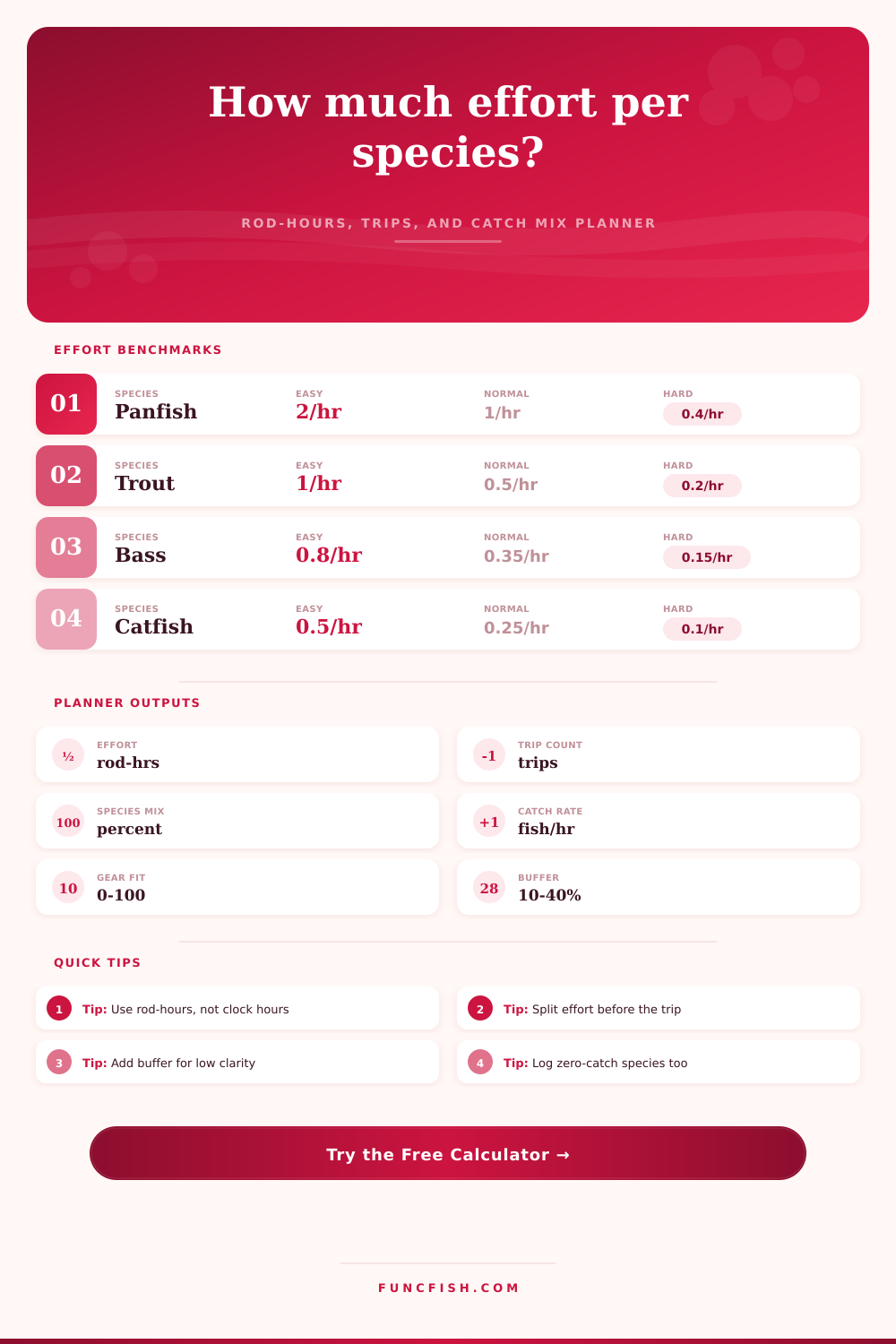
Compare species with rod-hours. A two-angler trip with two active rods for four hours is sixteen rod-hours, even though the clock only shows four hours on the water.
Keep the buffer visible. Add a larger buffer when search time, water color, boat traffic, or seasonal timing could push the real catch rate below the baseline.
If we’re being honest, most of us make our fishing plans by time. We wake up when the sun rises, putz around loading truck and then count the hours on the water until dark when we finally pack up and head home. While that seems like an easy way to do things, it’s an approach that completely overlooks the metric which determine whether or not you catch fish.
How well you do is determined by how hard you work, how many hours are your lines actualy fishing? Catching fish isn’t about sitting in a boat because the fish do not care about that. They only care about what you show them. So use the calculator above to turn your fuzzy ideas into actual numbers, how many rod-hours should I fish?
Think About Rod-Hours
Once you start thinking in those terms, everything changes: Every trip, you’ll know exactly how much effort go into catching your fish. But it’s really just a simple idea at its core. With two anglers each using their own rod, four hours becomes 16 rod-hours of possible fish contact time.
Your brain will remember it as a long day and the clock will show four hours have gone by but all the fish give a hoot about is that bait. Now take away thirty percent for fighting the wind or looking for something to throw to and now you’ve cut way down on how much time you’re actualy fishing.
This is where tool comes into play. You can set what percentage of your time are spent searching. It makes you admit that not every minute spent on the water is the same, and admitting that is often the first step to catching more fish.
Your gear has a huge impact on efficiency. A heavy trolling rig isn’t going to be treated like an ultralight panfish stick. And you don’t want to use light line for heavy-cover bass fishing, that will result in lost fish. The reference table on the page provides starting point to see where the match-up makes sense.
Trying to throw a stiff baitcasting rod at small creek trout seems cumbersome and slows down your presentation, reducing your cast/hour output. So results help quantify how much of a mismatch you are making with the gear. It is about more than holding proper rod; it is about putting the most efficient tool in your hands to increase casting speed and hook-setting power for target species.
These expectations gets skewed by water conditions as well. Clear water and bright sun may seem like they’d be prime conditions for taking that great photo. However, all too often those same conditions drives fish deeper and harder to find.
The calculator uses multipliers for bite conditions to adjust your expected results lower when the weather goes tough. Too often anglers will blame their bad luck on something that’s really nothing more than basic biology. Light levels and barometric pressure affects fish behavior. Since the weather won’t change, you have to adjust your budget for effort to match.
A buffer for planning takes into account the inevitable variables. It allows you to keep expectations realistic and avoid burning out if things goes sour after a slow start to the day.
Some folks has trouble dividing focus among several different species. They’d like some panfish action for numbers, but they also want to catch bass for the fight. Before you get out on the water, the tool prompts you to set an effort split. That way, the secondary target won’t steal time away from the primary target through the back door.
If you don’t establish a split, you may end up sitting in the boat for hours chasing shadows rather than really working your primary target. Settling on a split, such as sixty-five percent for bass and thirty-five percent for panfish…
Establishes a disciplined approach. You’ll check the clock, you’ll change tactics, you’ll keep yourself on task.
At the end of the day it’s all about probability. It is risk versus reward. And that’s where the calculator comes into play. It gives you a framework for how you manage that risk. It removes the romance from chasing sunrises and puts numbers behind the bite. Where it helps you determine if a three trip plan makes sense or if you should shift your focus. It helps make you a more efficient angler.
Once you begin to think in terms of rod-hours instead of clock hours, you are not wasting any time out there. You’re starting to count contacts. This change of perspective turns a casual outing into a successful campaign. You should of used this sooner.