🐟 Live Bait Freshness Calculator
Estimate how long your live bait will last based on type, temperature, and storage conditions
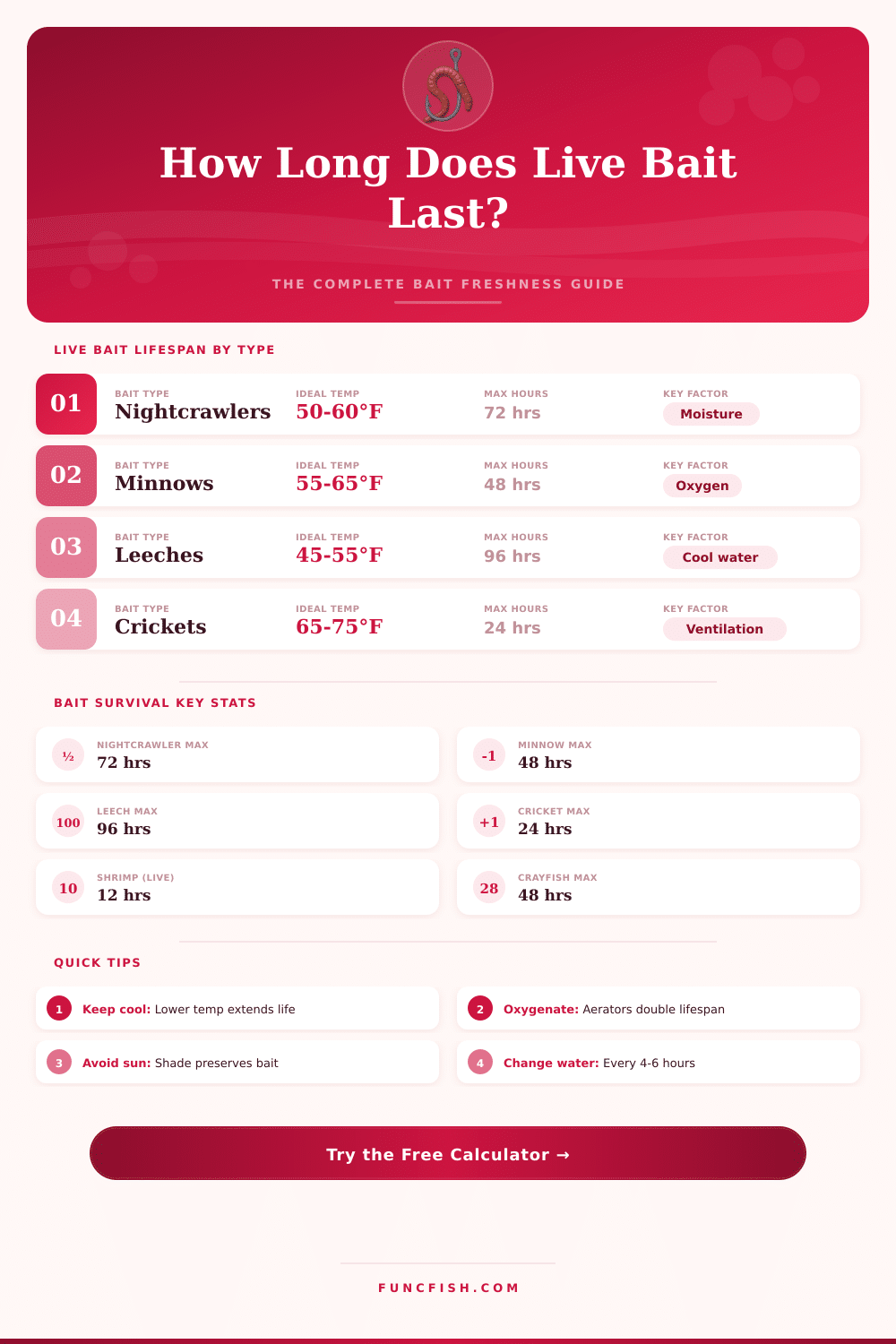
| Bait Type | Ideal Temp (°F / °C) | Max Lifespan (Ideal) | Lifespan at 80°F (27°C) | Critical Temp (°F) |
|---|---|---|---|---|
| Nightcrawlers | 50–60°F / 10–16°C | 72 hours | 6–12 hours | >75°F |
| Minnows | 55–65°F / 13–18°C | 48 hours | 4–8 hours | >78°F |
| Leeches | 45–55°F / 7–13°C | 96 hours | 8–16 hours | >72°F |
| Crickets | 65–75°F / 18–24°C | 24 hours | 12–18 hours | <50°F |
| Live Shrimp | 60–70°F / 16–21°C | 12 hours | 3–5 hours | >80°F |
| Crayfish | 55–65°F / 13–18°C | 48 hours | 6–10 hours | >80°F |
| Waterdogs | 50–60°F / 10–16°C | 72 hours | 10–18 hours | >75°F |
| Bluegill (Live) | 55–68°F / 13–20°C | 36 hours | 5–10 hours | >82°F |
| Storage Method | Lifespan Multiplier | Best For | Key Requirement |
|---|---|---|---|
| Bucket (No Aerator) | 1.0x (baseline) | Short trips (<4 hrs) | Change water every 2 hrs |
| Livewell (Aerated) | 2.0–2.5x | Minnows, shrimp | Recirculate & aerate |
| Cooler w/ Ice | 1.5–2.0x | Worms, leeches | Drain melt water |
| Ventilated Container | 1.2–1.5x | Crickets, crayfish | Airflow, no direct sun |
| Styrofoam Box | 1.3–1.8x | Worms, leeches | Keep sealed & cool |
| Pure O2 System | 3.0–4.0x | Minnows, shrimp | Proper O2 regulation |
| Bait Type | Primary Target Species | Typical Hook Size | Recommended Qty / Trip |
|---|---|---|---|
| Nightcrawlers | Bass, Catfish, Walleye, Trout | #4 – #1/0 | 24–48 worms |
| Minnows | Walleye, Pike, Bass, Crappie | #4 – #2 | 2–3 dozen |
| Leeches | Walleye, Smallmouth Bass, Trout | #4 – #6 | 1–2 dozen |
| Crickets | Bluegill, Sunfish, Crappie | #8 – #10 | 50–100 crickets |
| Live Shrimp | Redfish, Flounder, Speckled Trout | #1 – #2/0 | 2–3 dozen |
| Crayfish | Smallmouth Bass, Catfish, Trout | #2 – #1/0 | 12–24 crayfish |
| Waterdogs | Largemouth Bass, Pike, Catfish | #1/0 – #3/0 | 6–12 waterdogs |
| Bluegill (Live) | Largemouth Bass, Pike, Muskie | #2/0 – #4/0 | 4–8 bluegill |
| Bait Type | Max per 1 Gal (3.8L) No Aerator | Max per 1 Gal Aerated | Ideal Water Change Interval |
|---|---|---|---|
| Nightcrawlers | 50–75 worms | N/A (soil-based) | Not applicable (soil) |
| Minnows (2–3 in) | 8–12 minnows | 20–30 minnows | Every 4–6 hours |
| Leeches | 20–30 leeches | 40–60 leeches | Every 8–12 hours |
| Crickets | 30–50 (dry) | N/A (air-based) | Not applicable |
| Live Shrimp | 4–6 shrimp | 12–18 shrimp | Every 2–3 hours |
| Crayfish | 10–15 crayfish | 20–30 crayfish | Every 6–8 hours |
Keeping bait in good shape is one of the most hard tasks for any angler. Healthy and active worm moves naturally and gives off scent that attracts many species of fish. If the bait stays fresh one saves money and cuts the costs on the hook because of the need to buy it again.
live bait like minnows can be very sensitive. One should do changes of temperature slowly, when one moves them from one place to another. Also airflow matters a lot.
How to Keep Bait Fresh
A small pump that keeps the water rich in oxygen helps a lot. Clearly fish used as bait, for instance shiners, last only some hours without steady flow of fresh water.
In warm tropical regions three main factors quickly kill the bait. Ammonia builds up when the fish pee in the water. The amount of oxygen drops.
And the temperature rises. All those three things work against the angler. Insulated cooler tin help to keep stable heat and extend the life of bait compared to regular metal versions.
Freeze bottles with water overnight before fishing is a simple and cheap way to keep minnows cold. Cold water is probably the most important thing for the survival of minnows. During winter, bait lasts much better on its own.
A livewell keeps the bait fresh all day. A live tank circulates the water too stop fish from dying. The choice of the right model depends on the size of the boat and the style of fishing.
One angler managed to keep a fish alive for a whole week in a tall round livewell, thanks to shade and sinking to the bottom, where the water was cleaner.
When one does not use the bait, keeping it in the fridge is the best method. Worms, stored with a bit of dirt in their box, can stay up to a month in the fridge. Salted bloodworms frozen work just as well as fresh in comparison tests.
For bonito and similar fish, wrapping round and freezing them keeps them useful even a year later. Some folks simply freeze whole fish in plastic bags, and those last months.
Dried baits get a big boost in their shelf life thanks to glycerin. Mix the liquid evenly over boilies and it adds at least three months to their life. Unopened PowerBait has a shelf life of around three years.
Some baits, like boilies from shellfish, dry out and crack after they pass their best date.
Canned bait, soaked in preservative for fourteen days, can be stored without a fridge anywhere. Fresh dead bait usually is much better than frozen in most situations. Artificial baits avoid all issues about keeping, because one does not need them live.
Fishbites stay on the hook longer than natural bait and are much easier to use. Ragworms should be bought as close to thefishing moment as possible, because they do not last forever.