🐟 Fish Growth Rate Calculator
Estimate fish size by age, annual growth, and projected weight for freshwater & saltwater species
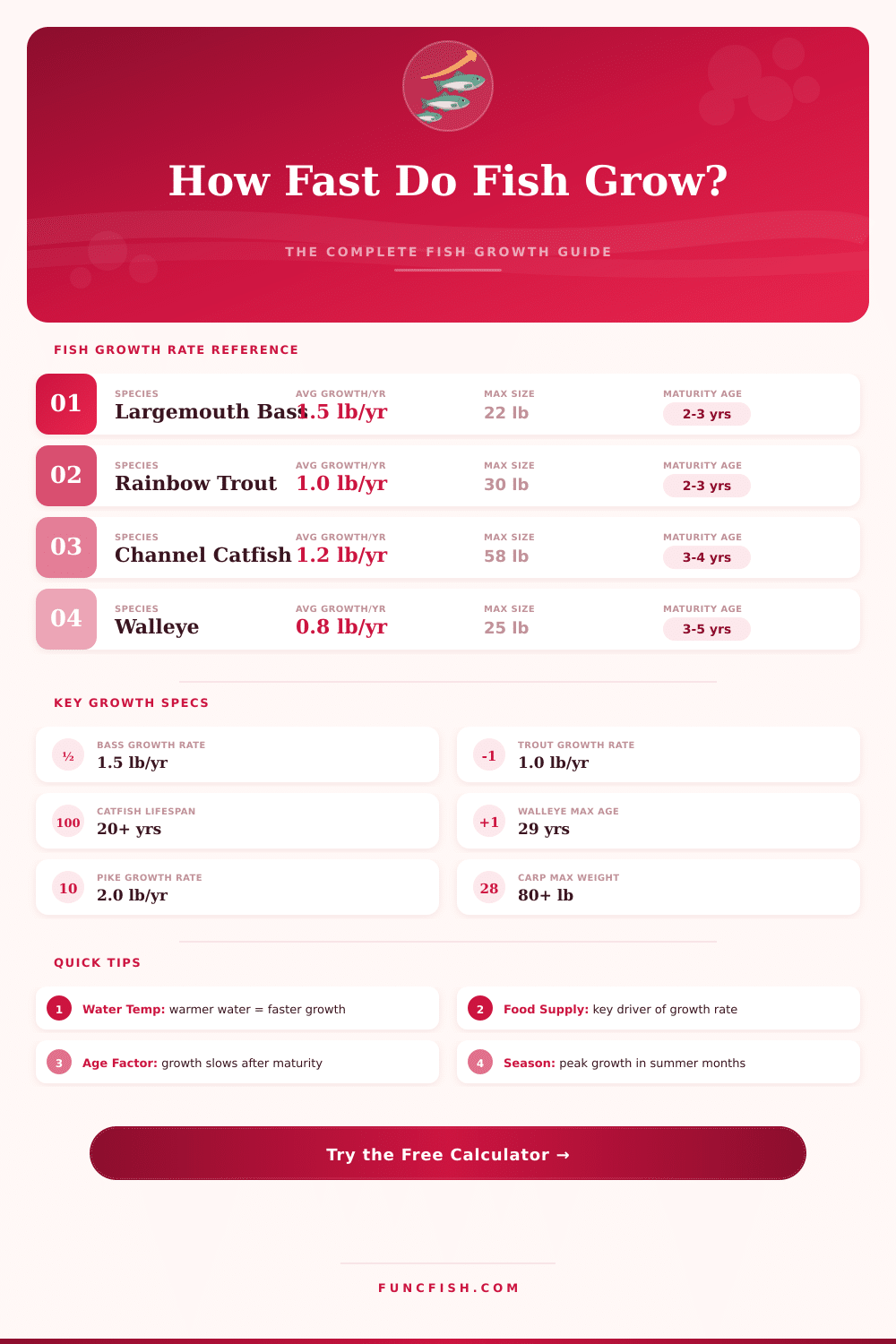
| Species | Avg Growth/Yr | Max Weight | Max Age |
|---|---|---|---|
| Largemouth Bass | 1.5 lb / 0.68 kg | 22 lb / 10 kg | 16 yrs |
| Smallmouth Bass | 0.9 lb / 0.41 kg | 12 lb / 5.4 kg | 20 yrs |
| Rainbow Trout | 1.0 lb / 0.45 kg | 30 lb / 13.6 kg | 11 yrs |
| Brown Trout | 0.8 lb / 0.36 kg | 44 lb / 20 kg | 20 yrs |
| Channel Catfish | 1.2 lb / 0.54 kg | 58 lb / 26 kg | 24 yrs |
| Walleye | 0.8 lb / 0.36 kg | 25 lb / 11.3 kg | 29 yrs |
| Northern Pike | 2.0 lb / 0.91 kg | 55 lb / 25 kg | 25 yrs |
| Muskellunge | 2.5 lb / 1.13 kg | 70 lb / 31.8 kg | 30 yrs |
| Bluegill | 0.5 lb / 0.23 kg | 4.5 lb / 2 kg | 11 yrs |
| Crappie | 0.4 lb / 0.18 kg | 5 lb / 2.3 kg | 15 yrs |
| Striped Bass | 2.5 lb / 1.13 kg | 67 lb / 30.4 kg | 30 yrs |
| Common Carp | 3.0 lb / 1.36 kg | 80 lb / 36.3 kg | 47 yrs |
| Condition | Multiplier | Description | Example |
|---|---|---|---|
| Poor | 0.55x | Cold, low food, stressed | High altitude stream |
| Average | 0.80x | Typical lake conditions | Northern reservoir |
| Good | 1.00x | Warm, ample forage | Southern lake |
| Excellent | 1.30x | Optimal food & warmth | Fertile farm pond |
| Habitat | Modifier | Reason | Growth Impact |
|---|---|---|---|
| Pond/Small Lake | 0.95x | Limited forage diversity | Slight reduction |
| Large Lake | 1.00x | Baseline benchmark | Standard |
| River/Stream | 0.90x | Energy spent fighting current | Moderate reduction |
| Cold Stream | 0.75x | Cold temps slow metabolism | Notable reduction |
| Saltwater | 1.10x | High forage availability | Slight increase |
| Species | Length 10 in / 25 cm | Length 15 in / 38 cm | Length 20 in / 51 cm | Length 25 in / 63.5 cm |
|---|---|---|---|---|
| Largemouth Bass | 0.6 lb / 0.27 kg | 1.8 lb / 0.82 kg | 4.3 lb / 1.95 kg | 8.6 lb / 3.9 kg |
| Rainbow Trout | 0.4 lb / 0.18 kg | 1.3 lb / 0.59 kg | 3.1 lb / 1.41 kg | 6.5 lb / 2.95 kg |
| Walleye | 0.3 lb / 0.14 kg | 1.2 lb / 0.54 kg | 3.5 lb / 1.59 kg | 7.5 lb / 3.4 kg |
| Northern Pike | 0.5 lb / 0.23 kg | 1.6 lb / 0.73 kg | 4.2 lb / 1.9 kg | 10.5 lb / 4.76 kg |
| Channel Catfish | 0.5 lb / 0.23 kg | 1.5 lb / 0.68 kg | 4.0 lb / 1.81 kg | 9.0 lb / 4.08 kg |
The growth rate of fishes depends on many factors that work together. It is a natural physiological reaction that considers outer conditions as quality and amount of food, temperature, water quality, and also internal state as health, stress and breeding. It commonly binds with survival of young fishes so well understand it genuinely matters
Fishes in warm regions that live short lives have determinate type of increase, while long-lived species from cold areas show indeterminate. You measure it by length and weight, and best describe by specific growth rate. Indeterminae increase have fishes, whose bones continuously expand during whole life, although the rate slows while they age and go to zero.
What Affects Fish Growth
From data about size and age you count growth rates. By means of length-at-age key it is possible to estimate age of other fish according to its length. You estimate the rate from changes of length and weight at one-year fish.
For population analysis, use a mathematical formula that gives size for any age.
Individuals of same species grow differently according to places. Seasonal temperatures seriously affect the increase. Higher temperature commonly boosts it.
Also size of tank or habitat plays a role. Ocean fishes have abundant pure water, but yet shrink because of excessive density. So sufficient water does not compensate absence of space.
Studies about fry show that they grow more slowly without sufficient room.
Good quality food gives better nutritious balance and more limiting nutrients, what strengthens increase. Switching between foods help to reach that. Alive or whole foods in rotation commonly surpass ready, because those use alike cheap ingredients.
In pools with 50-60 pounds of perch for acre commonly happen slow rates, while fast appear at 10-20 pounds. Similarly happen with largemouth bass. Edible fishes as salmon, cod, bass and flounder reach maturity and adult size in 2-5 years, although they continuously grow slowly later.
Goldfish reach half of final length in 18 months. After two years increase slows, and after five years it is extremely slow. Overfishing cause resource depletion and reduced biological rates.