Aggregate Limit Calculator
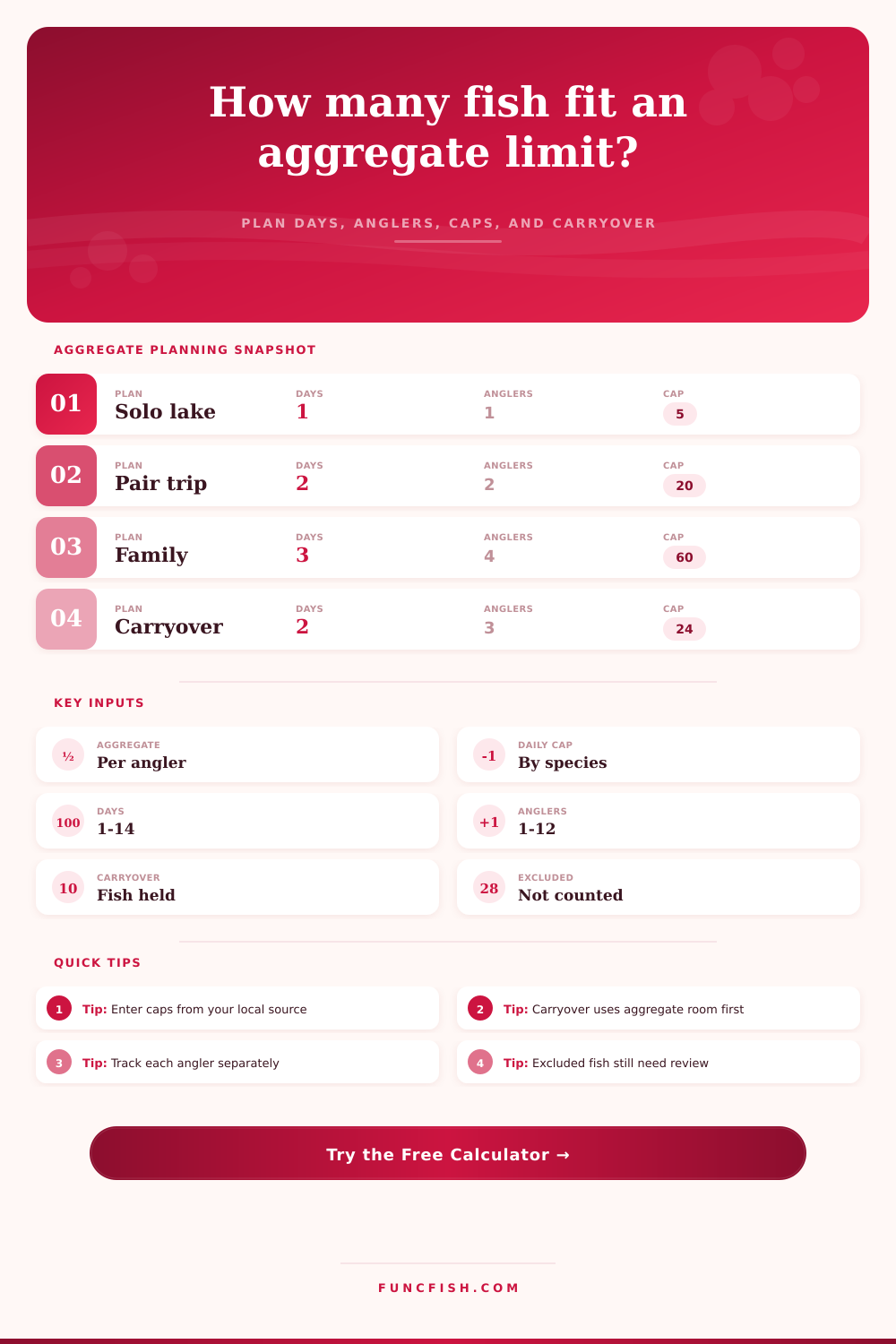
Estimate how a user-entered aggregate cap, daily species caps, fishing days, anglers, carryover possession, kept fish, and excluded species interact.
📌Named aggregate-limit presets
⚙Trip and cap inputs
🐟Kept fish and daily caps by species group
Aggregate limit forecast
Full breakdown
🧰Gear and species comparison grid
Cooler Log
Angler Tags
Species Slots
Carryover Bin
📋Reference tables
| Input | What it represents | How calculator uses it | Common audit check |
|---|---|---|---|
| Aggregate cap | Maximum counted fish per angler | Multiplied by anglers, then reduced by carryover | Confirm the cap applies to the same species mix |
| Daily cap | Species-group take per angler per day | Multiplied by fishing days and anglers | Check separate caps before pooling groups |
| Carryover | Fish already in possession | Consumes aggregate room before new keepers | Include frozen, stored, or transported fish if applicable |
| Excluded species | Fish not counted in the entered aggregate | Shown separately from aggregate slots | Do not assume excluded means unrestricted |
| Planning mode | Primary constraint | Best use | Output behavior |
|---|---|---|---|
| Conservative cap | Lower of aggregate room and daily cap total | Mixed waters or uncertain trip plans | Shows the smaller remaining number |
| Daily-cap view | Species-group daily ceilings | Checking which species group is tightest | Highlights daily overages first |
| Possession view | Aggregate cap after carryover | Cooler, freezer, cabin, and vehicle counts | Emphasizes held fish and cushion |
| Tagged group | Per-angler ownership clarity | Groups that store fish together | Adds a separation reminder to results |
| Species pattern | Aggregate behavior | Daily cap pressure | Tracking approach |
|---|---|---|---|
| Two similar gamefish | Usually share the same counted pool | Medium | Use separate rows with included status |
| High-volume panfish | Can fill group room quickly | High | Track kept count before sorting cooler |
| One excluded species | May sit outside the aggregate entered here | Varies | Record count and label separately |
| Carryover from prior day | Reduces room before new fish are kept | High | Mark stored fish by date and angler |
| Trip size | Suggested cushion | Why it matters | Calculator field |
|---|---|---|---|
| Solo day | 0 to 1 fish | Small counts are easy to audit | Planning cushion |
| Two anglers | 1 fish | Prevents one mistaken count from filling the cap | Planning cushion |
| Family group | 2 fish | Multiple hands can mix fish quickly | Planning cushion |
| Remote multi-day | 5 fish | Carryover and stored fish compound across days | Planning cushion |
💡Practical planning checks
Tip: Treat the aggregate result as a trip-planning check, then compare each species row to current local rule text before keeping fish.
Tip: When fish are shared in one cooler, write the angler name, species group, date, and count before the next fishing day starts.
So if the cooler is full then the aggregate limit eliminates any questions over whose fish is what. Not only does it apply to your daily catch but also to the total number of fish that you may have possession of. Before reaching for a cooler make sure you know the total limit you’re under. If there is more than one angler or more than one species involved, it get tricky.
Luckily someone created a calculator that takes care of that stuff for you. All you do is put in group size and your local limits. It will do the rest for you and save you from keeping track of all of them in real time.
Why You Should Use the Fishing Calculator
You’ve got a total limit that becomes your bucket of allowable catch. That could be across multiple species and/or multiple days. For example, if your bucket contains 10 fish and you fill five with walleyes, then you still have five available slots for whatever else you may catch.
And note, this isn’t based off what you caught today but rather what you currently have. This prevents maxing out on one species and going over your overall cap. If you’ve kept fish in the cooler and/or freezer from a prior day, that’s accounted for by the tool as well. It deducts the amount of fish you’re carrying over from your available space.
A lot of folks overlook this aspect. When you go fishing on Sunday, every fish you froze from Saturday take up one space. You don’t want to ignore your carry-over fish because it can cause you to get in an unintentional over-limit situation. See how your carry-over fish will reduce your available room in the reference table.
The big total cap excludes certain species. Typically, they has special regulations or a limit of their own. Know what species aren’t part of the aggregate. The excluded species don’t eat up your total spots. They keep their possession or daily limit. Many people think excluded means unlimited. This is not often true. Keep a running tally on these fish.
Liability increases when fishing with other person. Each person tosses their bag into the same bucket. Typically the total limit is what counts, so it all gets lumped together. Someone has to be responsible for tracking possession.
The calculator lets you model pooled coolers versus tagged bags, which helps you see where the risk lies. Pooled coolers and tagged bags can both be modeled on the calculator. Doing so allow you to visualize risk.
A single miscalculation at the end of the day fill up someone else’s bucket. That’s why there is a bit of a planning cushion built-in. If a few fish aren’t labeled or get counted wrong, having that extra one or two provide a cushion. It isn’t pessimistic. It’s simply adding a safety margin.
Depending on which mode you’re in, it will show either your daily cap or your aggregate room (lower number) in conservative mode. This is safer for uncertain trips. In possession mode, it will show you the total bucket including carryover. That’s good to use if you want to check how much fish you have in your vehicle or freezer. Pick whichever mode matches your main concern.
If you are worried about exceeding a daily limit, then use the daily view. If you’re worried about having too much fish in the boat at the end of the week, then use possession view.
To avoid fines and keep the fish It is math. It is a safety net. Still, check with your local regulations for your particular water body. The rules do differ. Set up your trip parameters in advance so you can use the calculator to preload your trip. How many slots do I have left? Now you’ll know exactly where you stand.
That’s peace of mind worth the time it takes to input numbers. No more worrying about whether or not you’re going to get busted at the cooler; now you can focus on the fishing. You should of checked your limits earlier though. It actualy helps naturaly with a luxurius trip.