Air Exposure Survival Calculator
Estimate short-term release survival from air exposure, species sensitivity, water and air conditions, fight time, fish size, handling gear, and fish condition before release.
📌Air exposure presets
⚙Exposure inputs
Air exposure survival estimate
Calculation breakdown
🎣Species and gear grid
Coldwater Trout
Bass
Walleye
Large Pike
Muskie
Redfish
Bonefish
Catfish
📊Reference tables
| Species group | Baseline safe air window | Stress water temp | Air sensitivity | Field note |
|---|---|---|---|---|
| Brook and rainbow trout | 10-25 seconds | 65 F / 18.3 C | Very high | Coldwater species lose margin quickly in warm air. |
| Salmon | 15-30 seconds | 62 F / 16.7 C | Very high | Spawning and long fights narrow the window. |
| Bass | 35-70 seconds | 84 F / 28.9 C | Moderate | Quick photos are usually lower risk in mild weather. |
| Walleye | 25-50 seconds | 76 F / 24.4 C | High | Deep or warm catches deserve shorter handling. |
| Catfish and carp | 55-100 seconds | 86 F / 30 C | Lower | Durable fish still benefit from wet surfaces. |
| Handling gear | Slime protection | Drying multiplier | Best use | Caution |
|---|---|---|---|---|
| In-water cradle | Excellent | 0.55x | Large toothy fish | Keep head supported and calm. |
| Rubber landing net | Very good | 0.72x | Trout, bass, walleye | Do not leave fish suspended. |
| Wet unhooking mat | Good | 0.78x | Carp and bank fishing | Rewet mat between fish. |
| Wet hands | Fair | 0.92x | Short lifts | Avoid squeezing gills or belly. |
| Dry carpet or hands | Poor | 1.25x | Emergency only | Removes slime and dries gills faster. |
| Condition | Effect | Calculator adjustment | Practical response | Risk signal |
|---|---|---|---|---|
| Cool, humid, calm | Slower gill drying | -10% to -25% load | Still keep handling brief. | Low |
| Hot air over cool water | Thermal shock | +8 to +24 points | Measure fast, release faster. | Moderate |
| Dry wind | Fast evaporative drying | +10% to +40% load | Keep fish in net or water. | High |
| Long fight | Oxygen debt | +5 to +35 points | Revive in clean moving water. | High |
| Gill touch or bleeding | Injury stress | +18 to +35 points | Minimize extra air time. | Critical |
| Survival estimate | Band | Air-time interpretation | Release priority | Next choice |
|---|---|---|---|---|
| 90-100% | Excellent | Well under adjusted cap | Normal release | Return quickly. |
| 75-89% | Good | Near working limit | Short revive | Skip extra photos. |
| 55-74% | Guarded | Stress likely | Water support | Reduce handling next fish. |
| 35-54% | High risk | Air time too long | Immediate recovery | Keep fish submerged. |
| Below 35% | Critical | Severe exposure load | Emergency release | Do not add delay. |
💡Practical tips
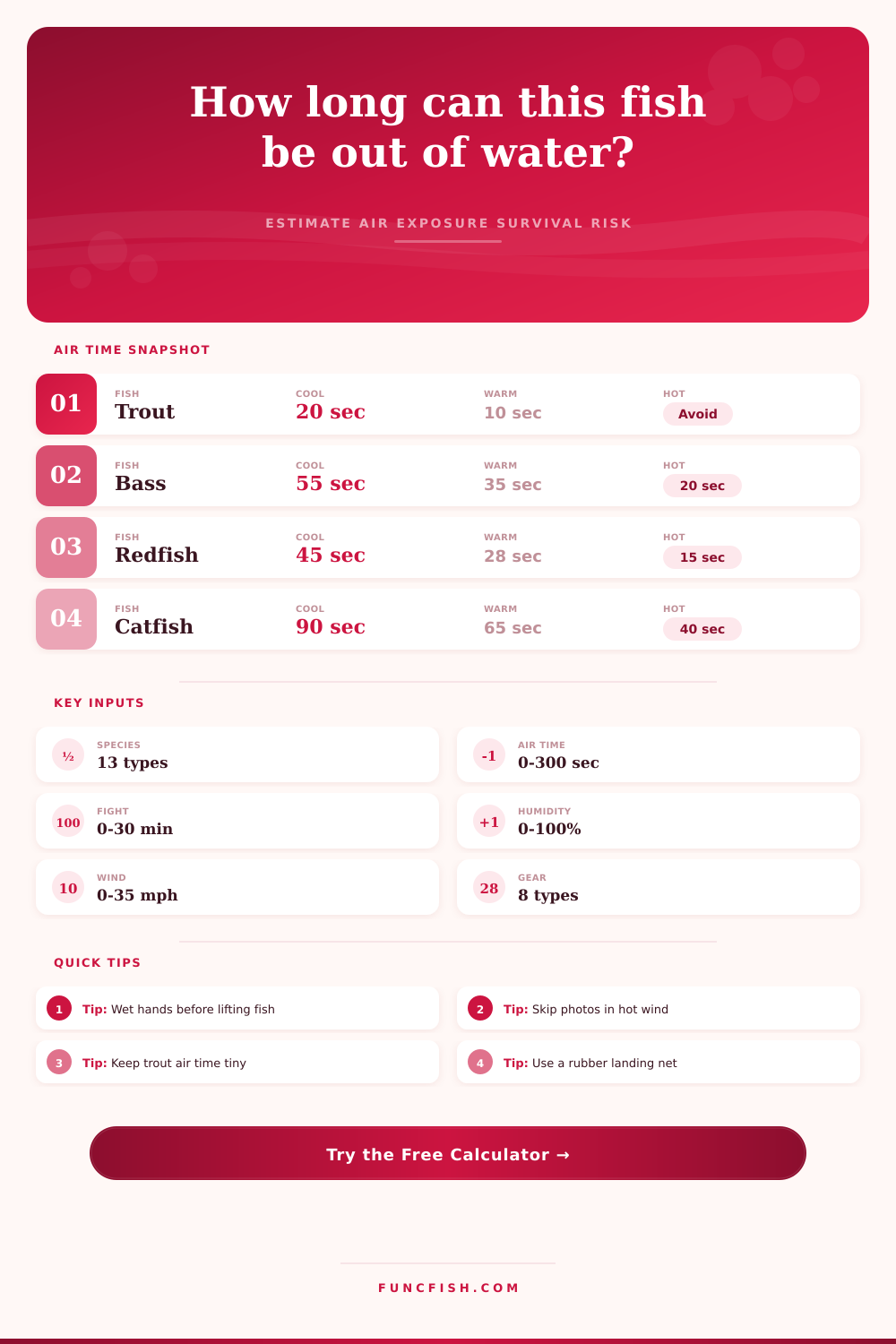
Tip: Start the clock when the gills leave the water, not when the camera comes out. Multiple short lifts still add up in the calculation.
Tip: Hot air, low humidity, and wind dry gill tissue faster. In those conditions, treat the calculator's recommended cap as a hard ceiling.
Gill function depends upon moisture (water) so fish will die rapidly when exposed to air. Handling a fish momentarily seems harmless, yet gill collapse and stick together without water.
To help avoid guessing drying rates and physiological limits, this calculator (above) estimates survival chances depending on gear used, species, and weather conditions. How long fish survive depends upon each species’ starting point. In this case, coldwater specialists such as trout and salmon has high metabolism needs and don’t do well out of water. Species like carp and catfish is harder to kill and can withstand being out of water longer.
How to Keep Fish Alive
The catch is these parameters vary depending on the conditions of the day. According to the reference table, a trout’s survival zone is limited to 20 seconds but a catfish could endure almost double then time.
The stress factor is greatly affected by temperature. When water is hot, the fish is already stressed from fighting to keep its internal systems cool. Air exposure makes this worse. The calculator factors in air vs. Water temps.
Dry, hot air removes slime coat quicker. Slime coat is a barrier to parasites and bacteria. Moist air prevents evaporation it buys you time. Dry air removes moisture quickly. This decreases your odds of success.
The rate at which they dry also depends on wind. If it’s a hot afternoon with a hard blow and you handle them then, they won’t last as long as if handled first thing in the morning when it’s calm and more humidly. Wind dries out the gills by speeding up how fast moisture evaporates off their gill filament surfaces, fusing them together in the process. Gills fused will not be restored simply by placing them back into water. They require clean, oxygen-rich water to re-hydrate.
Keeping fish wet is done by unhooking mats and/or rubberized nets. Scraping skin with mesh nets is something best avoided. This tool changes the survival estimate depending on level of physical stress your tools cause.
The other wrinkle is how much you fought the fish. Exhaustion increases impact of air exposure and uses up energy reserves. A fatigued fish lack the ability to control its buoyancy and is slow to rebound. That’s why fight time carries a lot of weight in the calculator.
Each additional second out of the water add to the cost of being out of water. We want the fish to be released in good shape. If you have a 90% or better survival rate, chances are the release went well. Under 75%, there is a serious threat to the survival of the fish. Consider those percentages as a guideline.
Get that picture fast! Wet your hands. Hold the fish correctly. When that fish swims away, you will feel even more satisfaction.
Each second is critical. Patience for a few seconds can make all the difference. From the moment the gills leave water, it’s game on. You should of known every second counts.