
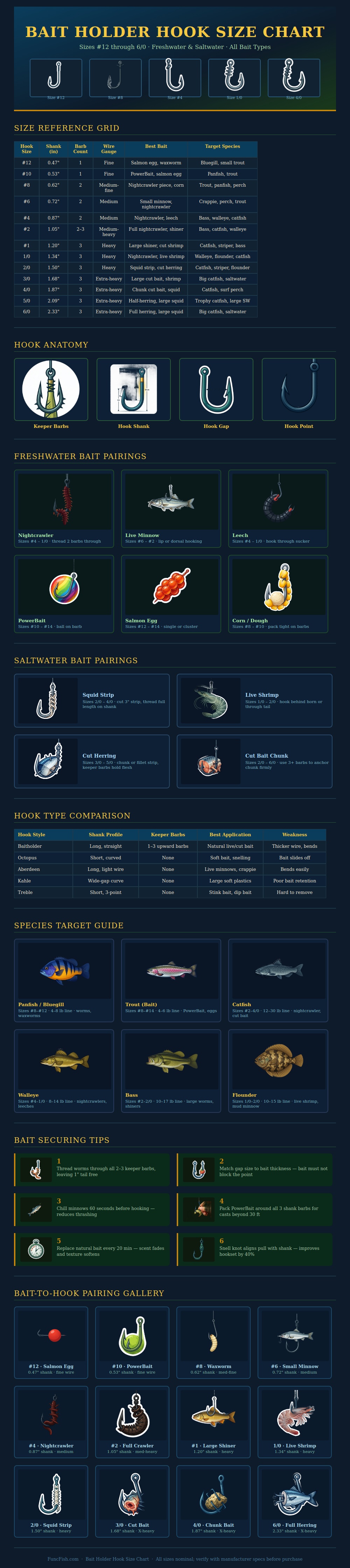
With this kind of organization in place, you don’t have to guess what goes where in your tackle box. Most anglers don’t believe all hooks is created equal; instead, they treat them as if they are interchangeable. But they change sizes without considering shank length and gauge of their wire. This is where folks go astray. They look at the size number, but that tells you little about the actual strength of the hook. A size six on the spool may appear tiny, yet how thick is the wire? Does it have a huge diameter due to its design, intended for heavy bass casting? Or was it made specificly for lightweight trout fishing? These differences are detailed in this infographic.
It groups certain sizes, such as a size four with medium wire and two barbs, which are perfect for keeping nightcrawler hooked up when walleye fishing. Yet if you apply that same hook to a gentle panfish bite, the hookset force becomes too strong and the line tear or snaps clear from the fish’s mouth.
How to Choose the Right Hook for Your Bait
The first step to selecting the proper bait holder hook is knowing what’s going on inside the hook. The short version is that the little up-pointing teeth on the shank are called keeper barbs. Their only function is to hold your bait in place as you make the cast and as it drift along in current. If you don’t have any, then you’re hoping and praying that surface tension will keep it in place. As the chart indicates, bigger hooks generally has more than two… Up to three, especially anything over size two. That’s because a big chunk of cut bait or live shrimp weighs something, and needs some extra anchor spots to fight gravity and current pulling it down. It works for a reason, and if you ignore it, you will see many empty hook long before you reach the target depth.
Saltwater For saltwater, we’re looking at baits that are more rigid and have a lot more body density such as chunks of herring or squid strips. Because those baits is more dense, you can get away with much more aggressive threading on bigger hooks like a four-zero or three-zero. That’s why those big gauges of heavier wire are paired with the bigger hook sizes here. Saltwater baits also don’t need a lot of holes. Since saltwater baits is tougher and denser, they can withstand the aggressive threading required on larger hooks that feature more than two barbs. They are night crawlers.
On the other hand, freshwater fishing is typically done with softer, more flexible baits such as leeches or worms. You’ll want to use fewer barbs and make sure not to pierce your bait too many times; otherwise, you’ll end up poking holes all the way through the bait. This will cause the bait to fall apart in water and release its scent too rapid. So when using soft baits, you’ll want to use fewer barbs to avoid puncturing them completely.
Bait retention is also a matter of timing. It is not about hook size, but about freshness. No matter what we do to rig our baits, naturaly baits will eventually lose both their texture and scent over time. To combat this, the guide advise using fresh natural bait every twenty minutes. This keeps the scent alive and ensures the bait doesn’t get so soft that it slips off of even the best barbed keepers. Another pro tip worth mentioning: chill your minnows for a minute prior to hooking them up. This not only helps prevent thrashing, but also keeps things clean. It seems small, but it could of make all the difference when you’re trying to keep your bait secure and your line neat while making long casts.
The whole idea behind matching your hook to your bait is to respect how a hook sets. Too small a shank will cause the bait to slide off, and if the gap is too large, the point never penetrate correctly. The chart shows that larger hooks and heavier wire have enough grip to stand up to the brute force of trophy-sized catfish. Smaller hook sizes, such as twelve or even ten, and a finer wire are intended for more subtle presentations like powerbait or salmon eggs. No need to commit each and every measurement to memory. Just know that the size of the hook determines how well it holds a certain type of bait based off its weight.
Then when you do land that fish, you can be sure it wasn’t dumb luck. You simply had the right tool for the job from the start.