Battery Runtime by Trolling Speed Calculator
Estimate trolling motor amp draw, usable battery energy, safe runtime, range, reserve time, and speed tradeoffs for electric fishing setups.
📌Scenario presets
⚙Battery, boat, and trolling inputs
Battery runtime estimate
Calculation breakdown
⚡Battery and motor comparison
Slower troll
Runtime at lower speed
0 hrEntered speed
Runtime at target speed
Faster troll
Runtime at higher speed
0 hrTrip margin
Planned time coverage
🔋Battery chemistry grid
Flooded Lead
AGM
LiFePO4
Older Bank
📊Battery usable capacity reference
| Battery type | Typical usable depth | Runtime behavior | Field note |
|---|---|---|---|
| Flooded lead-acid | 45% to 55% | Voltage drops under sustained high draw | Keep extra reserve on windy days |
| AGM deep cycle | 55% to 65% | Handles vibration and moderate current well | Good for mixed motor and electronics loads |
| Gel deep cycle | 55% to 65% | Prefers steady moderate discharge | Avoid repeated hard high-amp pulls |
| LiFePO4 lithium | 85% to 95% | Holds voltage flatter through the day | Best fit for long trolling sessions |
| Dual-purpose marine | 40% to 50% | Less ideal for deep cycling | Use conservative reserve settings |
🚤Trolling motor draw reference
| Motor class | Voltage | Max draw band | Common boat match |
|---|---|---|---|
| 30 lb thrust | 12 V | 25 to 32 A | Kayaks, jon boats, small ponds |
| 40 lb thrust | 12 V | 35 to 42 A | Light aluminum boats and skiffs |
| 55 lb thrust | 12 V | 45 to 55 A | Most bass, panfish, and utility rigs |
| 70 to 80 lb thrust | 24 V | 42 to 56 A | Windy lakes, walleye boats, bow mounts |
| 101 to 112 lb thrust | 36 V | 46 to 62 A | Large boats, current, offshore support |
🎣Species and technique runtime targets
| Fishing use | Typical speed | Runtime target | Reserve advice |
|---|---|---|---|
| Bass shoreline casting | 0.7 to 1.6 mph | 4 to 8 hours | Hold 20% for wind and returns |
| Walleye contour trolling | 1.2 to 2.2 mph | 3 to 6 hours | Watch draw in waves and current |
| Trout or kokanee troll | 0.9 to 1.8 mph | 4 to 7 hours | Slower speed stretches range sharply |
| Kayak inshore move | 1.5 to 3.5 mph | 1.5 to 5 hours | Keep reserve for tide or headwind |
| Spot-lock holding | 0 mph over ground | 2 to 6 hours | Corrections can draw like a slow troll |
⚖Runtime speed comparison table
| Speed change | Draw effect | Runtime effect | Best use |
|---|---|---|---|
| 0.3 mph slower | Often 15% to 30% less | Noticeably longer | Long weedline passes and battery saving |
| Target speed | Calculated draw | Baseline estimate | Normal lure action and boat control |
| 0.3 mph faster | Often 20% to 40% more | Shorter runtime | Covering water or fighting current |
| Spot-lock bursts | Variable pulses | Depends on wind | Anchoring over structure or bait |
💡Runtime notes
Reserve note: Keep a larger reserve when the ramp run, current, or wind direction could change. Batteries also deliver less usable energy when cold or aging.
Speed note: Trolling motor draw rises faster than speed. A small speed reduction can add meaningful runtime without changing your whole spread.
This is one of those all too common avoidable boat disasters: Your trolling motor is sputtering just three miles away from the boat ramp, and you’re panicking. It’s not always because the dang battery died. More often than not, it’s because no one checked how long the battery would last before they launched their boat. Most folks buy solely by amp hour number and find themselves surprised by physics.
The calculator above can do the math for you as soon as you plug in what works with your setup. You won’t have to guess about drag coefficients or voltage sag when you are waist deep in the weeds.
How to Calculate Your Trolling Motor Battery Life
“First off, you don’t use twice as much energy if you move twice as fast. That’s not how power works,” he says. You use three times or four times more energy because of hydrodynamic drag. Cutting a little bit off my trolling speed will actualy buy me quite a lot more run time without having to change my entire spread.
5. You may be able to get away with turning down a little on the trolling speed and let the current push you around a bit and still fish effectively. This buys you that little bit more fishing time, maybe even another hour. A little thing like that is huge when you’re trying to use every part of a piece of structure.
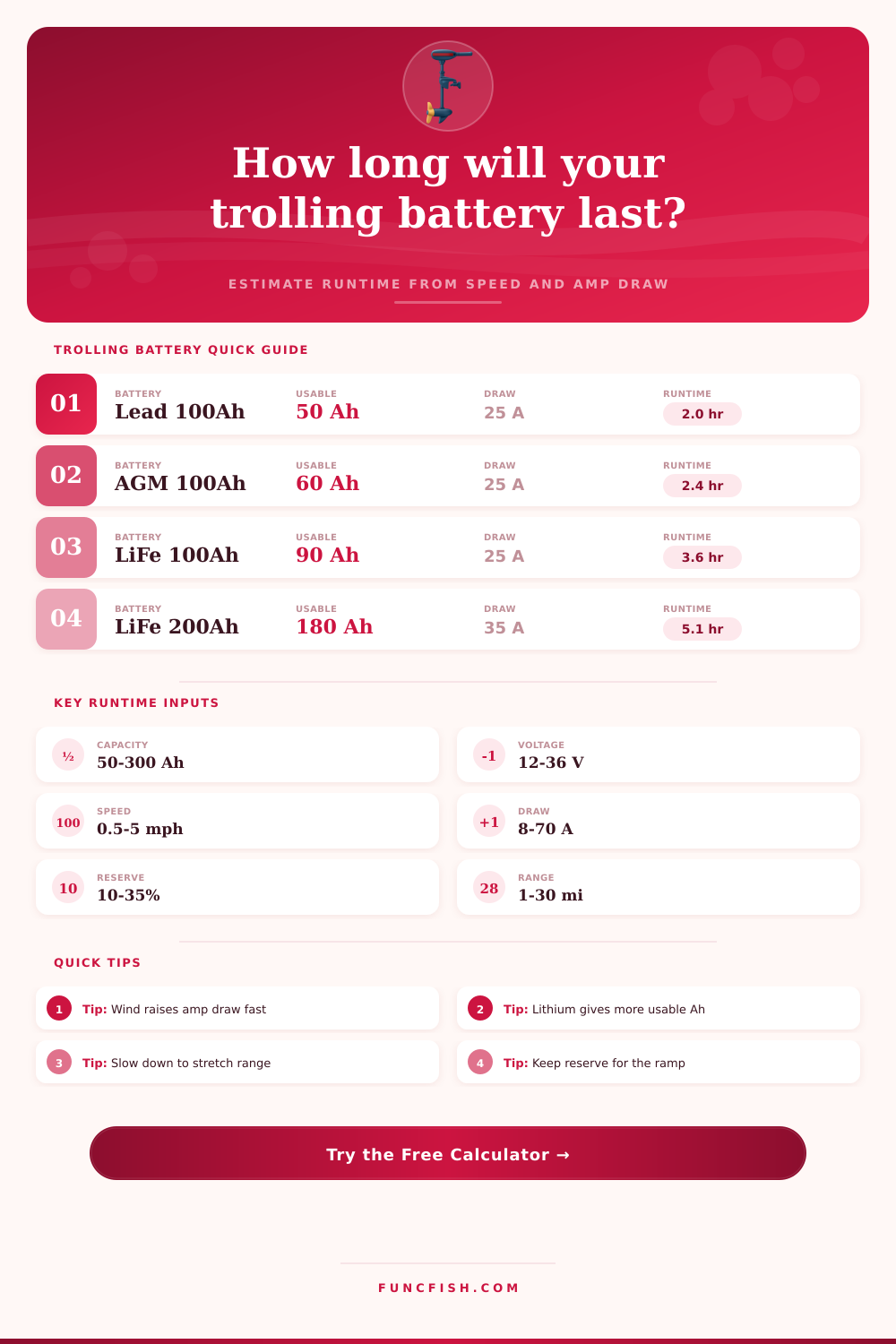
“The tool estimates your draw dynamically based off water conditions and your boat weight to give you something that’s closer to reality than some brochure best case scenario.” A typical flooded lead-acid battery may be rated at 100 amp hours, but you actually only get roughly 50 usable hours before it drops to a level that stalls your motor or damages the battery.
The thing that people miss when they compare prices is that you can use almost 90 percent of a lithium iron phosphate battery’s capacity without worrying about damaging it, while still keeping a flat voltage. In other words, a cheaper lead-acid battery may look like it has more capacity on paper, but it actually provides less once you consider its reserve and usable depth. It’s not uncommon to find that a single lithium unit lasts longer than two older ones combined through a season.
But most importantly: You should always have at least 20 percent of your battery energy kept as extra capacity, it’s not a cushion, but rather an insurance policy against the unexpected headwind that blows up on you halfway through the day. If it gets rougher than expected out there, you’ll want some extra juice to battle a current around the ramp or even just make it home with gas in your tank. That is why the calculator will automatically remove that reserve for you.
You’ll only see safe runtime, never a theoretical maximum. And that’s what keeps people from being falsely confident when they see a raw number, because in real life, your cooler fans, rod lights and fish finders is all taking tiny sips of energy off the same bank and slowly, but surely depleting it.
While rating does matter, age matters even more: an old deep cycle battery may well pass a static test with 100 amp hours, but it won’t perform well under load, nor provide much current when needed. Efficiency drops as voltage drops. The reference tables on the page make this obvious, as mixing chemistries and/or having older batteries in a bank reduces your effective runtime quite a bit. Don’t parallel old and new batteries either, as the new one will do all the work until it dies, at which point the old ones dies fast.
Wind increases amp draw quickly because now your motor is pushing against something instead of gliding, so plan for the worst case scenario, not the best. The calculator has input fields for adjusting for wind and current, but if it looks like there’s going to be a breeze in the prediction, reduce the runtime by a third just to be safe.
Trust the math, keep your reserve sacred, and remember, slow is fast; it’s always better to dock up early with plenty of juice left than to get stuck running low and having to wait for a tow. You should of planned better if you want more run time.