Black Marlin Weight Calculator
Estimate black marlin weight from lower jaw fork length, widest girth, body depth, ocean basin, sex and maturity, visible condition, confidence, and unit system.
📌Black marlin presets
⚙Measurements and marlin context
Model: this calculator starts with lower jaw fork length times girth squared for billfish, then blends a body-depth check and context factors for basin, maturity, condition, and measurement confidence.
Black marlin weight estimate
Results will appear after calculation.
Calculation breakdown
📊Black marlin shape grid
School-size black
Adult baitball fish
Heavy mature female
Grander track
Grid values are rounded field references in inches and pounds. Use the form for metric inputs and context factors.
🎯Billfish comparison grid
Black marlin
Deep shoulder, short heavy body, and very high top-end weight.
Blue marlin
Longer oceanic frame with large females carrying heavy girth.
Striped marlin
Slimmer body, smaller top end, and lighter weight at equal LJFL.
White marlin
Compact Atlantic billfish; much lighter than black marlin lengths.
Sailfish
Very fast, narrow body; depth and girth are far below marlin.
📑Reference tables
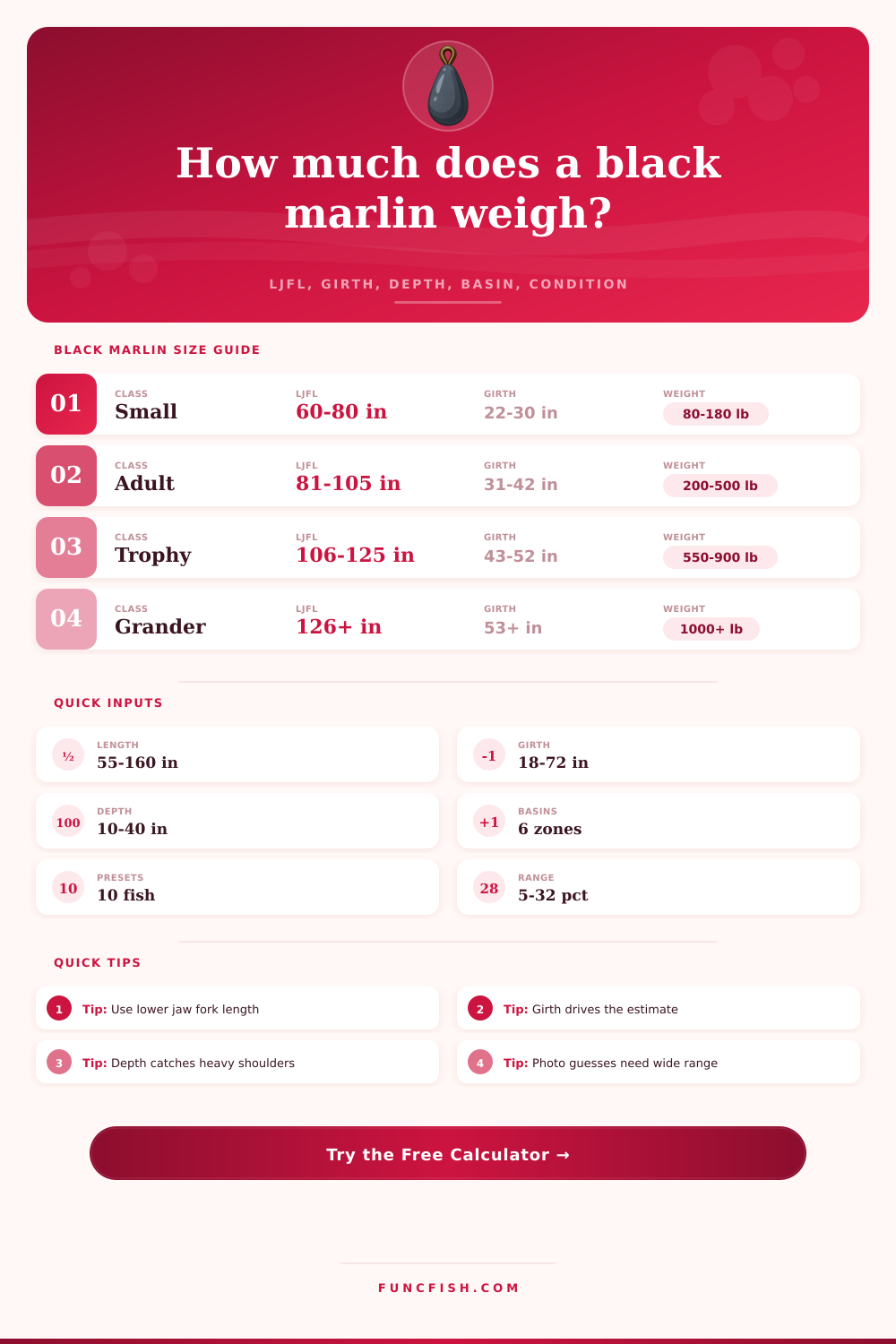
| Size class | Lower jaw fork length | Typical girth | Typical body depth | Estimated weight band |
|---|---|---|---|---|
| Small juvenile | 55 to 70 in / 140 to 178 cm | 18 to 27 in / 46 to 69 cm | 10 to 16 in / 25 to 41 cm | 55 to 140 lb / 25 to 64 kg |
| Light-tackle adult | 71 to 90 in / 180 to 229 cm | 28 to 36 in / 71 to 91 cm | 16 to 21 in / 41 to 53 cm | 150 to 320 lb / 68 to 145 kg |
| Large adult | 91 to 112 in / 231 to 284 cm | 37 to 47 in / 94 to 119 cm | 21 to 28 in / 53 to 71 cm | 330 to 700 lb / 150 to 318 kg |
| Trophy female | 113 to 128 in / 287 to 325 cm | 48 to 55 in / 122 to 140 cm | 28 to 34 in / 71 to 86 cm | 725 to 1050 lb / 329 to 476 kg |
| Grander candidate | 129+ in / 328+ cm | 56+ in / 142+ cm | 34+ in / 86+ cm | 1000+ lb / 454+ kg |
| Ocean basin | Factor | Typical context | Model effect |
|---|---|---|---|
| Coral Sea and Great Barrier Reef | 1.04 | Heavy females, reef edge bait, tournament-class fish | Slightly heavier midpoint and narrower top-end range |
| Western Pacific islands | 1.01 | Mixed reef, tuna, mackerel, and current edge fish | Near-standard black marlin shape |
| Indian Ocean coast or islands | 0.99 | Current edges, baitballs, and migratory adults | Standard midpoint with modest spread |
| East Africa current edge | 1.02 | Deep current lines and bait concentrations | Slight fullness bump for adult fish |
| Eastern Pacific seamounts | 0.98 | Less common black marlin encounters | Slightly wider uncertainty |
| Central Pacific rare black | 0.97 | Rare black marlin mixed with blue marlin grounds | Wider range because identification is often less certain |
| Sex or maturity | Factor | Shape clue | Weight note |
|---|---|---|---|
| Juvenile or small immature fish | 0.92 | Shorter, leaner, smaller shoulders | Use careful girth because small errors matter |
| Subadult, sex unknown | 0.97 | Building depth but not full mature girth | Often below adult formula at equal length |
| Adult male or slender adult | 0.96 | Longer and cleaner through the belly | May look long but weigh lighter than expected |
| Adult, sex unknown | 1.00 | Normal billfish shoulder and belly | Default field assumption |
| Large mature female | 1.06 | Deep back and heavy shoulder mass | Often rises quickly with girth |
| Grander-class female | 1.10 | Very deep body, thick caudal peduncle | Use high confidence range if measured well |
| Measurement quality | Range width | Best use | What to check |
|---|---|---|---|
| High: weighed or gantry-checked dimensions | 5% | Confirmed fish or very controlled measurements | Keep basin and maturity factors modest |
| Good: board/tape with measured girth | 8% | Boat-side measurement with stable fish | Verify LJFL was not total length |
| Standard: cockpit tape estimate | 13% | Fast cockpit or transom dimension estimate | Check tape bend and girth location |
| Rough: moving fish or curved tape | 21% | Large fish measured quickly before release | Use depth blend if girth is uncertain |
| Photo or release-side estimate | 32% | Photo, memory, or leader-side estimate | Use profile backup and report a wide band |
💡Measurement tips
Lower jaw fork length is shorter than total length on a billfish. Mixing the two can overstate weight because the formula squares girth and multiplies by length.
For black marlin, a small girth change moves the estimate sharply. Body depth is the sanity check for thick shoulders, soft photo angles, and heavy females.
To accurate estimate teh weight of a black marlin, several specific measurements will need to be took and considered. One specific measurement that will need to be taken is the lower jaw fork length of the black marlin. This measurement will need to be taken because it will eliminate the variable of the tail measurement of the black marlin.
The tail of the black marlin may vary depending upon the holding or photography of the black marlin, so using the lower jaw fork length as the starting point for calculating the weight will ensure that the estimate of the weight of the black marlin is more reliablier. Additionally, the girth of the black marlin will need to be measure, and this measurement is important because the formula to calculate the weight of the black marlin will square this measurement. Thus, a small change in the girth will have a more greater effect upon the weight estimate than a small change in the length of the black marlin.
How to Estimate the Weight of a Black Marlin
The body depth of the black marlin will also need to be measured, which will allow the estimate of the weight of the black marlin to be cross-checked with the girth measurement; the body depth will help to ensure that the girth measurement is accurate or that it is incorrect due to factors like the angle of the black marlin or its belly being soft. The location in which the black marlin is caught will also impact the weight of the black marlin. Black marlin of similar size may be caught in different areas of the oceans.
For instance, black marlin in areas like the Coral Sea and the Great Barrier Reef may have heavier shoulders than black marlin in the eastern Pacific ocean. Thus, this factor should of been considered in the estimate of the weight of the caught black marlin. The sex of the black marlin will also impact the weight of that black marlin.
For instance, the weight of a female black marlin may be more than the weight of a male black marlin of the same length. To account for this factor, the calculator will adjust the depth ratio of the black marlin to provide an estimate of the weight that is more accurate. Finally, the physical condition of the black marlin may impact the weight calculation.
For instance, if the black marlin was just spawn, or if it has been chasing bait for many days, it may have less condition; a thin black marlin will weigh less than a black marlin with more fat and muscles. The opposite is true for black marlin with a full belly or a heavy load of roe. Thus, the physical condition of the black marlin should be considered in the weight estimate.
A visible condition selection will allow this factor to be account for. The confidence level in the measurement of the black marlin will have an impact upon the weight estimate. If the black marlin is weighed on a stable gantry, with a verified girth measurement of the black marlin, the weight estimate can have a five percent band around the calculated weight.
A five percent band indicates a high degree of confidence in the measurement of the black marlin. If, however, the weight of the black marlin is taken quick, on a moving deck, or in a photograph of the black marlin, a much wider band should be used for the weight of the black marlin. In these cases, there is less precision in the measurement of the black marlin.
Thus, by using a wider confidence band in these instances, the weight calculation for the black marlin is not presented as precise as it may appear. A band of weight around the calculated number indicates the range in which the true weight of the black marlin lies. Using these bands rather than provide a single weight will allow black marlin catch records to be kept cleaner, and will help to realistically expect the weight of black marlin that are to be caught on future fishing trips.
Yet another mistake that many people make when calculating the weight of a black marlin is to use the total length of the fish instead of the lower jaw fork length. Because the tail of the black marlin will add to the total length of the black marlin, but will not be accounted for in the calculation of the weight of the fish, the weight will be inflated if the total length is used instead of the lower jaw fork length. Thus, care must be taken in this measurement, as the calculator will not account for this mistake.
Yet another mistake is in the taking of the girth measurement of the black marlin. If the girth of the black marlin is measured behind the pectoral fin of the fish, the girth will be smaller than if it was measured at the deepest point of the shoulder of the black marlin. Thus, the depth of the black marlin should be measured at the same station as the girth measurement.
These details and nuances in the calculation of the weight will have an impact upon the weight calculation; the more precise the measurements of the black marlin are taken, the more certain the calculation of the weight will be.