Boat Displacement Calculator
Estimate fishing boat displacement, loaded draft, buoyancy margin, and hull class from hull length, beam, draft, block coefficient, hull type, load weight, fuel, water, gear, water type, and units.
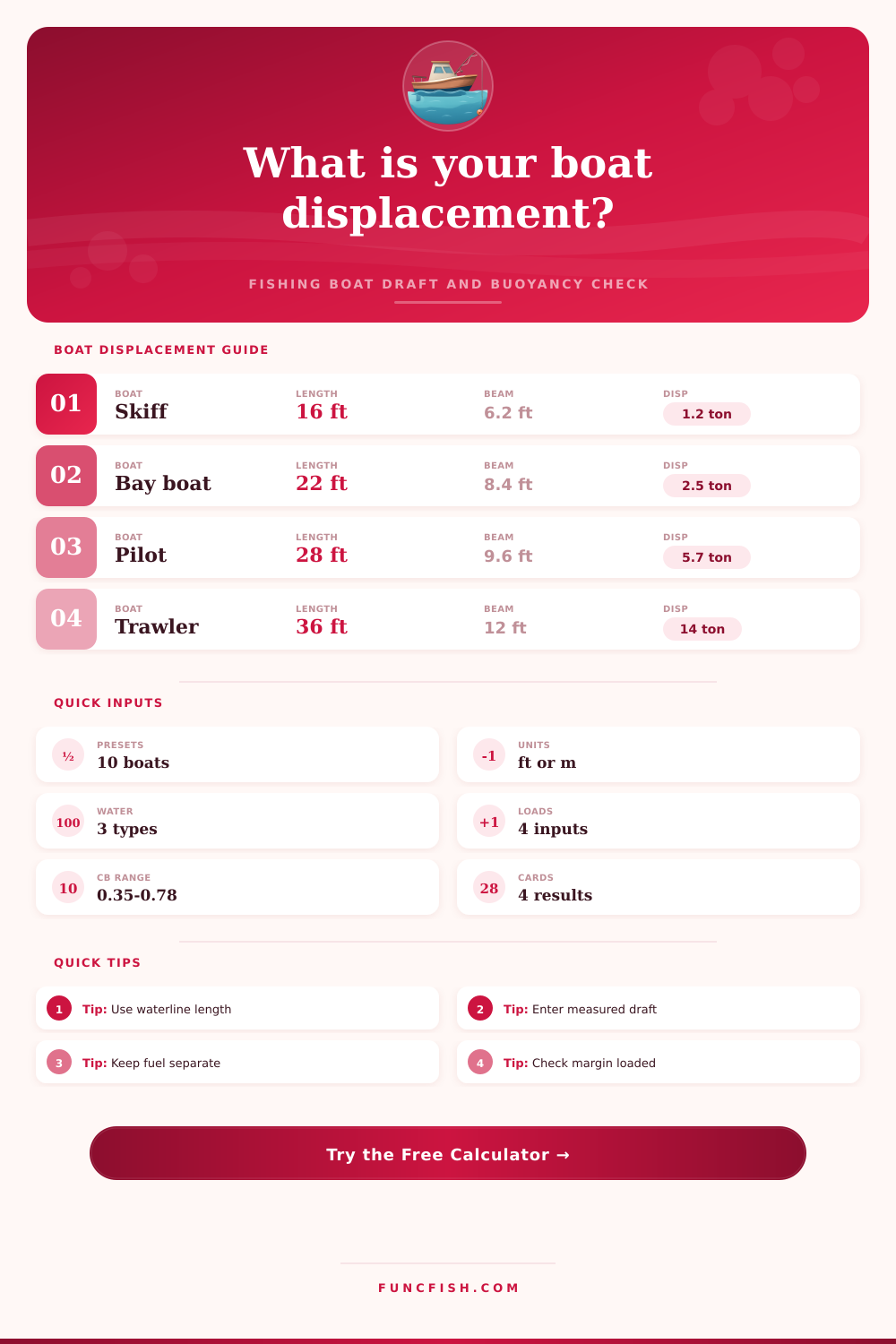
📌Named fishing boat displacement presets
⚙Hull dimensions, load, water type, and units
Model: this estimator uses length x beam x draft x block coefficient x water density for the floating displacement, then adds working load to estimate loaded draft and remaining buoyancy margin for a fishing boat.
Boat displacement estimate
Results update after calculation.
Calculation breakdown
🚤Fishing boat hull comparison grid
Flat Bottom Skiff
Wide waterplane, shallow draft, quick load sensitivity in chop.
Bay V Hull
Moderate deadrise with useful deck load and predictable draft rise.
Deep-V Offshore
Fine entry and deeper draft; load trim matters for fishing range.
Workboat Trawler
Fuller sections carry fuel, ice, and gear with slower draft change.
📊Hull coefficient and load reference cards
Fine V Entry
Center Console
Semi-Disp Hull
Full Work Hull
📋Reference tables
| Hull type | Useful Cb range | Waterplane factor | Fishing displacement note |
|---|---|---|---|
| Flat bottom skiff | 0.42 to 0.56 | 0.78 to 0.88 | Small load changes can show quickly at the transom |
| Shallow-V fishing hull | 0.40 to 0.52 | 0.72 to 0.82 | Balanced draft estimate for bay and lake boats |
| Moderate-V monohull | 0.38 to 0.50 | 0.66 to 0.76 | Common center console and walkaround profile |
| Deep-V offshore hull | 0.34 to 0.46 | 0.60 to 0.70 | Fine sections need conservative load placement |
| Semi-displacement work hull | 0.52 to 0.66 | 0.76 to 0.86 | Good fuel and ice carrying shape |
| Full-displacement trawler | 0.62 to 0.78 | 0.82 to 0.90 | High displacement and slower draft change |
| Fishing catamaran | 0.30 to 0.44 | 0.58 to 0.70 | Twin slender hulls need cat-specific caution |
| Pontoon fishing platform | 0.55 to 0.82 | 0.78 to 0.92 | Tubes carry by immersed cylinder volume |
| Water type | Density used | Metric density | Draft effect |
|---|---|---|---|
| Freshwater lake or river | 62.4 lb per cubic ft | 1000 kg per cubic m | Baseline freshwater draft |
| Brackish estuary | 63.2 lb per cubic ft | 1012 kg per cubic m | Slightly more lift than fresh water |
| Saltwater coast or bay | 64.0 lb per cubic ft | 1025 kg per cubic m | About 2 to 3 percent more lift |
| Cold dense seawater | 64.2 lb per cubic ft | 1028 kg per cubic m | Smallest draft for same loading |
| Fishing load item | Common estimate | Metric equivalent | Why it changes draft |
|---|---|---|---|
| Fuel | 6.1 lb per US gallon | 0.73 kg per liter | Often sits aft and changes running trim |
| Fresh water | 8.34 lb per US gallon | 1.0 kg per liter | Livewells and tanks can add steady weight |
| Ice and catch | 55 to 65 lb per fish box layer | 25 to 30 kg per layer | Usually accumulates through the trip |
| Anchors and chain | 40 to 220 lb on small boats | 18 to 100 kg | Concentrated bow weight affects trim |
| Batteries and electronics | 45 to 180 lb per bank | 20 to 82 kg | Fixed gear remains aboard every trip |
| Boat class | Typical displacement | Draft range | Margin reading |
|---|---|---|---|
| Creek skiff | 700 to 1800 lb | 0.3 to 0.8 ft | Watch crew and battery placement |
| Bay fishing boat | 2500 to 6500 lb | 0.8 to 1.6 ft | Normal margin works for protected water |
| Offshore trailer boat | 6500 to 16000 lb | 1.5 to 2.8 ft | Reserve should stay healthy when fueled |
| Commercial work hull | 18000 to 90000 lb | 3.0 to 8.0 ft | Load records beat rough estimates |
These tables are estimating aids for recreational and light commercial fishing boats. For design, survey, stability, or capacity decisions, use a naval architect, marine surveyor, or the boat builder data.
💡Displacement calculation tips
If the boat is already carrying fuel, gear, batteries, or a livewell, count those items as part of the observed displacement and add only the extra trip load you still plan to put aboard.
A fine offshore V should use a lower Cb than a boxy skiff or trawler. If the result looks too heavy or light, compare your Cb with the hull table before changing dimensions.
Boat displacement is a amount of water that a boat displaces while remaining afloat. The displacement of a boat is determine by the total weight of the boat and everything inside the boat. The more weight that is added to a boat, the deeper that the boat will sink into a water.
The deeper a boat sinks, the more water that it must displace. An understanding of the effect of weight on boat displacement allow people to understand how high that boat will sit on the water. If a boat becomes too loaded with too much weight, the boat will sit too low in the water, and the boat may become unsafe.
How boat displacement works with weight, water and hull shape
The weight of a boat includes items such as fuel, ice, the fish that is being transported in the boat, and the members of the boats crew. The weight of the fuel can change as the boat use that fuel. Additionally, the weight of the ice and the weight of the fish can be added to the boat during its trip.
Thus, the total weight of a boat can change during a trip, which indicate that the displacement of that boat also changes during that trip. The draft of the boat can be used to monitor the change in displacement of the boat. The draft is the distance between the waterline of the boat and the bottom of the boat.
The density of the water in which a boat is floating can affect the amount of weight that the boat can carry. The density of the water will affect the type of water in which the boat is sailing. Saltwater is more dense then freshwater.
Because of the density of saltwater, objects will experience more buoyancy when in saltwater than when in freshwater. Thus, the same boat will sit higher in saltwater than in freshwater. Brackish water has a density that is in between that of saltwater and freshwater.
Therefore, a boat will sit at a depth that is in between the depth of the same boat in saltwater and freshwater. The density of the water impact the effect of boat displacement upon the boat. The shape of the hull of a boat can impact the effect of boat displacement upon the boat when weight is placed on the boat.
Deep-V hull boats has a fine entry that allows the boat to move easy over the waves. However, deep-V hulls boats tend to have less stability when weight is placed towards the back of the boat. Boats with flat-bottom hulls can better take the weight of loads when the draft of the boat is shallow.
Flat-bottom hulls tend to also have a quick response to the addition of weight upon the boat. The block coefficient is a measurement of the fullness of the hull of a boat. The block coefficient is indicative of the amount of weight that the boat hull can absorb before the draft of the boat changes.
The placement of weight on a boat can impact the trim of the boat. The trim of a boat is the angle at which the boat is resting on the water. If the weight of items on the boat are placed low and towards the center of the boat, such as fuel and livewells, the boat will be more stable.
However, if the weight of items on the boat are placed high on the boat and towards the back of the boat, such as ice and fish tanks, the boat will have a negative impact upon its trim. A displacement calculator will allow a boat owner to calculate the total weight of the boat. However, a displacement calculator will not indicate the placement of the weight on the boat.
Thus, measuring the draft of the boat at the same location on the boat will allow the owner to understand if the placement of the weight is creating an impact upon the trim of the boat. The reserve buoyancy of a boat is the amount of space that exist between the waterline of the boat and the deck of the boat. A boat with a large amount of reserve buoyancy has a large safety margin for the boat.
A boat with a large amount of reserve buoyancy will be able to ride over waves and take on extra weight without the boats deck filling with water. A boat with a small amount of reserve buoyancy has a small safety margin for the boat. Thus, a small amount of reserve buoyancy mean that the boat will tip more easy and will be forced to take on more water if it has to carry extra weight or passengers.
Boats that travel offshore need a larger amount of reserve buoyancy than those that remain in protected waters because of the more rapid changes in weather and water conditions that occurs offshore. People can make several mistakes when calculating the displacement of boats. People may use the wrong measurements when calculating the displacement of a boat.
For instance, people may use the length of the boat overall rather than the length of the boats waterline. The length of the boats waterline can be different than the length of the boat overall if the boat has a raked bow or an extended swim platform. People also may use the wrong block coefficient for the boat.
The block coefficient can change based off how the boats manufacturer made the boats hull. Thus, the block coefficient can be adjusted in calculations if the draft of the boat is measured but the displacement of the boat is calculate. People can use reference tables to determine the displacement of boats.
These tables can indicate the typical displacement of boats of a specific hull shape. These reference tables helps to ensure that calculations made for the displacement of boats are correct. Additionally, understanding the effect of boat displacement allows boat owners to understand if adding equipment to the boat will increase its total weight.
Thus, understanding the effect of boat displacement also allows boat owners to understand how much weight the boat can take.