Boat Trim by Load Calculator
Estimate bow-up or bow-down trim from the actual position of crew, fuel, batteries, livewell water, anchor weight, and fishing gear.
📌Scenario presets
⚙Boat and loading settings
Measure every distance forward from the transom or aft end.
Load trim forecast
Full breakdown
📋Hull profile data used by the calculator
Flat jon
Mod-V aluminum
Bass boat
Deep-V
| Common load | Typical weight | Common position | Trim effect if moved forward |
|---|---|---|---|
| Group 31 battery | 60-75 lb / 27-34 kg | 1-4 ft from transom | More bow-down moment |
| Gasoline fuel | 6.1 lb/gal / 0.73 kg/L | Midship tank | Depends on tank center |
| Full livewell | 8.34 lb/gal / 1 kg/L | Aft or center | Can change trim as it fills |
| Trolling motor | 45-90 lb / 20-41 kg | Bow deck | Pushes bow lower |
| Ice chest and tackle | 40-160 lb / 18-73 kg | Loose load | Best trim adjustment load |
| Two anglers | 300-450 lb / 136-204 kg | Seats or decks | Strongest quick adjustment |
| Result range | Trim difference over length | Likely feel | Useful adjustment |
|---|---|---|---|
| Balanced | 0-2 in / 0-5 cm | Normal attitude | Fine tune with small gear |
| Mild bow-down | 2-5 in / 5-13 cm | Wetter bow, easier plane | Shift gear or passengers aft |
| Heavy bow-down | 5+ in / 13+ cm | Plowing, spray, slower response | Move dense load aft first |
| Mild bow-up | 2-5 in / 5-13 cm | Stern squat, higher bow | Shift gear or passengers forward |
| Heavy bow-up | 5+ in / 13+ cm | Poor visibility, slow planing | Move batteries or crew forward |
| Term | Calculator meaning | Imperial basis | Metric equivalent |
|---|---|---|---|
| LCG | Longitudinal center of gravity | ft from transom | m from transom |
| LCF | Center where trim rotates | % of length | % of length |
| MCT 1 in | Moment for one inch trim | ft-lb per in | N-m per cm shown |
| Cwp | Waterplane fullness factor | 0.58 to 0.88 | same factor |
| Trim moment | Weight times arm from neutral | ft-lb | N-m |
💡Practical checks
Tip: This is a planning calculator, not a stability certificate. Confirm safe capacity, flotation, and handling on the actual boat in calm water before running loaded.
Tip: Recheck after fuel burn or a livewell change. Liquids are heavy, and a tank that is forward or aft can move the loaded center of gravity more than expected.
Weight distributions is critical to boat performance. The location of the weight is more important then the amount of weights on the boat. Any time you place weight on a boat, the weight affect how the boat sits in the water and how the boat responds to the throttle.
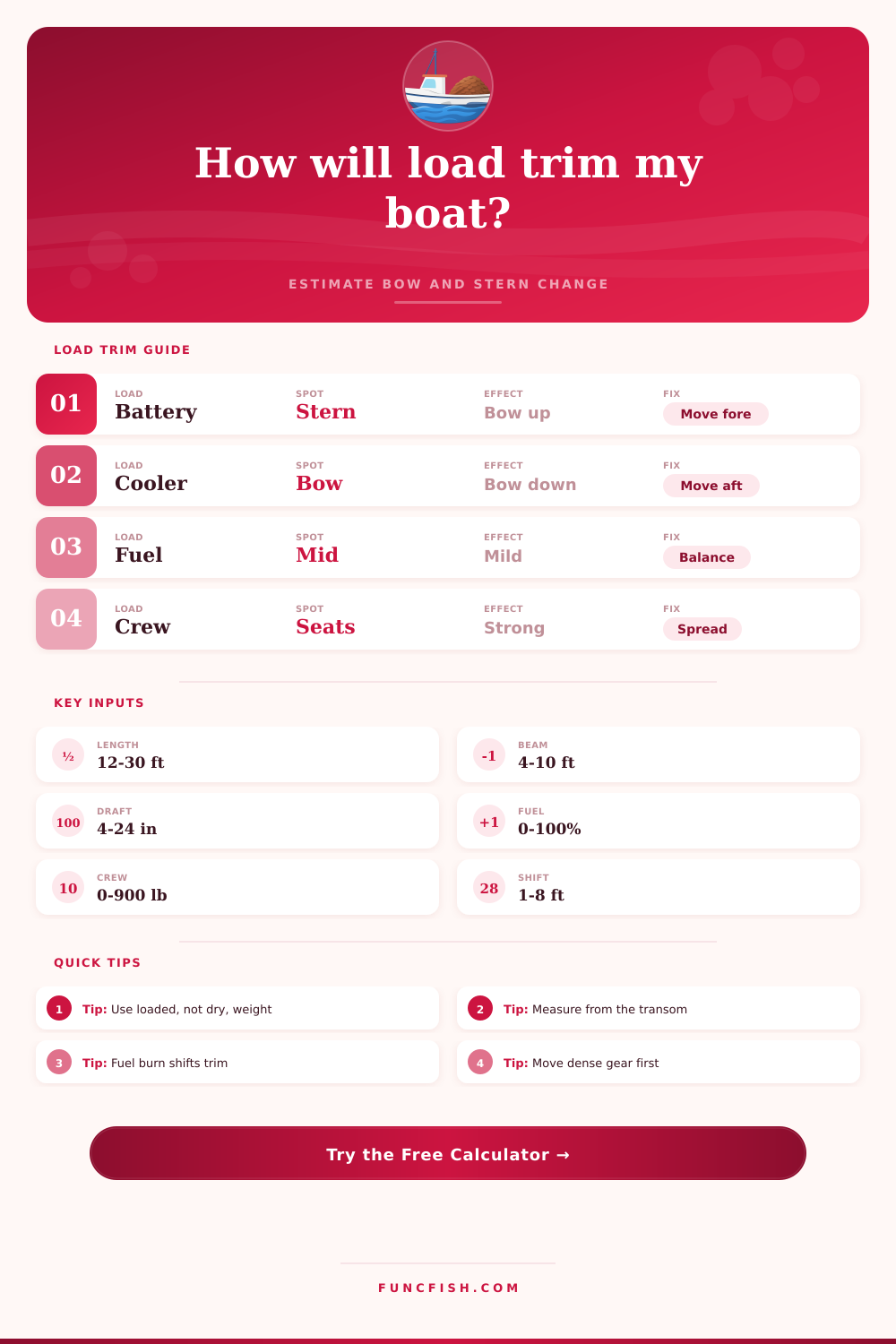
For instance, if you place batteries on the boat near the transom, this will push the bow of the boat higher. Conversely, if you place a cooler with ice on the boat near the front of the boat, the boat will feel heavyly and slow to plane. Any time you place weight on a boat, that weight creates a turning force.
Where You Put Weight Changes How the Boat Sits
Every pound of weight create a moment arm that either lifts one end of the boat or lowers one end of the boat. The calculator provides results for the mathematical description of the boat, the loads on the boat, and the mode in which the boat is being operated. The most important of the inputs for the calculator are the distance that each item is from the transom.
This distance is what turns the weight of each item into a turning force that can be compared with the natural balance point of the hull of the boat. Jon boats tend to react quick to the addition of weight on a boat because of the wide and flat waterplane of the jon boat. Offshore boats, on the other hand, require more weight or more distance from the transom before such an addition to the boat will have any effect on the boats balance because of the deep V hull of those boats.
Additionally, users must select the mode in which the boat is being operated. The effect of the load on the boat change when the boat is on plane with the water as compared to when the boat is resting in the water at rest. When the boat is at rest, the boat will naturally balance itself.
When the boat is on plane, though, the water will lift certain sections of the boat hull, changing how those added loads on the boat appear to react to the boat. Users often only consider the weight of the heaviest items on the boat. Yet, you must also consider liquids.
Fuel tanks on boats loses weight as the boat operator spends the day on the water. Livewells on boats, in contrast, gain weight when filled with water. Both of these variables can be adjusted on the calculator so that operators can consider the potential impact that these two categories of items has on the boats balance.
Additionally, the reference tables on the calculator can help users to more easy decide which load to move to achieve a desired attitude of the boat. Trim problems are often visible at the extremes of the boats operation. For instance, while a bow-down attitude to the boat may allow the boat to plane faster and with less water on the boat when traveling over choppy water, the same bow-down attitude in rough water could cause the bow of the boat to dig into the water, slowing the boat.
Similarly, while a boat that squats in the stern while stationary may be stable in drifting boats, the same boat may be difficult to control when attempting to get the boat onto plane. The calculator calculates the correction that is helpful in that it provides the target for the movement of the boats load. For instance, instead of merely understanding that the boat has a bow-up attitude, the operator can use the target to make a decision of how to move the boats batteries, coolers, or even passengers to even out the trim of the boat.
In order to properly use the calculator, the user should weigh each item that is placed on the boat in the same manner in which the boat is used. For example, the fuel that is normally contained in the boat should be accounted for. The same is true for the number of people that normally ride in the boat.
Finally, any gear that is always on the boat between trips should also be accounted for in the boats total weight. By knowing the total weight of the boat when the boat is in its normal operation, it will be easier for the boat operator to decide how to adjust the balance of the boat. For instance, moving a single battery two feet forward on the boat can have a more large effect on the trim of the boat.
This is one of the reasons that the calculator ask for both the weight of each item and its distance from the transom. The same is true for coolers, tackle bags, and trolling motors. Items with the greatest density will create the largest turning forces; thus, these are the items to which an operator should first apply changes to even out the trim of the boat.
The goal for the owner of a boat that has a tendency to develop trim issues is not to achieve perfect trim at all times. Yet, by understanding in what manner the boat will react to the water, the operator can make adjustments to the boat while it is afloat instead of struggle with its trim during the day while on the water.