Boilie Base Mix Egg Ratio Calculator
Balance dry base mix, egg size, liquid attractors, oil, humidity, and bait diameter to estimate a workable boilie dough before rolling.
📌Boilie mix presets
⚙Mix settings
Boilie dough ratio forecast
Full breakdown
🧪Base mix absorption grid
Milk Protein
Birdfood
Fishmeal
Nut Meal
📋Reference tables
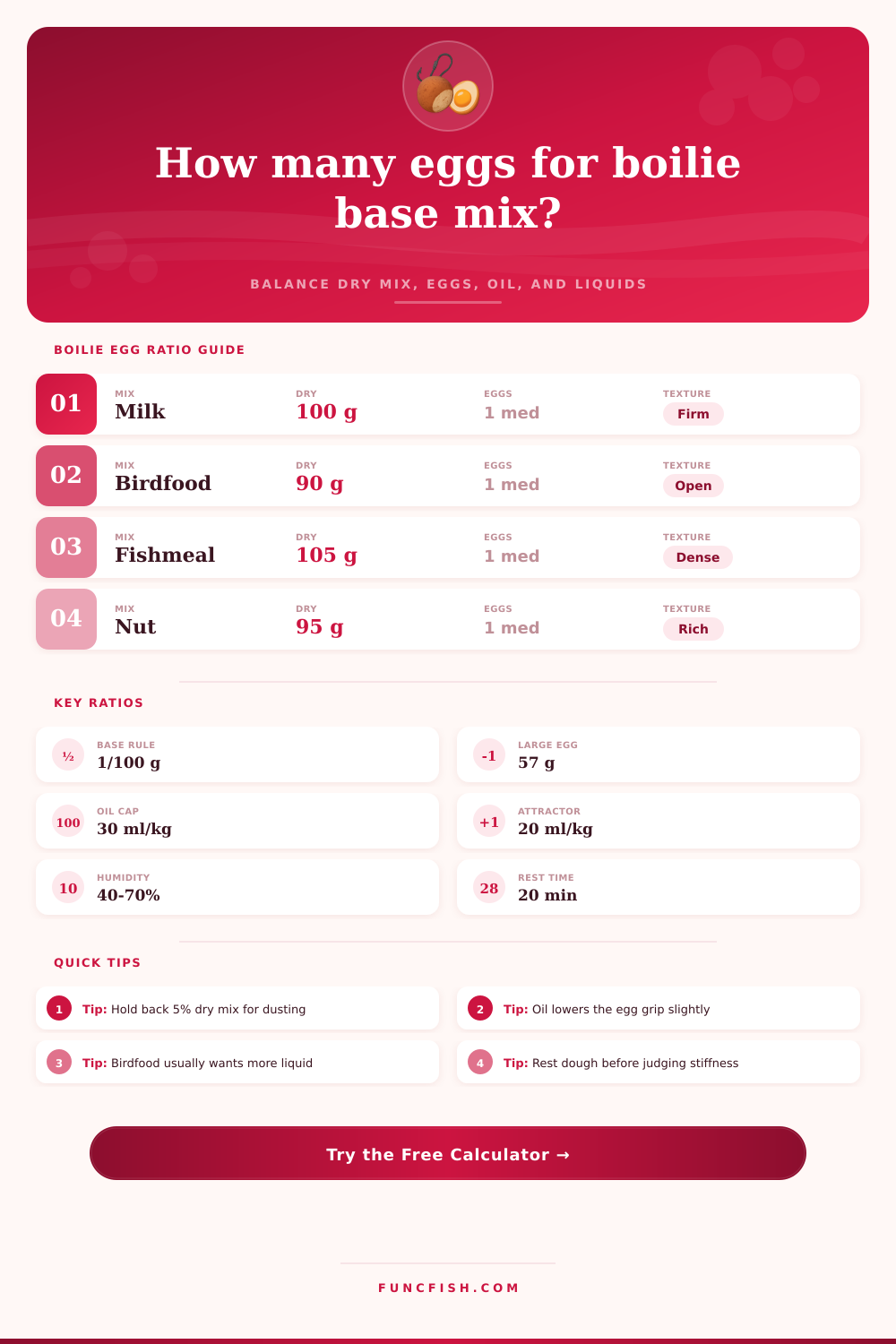
| Base mix style | Target wet ratio | Typical dry per large egg | Rolling note |
|---|---|---|---|
| Balanced 50/50 base | 57 g wet / 100 g dry | 100 g / 3.5 oz | Standard firmness |
| Milk protein base | 54 g wet / 100 g dry | 106 g / 3.7 oz | Can tighten while resting |
| Birdfood open texture | 63 g wet / 100 g dry | 91 g / 3.2 oz | Needs longer hydration |
| Fishmeal dense base | 55 g wet / 100 g dry | 104 g / 3.7 oz | Watch heavy oil loads |
| Nut meal rich base | 60 g wet / 100 g dry | 95 g / 3.4 oz | Often rolls softer |
| Cork dust pop-up base | 65 g wet / 100 g dry | 88 g / 3.1 oz | Bind gently to keep lift |
| Egg size | Usable beaten egg | Dry mix at 57% | Best use |
|---|---|---|---|
| Small hen egg | 44 g / 1.55 oz | 77 g / 2.7 oz | Small test batches |
| Medium hen egg | 50 g / 1.76 oz | 88 g / 3.1 oz | Short bait trials |
| Large hen egg | 57 g / 2.01 oz | 100 g / 3.5 oz | Standard rolling |
| Extra large hen egg | 64 g / 2.26 oz | 112 g / 4.0 oz | Large batches |
| Duck egg | 72 g / 2.54 oz | 126 g / 4.4 oz | Richer hookbaits |
| Liquid egg measure | 50 g / 50 ml | 88 g / 3.1 oz | Repeatable batches |
| Additive | Normal range | Calculator treatment | Effect on eggs |
|---|---|---|---|
| Liquid food or attractor | 10-35 ml per kg | Counts as wet binder | Reduces egg need |
| Oil or hemp oil | 5-30 ml per kg | Counts at 70% binding value | Displaces some egg |
| High humidity room | Above 65% | Lowers target liquid slightly | Needs less egg |
| Short rest time | Under 15 min | Raises apparent wet need | May seem dry early |
| Birdfood or seed | Coarse meals | Raises absorption target | Needs more wet binder |
📊Mix comparison grid
Firm Freezer Bait
Lower wet ratio, longer rest, and modest oil for clean rolling and drying.
54-57%Open Food Bait
Birdfood, seed, and coarse meals need more liquid before the dough relaxes.
Fast Hookbait
Smaller batch, higher binder, and shorter rest can suit quick rolling tests.
58-62%Oil Rich Mix
Oil helps texture and leakage but does not bind like beaten egg protein.
💡Practical checks
Tip: Keep back a small cup of dry base mix before adding the last egg. If the calculator shows the dough is close, dust the board instead of forcing in more powder.
Tip: Judge birdfood and cork dust mixes after the rest time. They often look wet at first, then tighten as coarse particles absorb egg.
There’s nothing worse than spending an hour mixing a boilie base only to discover that either it’s too wet and sticks to your fingers like glue or too stiff to be rolled. As all carp angler will testify, it’s a common issue and not usually down to bad ingredients but the balance of them. Dry mixes absorb moisture different. Some ingredient take longer to soak in, while milk proteins tightens up rapidly. Eggs bind the mix but also add protein. Get this ratio incorrect and there’s no point making bait as it’ll end up wasted in frustration long before you’ve boiled a single sphere.
With one click you enter all the factors other guys skip when they go rolling, like egg size, wet ratio and the displacement of additives. The calculator takes care of heavy lifting and allows you to focus on making dough.
How to Get the Right Mix Ratio
Oil isn’t an egg protein and doesn’t bind the way an egg does. Oil also coats the particles instead of knitting them together. Add 30 mils of hemp oil to every kilo of mix and don’t change the egg count. The dough will be soft at first, but then it will tear up during the boil. That’s why it makes up for oil being treated like a partial binder with less structural properties than a beaten egg. This is important for very dense baits used in river fishing, where a good hook hold depends on bait staying intact.
Another consideration is the number of eggs. Contrary to popular belief, egg size do matter. A hen egg contains about forty-four usable grams of liquid whereas a duck egg will contain upwards of seventy. Drinking too much or too little water because of a mistake are bad. For larger freezer baits where you want a firmer texture, use less water compared to the dry mix so the freezing process doesn’t make the mix too loose. For looser textured food baits with attractive loose crumbs in the water column, you’d want a higher ratio of wet to dry. This allows for better meal absorption and helps seed meals swell up properly all the way through. The page’s reference tables breaks these general target ranges down by mix type and explain why you’ll have different behaviors between a nut meal rich blend versus a milk protein base.
There’s also one more variable: humidity. Dry mixes tend to draw moisture out of the air when they’re sitting on your bench in damp conditions, which means you may want to use a little less liquid attractant/egg than the amounts given. When I first started using these calculators I was guilty of trying to judge my mix right away, which is an error because the dough change dramatically within 20 minutes as the proteins fully hydrate and the dough stabilizes in its stiffness. There is an option on the calculator to enter a rest time which will adjust the predicted amount of liquids needed based off the idea that resting the mix lets the dough absorb better and therefore you won’t need as much added egg or water in the end.
The other thing to know about liquid additives is that they are included in your wet binder volume totals. So, for example, an egg provides moisture, but so does a juicy fruit juice or sweet syrup. So if you add a large amount of additive to your mix and follow with however many eggs you would normally, it’s going to be soup. That’s why the tool includes these liquids in the overall hydration budget and uses the rest of the bowl contents to calculate how much room there is left for egg. It takes away any guessing when adding more than one liquid and helps you avoid ruining dough structure.
There is no strict recipe. I have had to adjust batches for changes in egg age, room temperature, or which meal brand I am using. However, understanding these factors makes rolling more consistent since each batch is different. The calculator use absorption rates and basic physics to give a good baseline for the number of eggs per unit of dry mix. It also estimates how many baits you’ll get once you boil them off. That’s useful for planning your session size and making sure you don’t over-purchase ingredients.
Begin with the recommended number of eggs and tweak as needed throughout the rest period. Save some dry mix to dust on if they gets too sticky, and save a bit of lightly beaten egg to add if they seem too crumbly. You want something that rolls smoothly but doesn’t fall apart and isn’t too dry/brittle. Once you dial-in the ratios, boiling bait will become less trial-and-error and more fine-tuned skill. You won’t waste as much time trying to figure out what’s wrong with your dough; you’ll spend more time catching fish on baits that do exactly what you expected them to. That’s the real power of that give-and-take between science and feel.