Bottom Rig Dropper Spacing Calculator
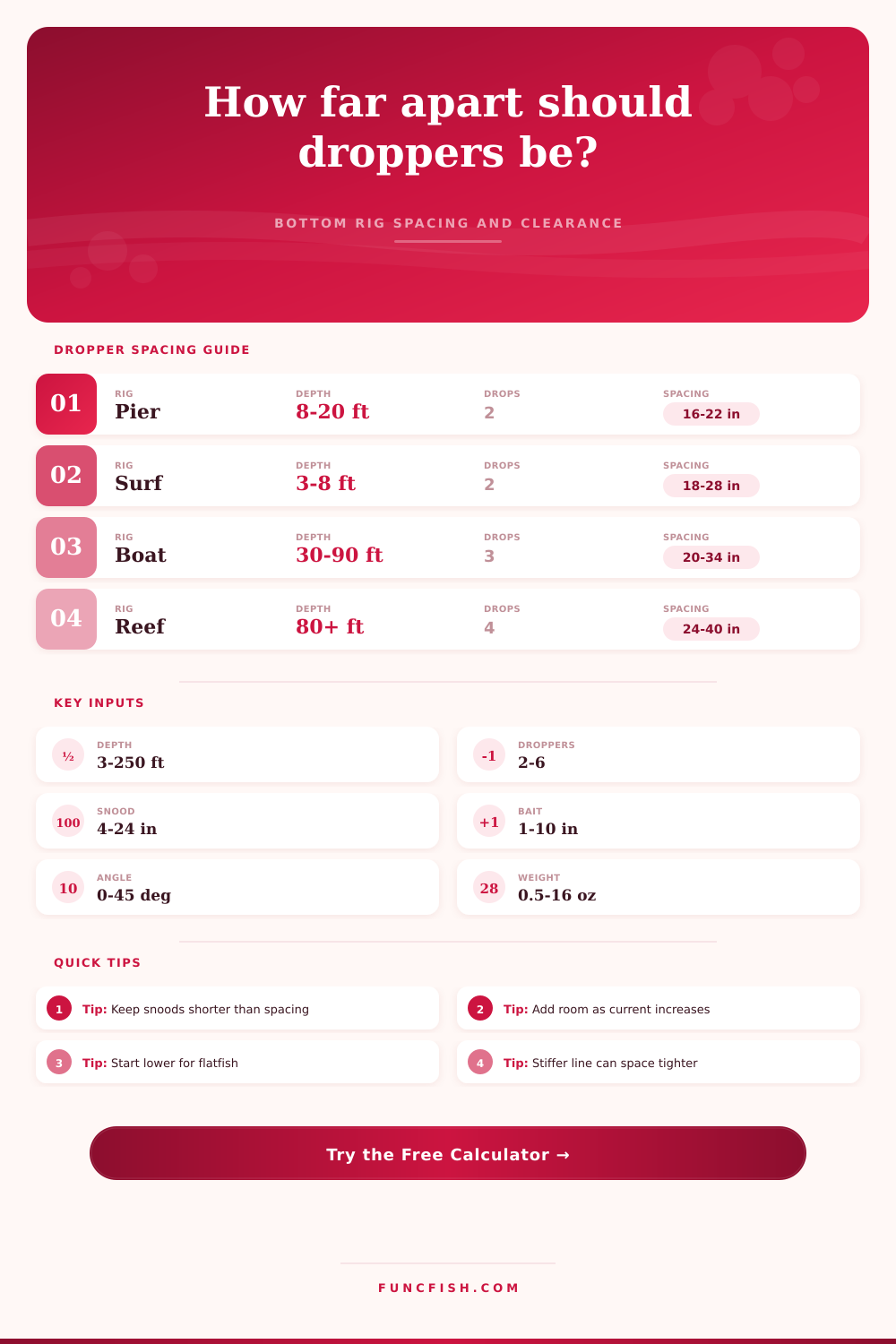
Calculate center-to-center dropper spacing, bottom-hook clearance, and total leader length for pier, surf, boat, river, and deep bottom rigs.
📌Scenario presets
⚙Rig settings
Dropper spacing forecast
Full formula breakdown
🧵Dropper material comparison grid
Mono leader
Fluorocarbon
Stiff mono
T-bar boom
📊Reference tables
| Rig style | Typical droppers | Spacing range | Bottom clearance | Calculator bias |
|---|---|---|---|---|
| Hi-low surf rig | 2 | 18-30 in / 46-76 cm | 8-14 in / 20-36 cm | Wider in wash |
| Paternoster boat rig | 2-4 | 18-34 in / 46-86 cm | 10-18 in / 25-46 cm | Depth balanced |
| Sliding ledger rig | 1-2 | 20-36 in / 51-91 cm | 12-22 in / 30-56 cm | Low hook start |
| River bottom rig | 2-3 | 22-38 in / 56-97 cm | 12-24 in / 30-61 cm | Current margin |
| Deep reef rig | 3-5 | 24-42 in / 61-107 cm | 16-28 in / 41-71 cm | Longer ladder |
| Sabiki-style bait rig | 4-6 | 8-16 in / 20-41 cm | 6-12 in / 15-30 cm | Compact arms |
| Target group | Feeding zone | Bait swing | Spacing preference | Bottom hook note |
|---|---|---|---|---|
| Panfish / baitfish | Low-mid | Small | Compact | Keep close to sinker |
| Pompano / whiting | Low | Moderate | Medium | Above rolling sand |
| Flounder / flatfish | Very low | Moderate | Medium-low | Bottom dropper starts low |
| Walleye / perch | Low-mid | Moderate | Medium | Protect from snags |
| Sea bass / scup | Mid-low | Quick bite | Medium-wide | Use even ladder |
| Catfish / cut bait | Bottom | Large | Wide | Big bait needs gap |
| Snapper / grouper | Reef edge | Large | Wide | Lift from rocks |
| Rockfish / cod | Deep bottom | Large | Wide | Allow drop and drift |
| Material | Sweep factor | Spacing adjustment | Tangle behavior | Best use |
|---|---|---|---|---|
| Monofilament leader | 1.00 | Baseline | Average coil memory | General bottom rigs |
| Fluorocarbon leader | 0.92 | +1 in / +3 cm | Dense and direct | Clear water rigs |
| Stiff mono / amnesia | 0.78 | -2 in / -5 cm | Stands away well | Surf and pier rigs |
| Braided branch line | 1.18 | +5 in / +13 cm | Limp and wraps easily | Short bait arms only |
| Light wire snood | 0.70 | -3 in / -8 cm | Stiff but visible | Toothy fish rigs |
| Coated wire snood | 0.74 | -2 in / -5 cm | Controlled swing | Heavy bait rigs |
| Twisted dropper loop | 0.86 | -1 in / -3 cm | Better stand-off | Boat bottom rigs |
| T-bar or stand-off boom | 0.62 | -4 in / -10 cm | Strong separation | Deep multi-hook rigs |
| Line angle | Current feel | Spacing addition | Bottom margin addition | Practical effect |
|---|---|---|---|---|
| 0-8 deg | Vertical | 0-2 in / 0-5 cm | 0-1 in / 0-3 cm | Clean drop |
| 9-18 deg | Light sweep | 2-5 in / 5-13 cm | 1-3 in / 3-8 cm | Most boat drifts |
| 19-30 deg | Moderate sweep | 5-10 in / 13-25 cm | 3-6 in / 8-15 cm | Wider bait arcs |
| 31-45 deg | Strong sweep | 10-16 in / 25-41 cm | 6-10 in / 15-25 cm | Use fewer droppers |
| 46+ deg | Hard sweep | 16+ in / 41+ cm | 10+ in / 25+ cm | Shorten rig or add weight |
💡Spacing checks
Tip: If the spacing is less than twice the snood length, shorten the snood first. That usually fixes hook-to-hook wraps without making the whole leader excessive.
Tip: In strong current, keep the lowest hook high enough that bait swing does not tap the sinker or bottom on each lift of the rod tip.
When your bait sinks into water, the hooks can tangle into a knot that looks impossible to untangle. Whether you’re fishing bottom fish out on a deep reef or in the surf trying to catch some pompano, this are a very common problem among bottom fisher.
And while you might think swapping to a different bait or a heavier weight is the solution, more often than not, it’s all about geometry. Is there enough space between your droppers? Because if there isn’t, your rig will be nothing short of a chaotic mess, or as we like to call it, a ladder of opportunities.
How to Stop Fishing Lines from Getting Tangled
Once you input your environmental conditions and type of fish you’re going after, the calculator do the math for you so you don’t have to guess at how much clearance your rigs should has or if it’s at risk of tangling.
Most folks completely forget about the swing radius. If you hang a snood straight down in a pool, it occupy zero lateral space. Once current hits it, however, that line begin sweeping out an arc. That arc have a finite size and if you space your dropper lines narrower then said arc, they’re going to intersect eventually.
This tool considers this because it includes how far off-vertical your line happens to be. Fifteen degrees may not sound like much, but it make a huge difference in terms of increasing the sweep zone. What the calculator does is adjust the center-to-center spacing needed to keep those arcs from overlapping. That’s why hooks gets wrapped around one another: it’s all about overlap.
It’s not just about dropping line. It’s controlling a three dimensional volume of water. Surprisingly, one element that plays a part are material stiffness. Limp fluorocarbon or braid will drape and blow around, requiring extra space to breathe. Stiffer mono or amnesia stay off the main line and keeps things tight. This reduces the swing radius and lets you get by with closer spacing.
These coefficients is laid out on page’s reference grid. You can see how T-bar boom holds the bait away rigidly from leader and effectively eliminates swing. In heavy current, the choice of a stiffer material can be the difference between a clean presentation and a ruined leader. It’s a small mechanical advantage that builds up over a long session.
Now here is the part of depth that most anglers don’t think of; but should of: how depth determines your strategy. Surf close to shore? Space them out widely so the bait stays off the bottom and the hook clears the sand freely. Out deeper? You’re trying to get the bait up there long enough for a bite, but not down too far since the bait isn’t fighting as much bottom interference.
The bait’s lowest point will hover slightly over the bottom (see illustration below). That keep the bait out of trouble while still being in the strike zone. A bait on the bottom is an invisible bait. You want the hook position hanging in the water column where the fish can see and feel it best.
Tangles are inevitable, not random events; they’re a consequence of insufficient spacing compared to your droppers’ length. In moderate current, your center-to-center distance should be at least twice the length of your snood (for example, if your snood is 12 inches long, stay at 24 inches or more). Your tangle risk score reflects this ratio. It’s a red flag you see before tying the knot.
High score? Your rig is too dense for the conditions. The solution: Either increase the gap between them or decrease the snood length. Both lower the odds of a collision.
At the end of the day, it’s all about presentation. If your rig is tangled, then it was not presented properly. When you think of your leader as an organized structure instead of a haphazard hook jumble, you can control where your bait sits in the water column.
That’s why I said the numbers are only a guideline to allow you to mentally picture the area. Once you understand the relationship between swing, stiffness, and depth, the knots starts to dissapear. Your bait will sit in the strike zone right where you need it to be and the fish begin to appear.