Breakaway Lead Release Tension Calculator
Estimate the line tension needed to trip a breakaway or grip lead free, accounting for wire count, wire length, bottom hold, surf set, line angle, leader strength, and planned rod lift.
📌Breakaway lead presets
⚙Release tension inputs
Breakaway release estimate
Your release calculation will appear here.
Calculation breakdown
📊Grip wire reference data
Light spring wire
Standard stainless
Heavy grip wire
Short trip wire
📘Breakaway lead reference tables
| Bottom condition | Typical grip behavior | Release range | Calculation note |
|---|---|---|---|
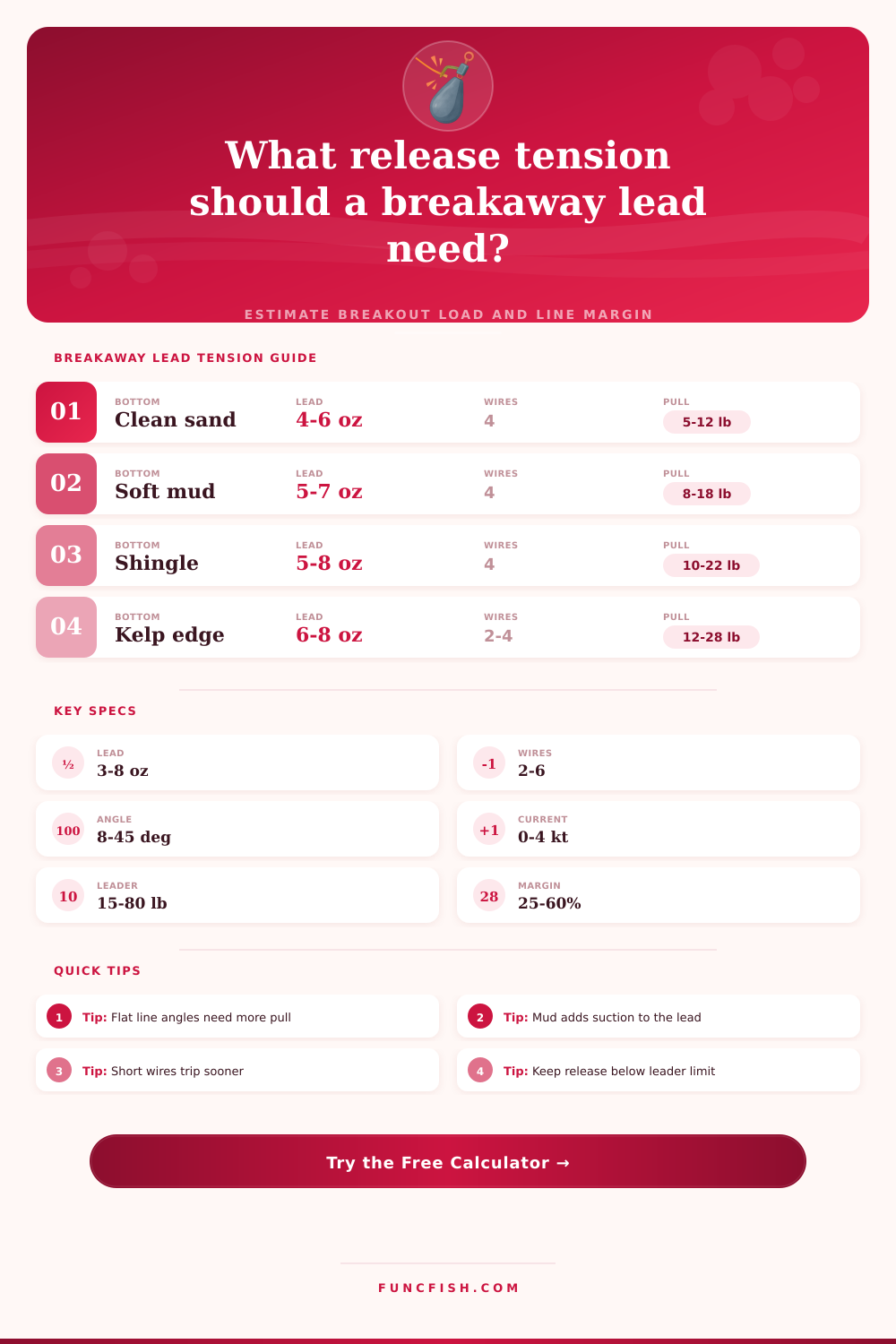
| Clean packed sand | Predictable wire bite | 5-14 lb / 2.3-6.4 kg | Good base case for normal surf leads |
| Soft sand | More burying and suction | 7-18 lb / 3.2-8.2 kg | Release rises after repeated surf pulses |
| Mud or silt | Suction dominates | 9-24 lb / 4.1-10.9 kg | Lead body and wires both resist lift |
| Shingle or shell grit | High friction, uneven release | 10-26 lb / 4.5-11.8 kg | Wire points wedge between hard particles |
| Rock pockets | Patchy hold and snag risk | 8-30 lb / 3.6-13.6 kg | Use shallow set if release margin is low |
| Weed or kelp edge | Fibers wrap around wires | 12-32 lb / 5.4-14.5 kg | Shorter wires reduce wrap load |
| Line angle at lead | Release efficiency | What it means | Adjustment |
|---|---|---|---|
| 8-12 degrees | Low | Most pull drags sideways through the bottom | Expect a higher tension spike |
| 18 degrees | Normal surf | Good mix of backward pull and upward lift | Use as the standard estimate |
| 25-35 degrees | High | Rod lift helps trip wires cleanly | Lower steady pull may release |
| 50 degrees | Very high | Boat, pier, or steep bank lift | Watch for sudden pop-out |
| Leader class | Cautious release | Balanced release | Heavy gear release |
|---|---|---|---|
| 20 lb / 9.1 kg | 5 lb / 2.3 kg | 7 lb / 3.2 kg | 11 lb / 5.0 kg |
| 30 lb / 13.6 kg | 7.5 lb / 3.4 kg | 10.5 lb / 4.8 kg | 16.5 lb / 7.5 kg |
| 50 lb / 22.7 kg | 12.5 lb / 5.7 kg | 17.5 lb / 7.9 kg | 27.5 lb / 12.5 kg |
| 80 lb / 36.3 kg | 20 lb / 9.1 kg | 28 lb / 12.7 kg | 44 lb / 20.0 kg |
The model estimates steady release tension, not shock load from a snapped rod lift. Inspect line, leader knots, swivels, and links before using heavy breakout pressure.
💡Release tuning notes
A flat beach line wastes lift by dragging the lead sideways, so the same grip lead can need noticeably more line tension than it does from a pier or boat.
If calculated release tension approaches the chosen leader safety ceiling, reduce wire spread, use fewer active wires, shorten legs, or avoid burying the lead hard.
Even if you’ve never had a rod in hand, there’s something about that moment. You pick it up and feel the line tighten. You hold your breath as time seems to stand still. In that moment, you know you’re either going to snap that thing off or hear a satisfying pop as the lead comes free. And then it’s gone…or maybe your leader has snapped cleanly beneath the shock load.
That’s the moment of truth; breakaway fishing exist or dies on that split-second decision. It isn’t a question of strength. It is a matter of precisely how much pressure needs to be used to move those wires from their perch on the bottom, but not more than your line can bear. Pulling up this page will run numbers for you and translate some of that abstract friction into a solid number you can bank on next time that surf pushes back.
How to Use Breakaway Leads
Weight The vast majority of folks believe weight alone is what makes a breakaway lead work. If I used five ounces last week, I use six this week. They fail to account for the action of the grip. Lead is suspended above the bottom, clamped by crooked wires that pierce the sand, muck, or shingle. How those wires grip the bottom are far more important than gravity in determining the break-out load.
Suction exists in soft sand. Friction develops between granules in shingle. Muck behaves like glue. Every bottom type change the breakout load a lot. What may be a five-pound break-out on a typical four-wire lead in clean, packed sand might require fifteen-pounds in thick muck to trigger the trip.
This is where folks miss the boat. They dial in weight and overlook that the bottom grips the wire, not simply the body of sinker. Line angle also matters. A flat line sitting low on a beach pulls the lead sideways. This makes it slide through sediment instead of lifting the wires away from it. That dramatically adds resistance.
Pulling from a boat or pier is more steeply angled and lifts the lead up vertically. This geometry are automatically calculated into the math. You just need to know how to use it. When shallow, the angle make it harder than a pier trip or surf session. When you use the same gear as before but have to pull harder, that is mostly physics working against you.
The other hidden variable is wire count and stiffness. Obviously the more you add, the more grip. However, the stiffer the wire, the deeper it will bite before bending far enough to let go. Lighter spring wire trips softer and that’s good when fishing for small fish. It’s also good near structure for wary bass because light spring wire trips softly. Heavier grip wire holds tight on the surge but must be lifted sharply to break free. That means matching the wire to bottom condition and the species targeted.
For example, using heavy wire for light surf fishing makes each cast a potential snagging situation. The rod feels softer or firmer depending on the wire type, which is shown clearly in the reference table on this page.
Experience trumps intuition when it comes to safety margin. Don’t set the release tension too close to the point where your leader will break. A 50-pound leader shouldn’t be rigged with a need to release at forty-five-pounds. Shock loads come from fish strikes, wave impact, and surge, which all outdo steady pull. Aim for a tension release within about thirty to forty percent of your leader strength. That gives you some wiggle room in case a swell suddenly kickss in or a fighting fish puts on a jolt.
A small buffer give a big payoff because you won’t lose your rig and can stay on the water longer. Perfection doesn’t exist outside of a lab. The current pushes leads into holes. Wires get wrapped in weeds. Anglers have different techniques for lifting the rod. Remember, the tool provides an estimated starting point; not a guaranteed solution.
Apply it to whittle down your options and take it out on the water. Shorten the wires or decrease the spread if it feels stuck, or stiffen the wire or increase the count if it’s tripping too soon. Stiffen the wire or increase its count if it frees up too easily and swings loose in the surf. It’s an iterative process. Setup is guided by numbers; truth comes from the bottom.
Managing your release tension is a matter of respect for the system. Balancing between hope and hold. Hold too tight and you lose gear. Too little hold and you lose position. Managing this balance correctly require knowing when the lead is holding you down and how to pick it up clean.
Begin with your calculated baseline. Adjust based off bottom feel. Let your rod talk to you and make adjustments accordingly. The rigs that stays in place the longest until you truly want them to move are the best rigs.