
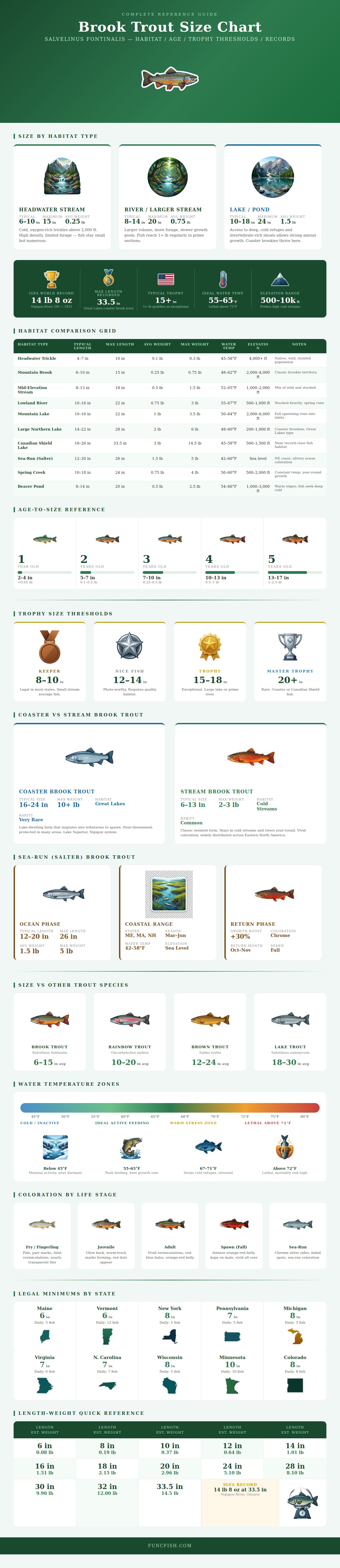
Brook trout are a species of extremes. You can be standing in mountain stream catching 20 little brookies before lunch, or you can spend three days looking for one that will put a real bend in your rod. When it comes to understanding how to find those fish big enough to care about, it’s typically a matter of habitat. Most people just lump all brookies together; they go into a tiny headwater stream hoping to run across some trophies, and end up frustrated because they’re missing something. The truth is much more complex.
Everything from their coloration to their growth rate are dictated by habitat. Knowing this make an entire world of difference in what you bring with you in your tackle box.” As you can see in the chart above, direct volume of water does have a direct impact on max size, and this is why brookies in big northern lakes far outsize there cousins from smaller streams. There’s not just a matter of more food; because they live in deep cold refuges, these lake brookies can continues feeding all summer where smaller streams are already warming up and turning off.
How to Find Big Brook Trout
And that’s where folks tend to go wrong. More water = more fish right? Wrong. High-altitude trickles may be loaded with one small, stunted population after another. Go ahead and catch yourself lots of little six inchers there, but don’t hold your breath waiting for an over-ten-incher to appear unless everything lines up just right. It’s a numbers game, not a quality game. What you’re looking for determines what type of water you should of choose.
However, things slow down considerably after these fish mature. A two year old brook trout may measure just five inches, which is well below the size of most legal keepers in states such as New York or Minnesota. If given a chance to feed on some decent forage, by age four you’ll begin to encounter respectable brookies measuring ten to thirteen inches. And that’s where weight starts increasing unevenly with length. An extra inch at six inches will not add nearly as much mass as an extra inch at twenty inches. Because of this rapid growth curve, it makes sense to target bigger bodies of water when seeking out fish weighing a pound and more.
Because their habitat puts a cap on them, stream brookies generally tops out in the two or three-pound range. However, lake dwellers can continue to grow right up until environmental stress take its toll. Brook trout need cold, oxygen rich water and they can’t be in it long enough if the water gets warmer than about sixty-five degrees Fahrenheit. Feeding activity plummets in water above that level, as fish move into cooler spring inflow waters and deeper pools to escape thermal stress. Mortality risk rapidly increases beyond seventy two degrees.
That’s why spring creeks are such a special treat to experienced anglers. Their underground sources keeps the water cool throughout the year, which lets brookies grow at a constant rate with no seasonal lulls. The result is an odd window of opportunity when fish stay active while surrounding river systems reaches temperatures too hot for survival.
They change color significantly depending off the habitat, too, not to mention their life stages. Fry are nearly transparent, with subtle worm-like lines running along their sides. As they grow older, the line become more pronounced; vermiculations in vibrant colors edged with blue halos, particularly when they are male and ready to spawn. Those same fish, called sea-run brookies or salters around here, get a distinctive chrome silver sheen out at sea then return to the river, all fired up with even redder bellies for breeding time. That metamorphosis alone makes the Northeast a special place to fish. It’s a reminder these trout are survivors that can adapts to both fresh water and marine systems if provided an opportunity.
Typically, states has minimum sizes ranging from six to eight-inches to help support the younger population of brook trout. It’s nice to catch a ten inch brookie but it’s better to let him go because he’ll have a chance to grow into a fifteen incher next year. At the wader’s level, conservation begins.
We all have stories about that one special fish that escaped just as it hit the net. Those memories last longer then any of those little fish in the livig well. Knowing where to respect temperature limits and habitat boundaries means more big brookies will be available for future angler to catch.