
The good thing about targeting big fish in small waters is that you can spend hours standing over same pool without a bite, and then hook up with one that will change how you see rivers forever. How do you know when? Often it’s not all random chance. More often than not it’s because you know what you’re looking for.
Brown trout are not simply generic gamefish. Brown trout have a very complicated set of biological rules that governs how, why and where they live. Their diet varies by season. Their growth rate is very different than other species such as brookies or rainbows. They are also extremely influenced by the water chemistry around them.
Understanding Brown Trout Growth Habits
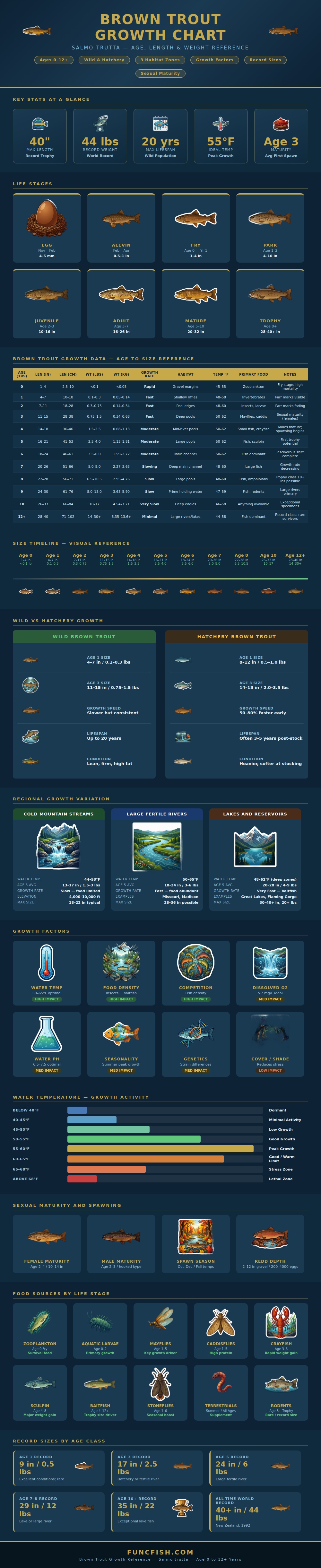
If you’re after truly big trout rather than just any big trout, stop thinking about them individually and start seeing their growth pattern as part of a larger story. The visual reference above shows how these fish grow from fry into adults, which explains why some rivers produce giants while others never grow big except because of a lack of resources. It’s not magic. It’s resource availability.
Water temperatures cool off quickly, there isn’t as much food around, and fish growth slow way down on cold mountain stream fisheries. They’ll take five years to get to the same size as a two year-old cousin who grew up in a lake. That makes the tradeoff worth paying attention to. It means that the old fish in high-elevation systems tend to be far more cautious, thinner, and harder to fight than their plump cousins in lower elevation lakes. You need to adapt your fly selection and presentation speed to fit the environment.
It all starts early; way early, in the egg stage of development. The newly hatched alevin (gravel bed dwellers in the late winter) is completely dependent on their yolk sacks. It’s called the bottleneck phase: Many die here. The lucky ones that survive turn first to algae and other microscopic organisms, and then mainly to zooplankton.
They are fry now, with unmistakable parr marks on their sides to help them blend in with shallow riffle water. By age one, they develop distinct parr marks, which then fade as they transition into juveniles around age two or three to reveal the classic golden brown spotted with red and black that will be their signature throughout the rest of their lives. The color transformation indicates a dietary shift as well. Gone are the days of grazing on surface insects. Instead, they pursue larger food, such as caddis larvae, mayflies and even small crayfish.
It’s also important to know how large they grow and at what age they mature. Generally speaking, females becomes sexually mature at the age of two-four and males tend to sprout that signature hooked jaw a bit sooner. Come autumn, when water temps begin to dip back down into the low fifties, they spawn. Spawning occurs during this period; however, their body essentially halts any growth for the time being and puts all of its energy towards breeding rather than bulk. So if you’re fishing directly following spawning season, don’t go expecting monster bites. These things have been working hard and need some recovery time. Give ’em a few more weeks and wait until springtime when the food starts getting thick once more. This is when those buggers truly start to chomp.
Hatchery stock complicates things even more. These fish are raised with no predators or competitors, fed high quality pellets, and develop faster at a young age. But when they hit the wild, most has trouble adjusting their feeding behavior and eluding natural predators. They seldom survive beyond five years after being stocked unless conditions is particularly mild. Meanwhile, wild born trout may live as long as 20 years (assuming they aren’t targeted by anglers or otherwise killed). This extended life span results in an occasional fish that breaks from the norm. These are the occasional trophies that don’t fit the typical growth curve.
The potential is perfectly shown by record size fish. Nothing is stopping a healthy 10 year old wild brown from reaching thirty inches or more and tipping the scale at more than twenty pounds on a fertile lake system. And that’s no anomaly. It’s the product of steady water temps ranging between fifty-five and sixty degrees Fahrenheit and constant access to high-protein food sources such as baitfish and even small rodents.
The 55-60 degree range is the sweet spot for metabolic efficiency. Anything below forty cause activity to grind to a halt. Anywhere above sixty-eight begins to cause stress rather quickly.
Next time you get one on a long cast in some deep water, consider the story behind the fish. It might be a young, struggling hatchery release trying to make it through its first winter, or an old wild veteran that’s lived longer than dozens of generations of fry. If you look at the chart above, you’ll find the probabilities laid out pretty clearly. To effectively target browns, we must respect not only the fish itself but also its environment. You need to know when to expect them and where to look for them.
You must also read the water for the right temperature and realize that size is just a sign of a healthy habitat. Slow down, be sure to read the temperature and keep your fly subtle. Let the water do the talking and it will reveal what’s hiding inside.