Bubble Float Water Fill Ratio Calculator
Balance a casting bubble float by solving fill water, total casting mass, buoyancy reserve, sink posture, and drift pull from real float volume and rig weight.
🎯Fishing Presets
⚙Bubble Float Inputs
Bubble Float Fill Results
📊Current Float Snapshot
📏Bubble Float Body Reference
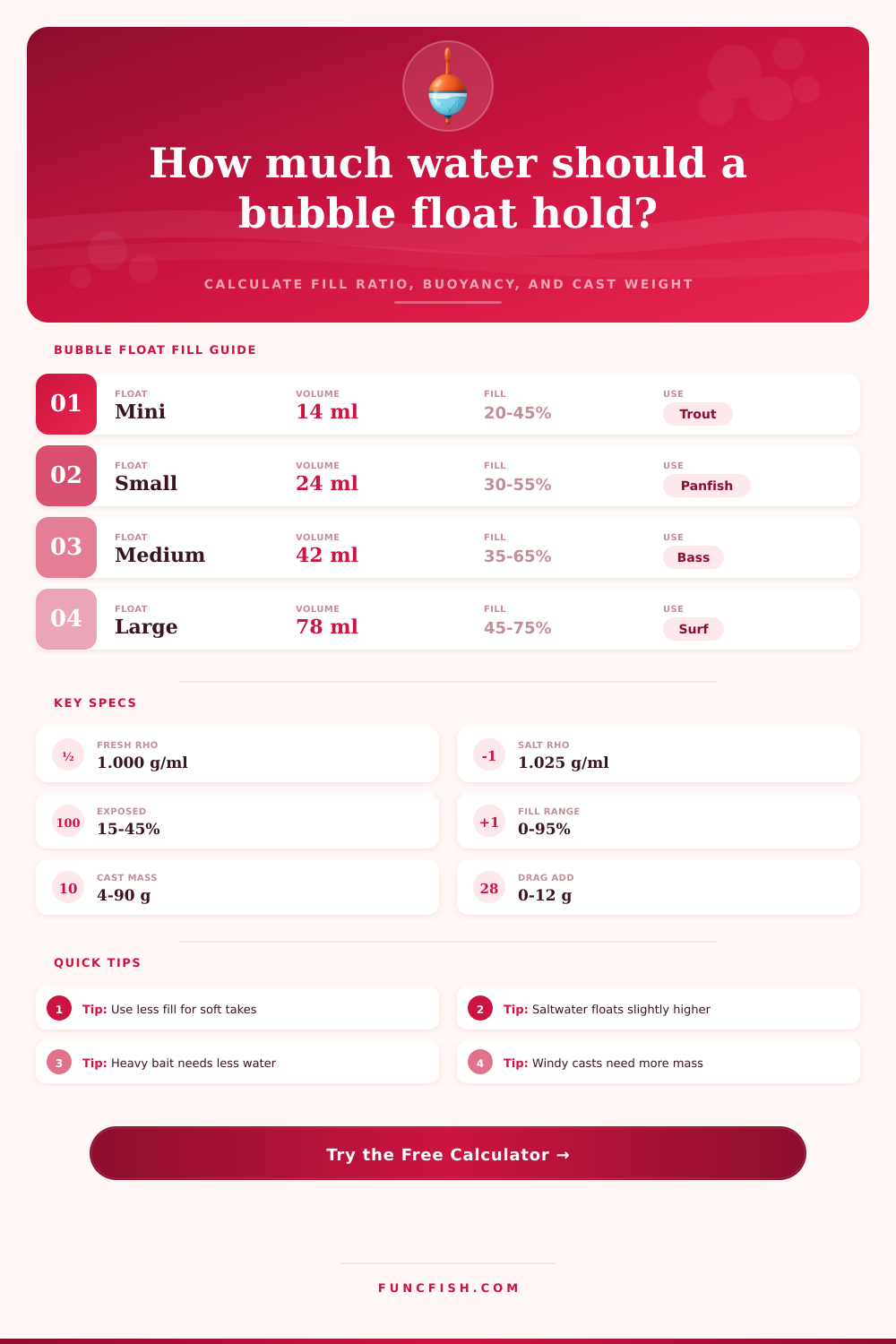
| Float body | Displacement | Empty weight | Best use |
|---|---|---|---|
| Micro clear bubble | 14 ml / 0.47 fl oz | 1.8 g / 0.06 oz | Small dry flies, calm trout pools |
| Small oval bubble | 24 ml / 0.81 fl oz | 2.9 g / 0.10 oz | Panfish bait, stocked trout, light leaders |
| Medium casting bubble | 42 ml / 1.42 fl oz | 4.8 g / 0.17 oz | All-around trout, bass, and stream rigs |
| Large casting bubble | 78 ml / 2.64 fl oz | 8.6 g / 0.30 oz | Long casts, live bait, windy banks |
| Slim pencil bubble | 36 ml / 1.22 fl oz | 4.2 g / 0.15 oz | Lower drag river drift and subtle takes |
| Long-cast rocket bubble | 64 ml / 2.16 fl oz | 7.4 g / 0.26 oz | Distance casting with flies or soft plastics |
| Surf bubble float | 110 ml / 3.72 fl oz | 12.5 g / 0.44 oz | Surf wash, mullet strips, larger bait rigs |
💧Fill Ratio Behavior Table
| Fill ratio | Float posture | Cast feel | Use case |
|---|---|---|---|
| 0-20% | High riding, very buoyant | Light and wind sensitive | Dry flies, bread, calm shallows |
| 20-40% | Visible top, easy bite read | Moderate cast control | Trout bait, panfish, finesse rigs |
| 40-60% | Balanced waterline | Good distance and stability | General bait, river drift, bass edges |
| 60-80% | Low profile with reserve | Strong cast mass | Wind, chop, inshore shrimp, surf troughs |
| 80-95% | Nearly neutral, touchy margin | Maximum water ballast | Special long casts only when load is light |
🐟Gear And Species Comparison Grid
🌊Water Density And Lift Table
| Water type | Density | Lift change | Fill adjustment |
|---|---|---|---|
| Warm freshwater | 0.998 g/ml | Baseline lake lift | Use calculated fill directly |
| Freshwater | 1.000 g/ml | Standard float rating | No correction needed |
| Cold river | 1.002 g/ml | Slightly more lift | Add about 0-1% water if needed |
| Brackish estuary | 1.010 g/ml | About 1% more lift | Add about 1% water for same line |
| Saltwater | 1.025 g/ml | About 2.5% more lift | Add 1-3% water for same posture |
⚖Load And Sensitivity Reference
| Rig load | Downward mass | Suggested exposed top | Notes |
|---|---|---|---|
| Tiny fly or bread | 0.5-2 g / 0.02-0.07 oz | 30-45% | Use low fill to land softly and stay visible |
| Small bait hook | 2-5 g / 0.07-0.18 oz | 25-40% | Good all-around bite indication range |
| Bait plus shot | 5-12 g / 0.18-0.42 oz | 20-35% | Often needs larger float or less water fill |
| Live minnow or shrimp | 8-20 g / 0.28-0.71 oz | 25-45% | Reserve prevents bait from dragging the bubble under |
| Surf leader bait | 15-45 g / 0.53-1.59 oz | 20-35% | Large displacement matters more than maximum fill |
💡Calculation Tips
Formulas use Archimedes lift, float displacement, shell weight, chamber capacity, water density, desired exposed float percentage, rig mass, current drag allowance, wind allowance, and casting-weight target.
There is water inside the float. Getting the ratio wrong makes your float sink like a rock initially upon hitting the water. Most guys don’t pay attention to the water that they put in their floats because it’s kind of an afterthought. “I’ll just throw some water in there so I can cast it.”
But really, there are three reasons to have water inside the float. First, it gives your float more mass for casting. Second, it balances your float so it floats upright. Third, it minimizes surface area for the wind to catch.
Why Water Inside Your Float Matters
So if you mess up ratio of water in your float, then your float might sink so far that you won’t even see your bait anymore, or the wide rim will catch the wind and blow your bait out of range. The point is you need to know what those milliliters in the chamber mean. This is where the math come into play.
After inputting weight of your rig and amount of float volume, the calculator above does the rest for you. This avoids the guesswork of whether a medium bubble can handle the weight of heavy load.
Water density vary based off its temperature and content (fresh vs salt). For example, cool water in a river will lift a float differently than warm water in a pond or the surf. Because saltwater is heavier it provides more buoyant force for the same amount of displaced water. This means the float might ride just right with 30% showing on lake, but it may ride too high in the bay, making it likely to blow upwind.
Adding a bit more water weight will help maintain consistency while keeping the bait at the desired depth. It’s a small adjustment but it keeps your bait fishing at the exact depth you intended rather than drifting an inch above it.
Most folks agree that wind decreases accuracy, although good ballasting can reduce this if done properly. Light weight coupled with an empty float acts as a sail, catching the winds pull and tugging the line side to side while alerting wary fish to your presence. Water added to the chamber drop the center of gravity, making the rig more stable in choppy weather.
There is, however, a point of diminishing returns when it comes to adding water. Too little water and the float won’t give any indication of a slight take. A slight downward dip beneath surface that should trip the rod may instead be swallowed up by all that extra mass.
You’re looking for a happy medium between a weighty rig capable of punching through a moderate breeze and something still sensitive enough to sense even tentative mouth movements. You have to make tradeoffs among all of those forces, but each species want something different.
If you’re trout fishing, delicate presentation and visibility matter. You want your float up high, riding gently onto the surface. So you hold the fill down.
When bass anglers are throwing weighty soft plastics out on the deep edge, or trying to hit a target further away with a longer cast, they want greater stability and longer casts. That’s why they’ll push their fill ratio up and give their floats more weight to help them fight the pull of water and give them some forward momentum.
And then there is the ultimate example: surf casting, where overcoming the air resistance from blowing off breaking waves is most important and demands maximum ballast to force the bait past the break zone. The page also has a handy table laying out which float bodies works best for which scenarios. Notice that it isn’t just big fish that benefit from a large displacement bubble. They’re also useful for heavy environmental loads.
How do you pick the proper fill? That’s based on how much weight you’re putting on the hook as well. For example, if you’re tying on a chunk of bread or a dry fly, there is almost no added weight; therefore the float has to support the bulk of the weight and not sink with the rigging.
When using live bait such as shrimp or minnow, they will actively swim and pull down on the line, applying dynamic downward pressure that isn’t accounted for with static weights. To keep the bait floating in the strike zone instead of letting it drag the whole rig to the bottom, you need more buoyancy.
So if you’re continuously readjusting split shot to get the float leveled out, you probably would of had an overly aggressive or conservative first try at balancing your buoyancy. The trick with the bubble float is learning its balance of water and air within the transparent container. You don’t just need to get it out there; you need to keep it there too, while still being sensitive enough to sense when something connects.
So take what the calculator suggests as your starting point and adjust according to what it does in the real world of current and wind. If it comes down and lays flat, stays up and runs true without hanging up or sinking too much, and bites cleanly without a lot of excess drag, you’ve dialed it in. Minimize the splash at the beginning so it has more juice left over for the bite than for the launch.