Calorie Burn per Fishing Hour Calculator
Estimate calories burned per fishing hour and across a full outing from fishing style, body weight, active casting time, walking or wading, carried gear, and field conditions.
📌 Fishing calorie presets
⚙ Angler, activity, and condition inputs
Fishing calorie estimate
Formula breakdown
📊 Current calculation details
Starting effort for the selected fishing style.
Extra cost from walking, wading, or sand travel.
Added strain from carried fishing equipment.
Time blended at low fishing-rest intensity.
🎣 Gear and species comparison grid
Bass bank gear
Moderate cast cadence, small bag, firm shoreline. Often near the middle of the calorie range.
Trout wading kit
Waders, current balance, and frequent stepping raise burn even with light tackle.
Surf species setup
Long rods, sand, bait buckets, and repositioning make surf sessions energy dense.
Boat trolling spread
Deck work and fish handling add bursts, but long trolling periods usually lower hourly burn.
📘 Reference tables
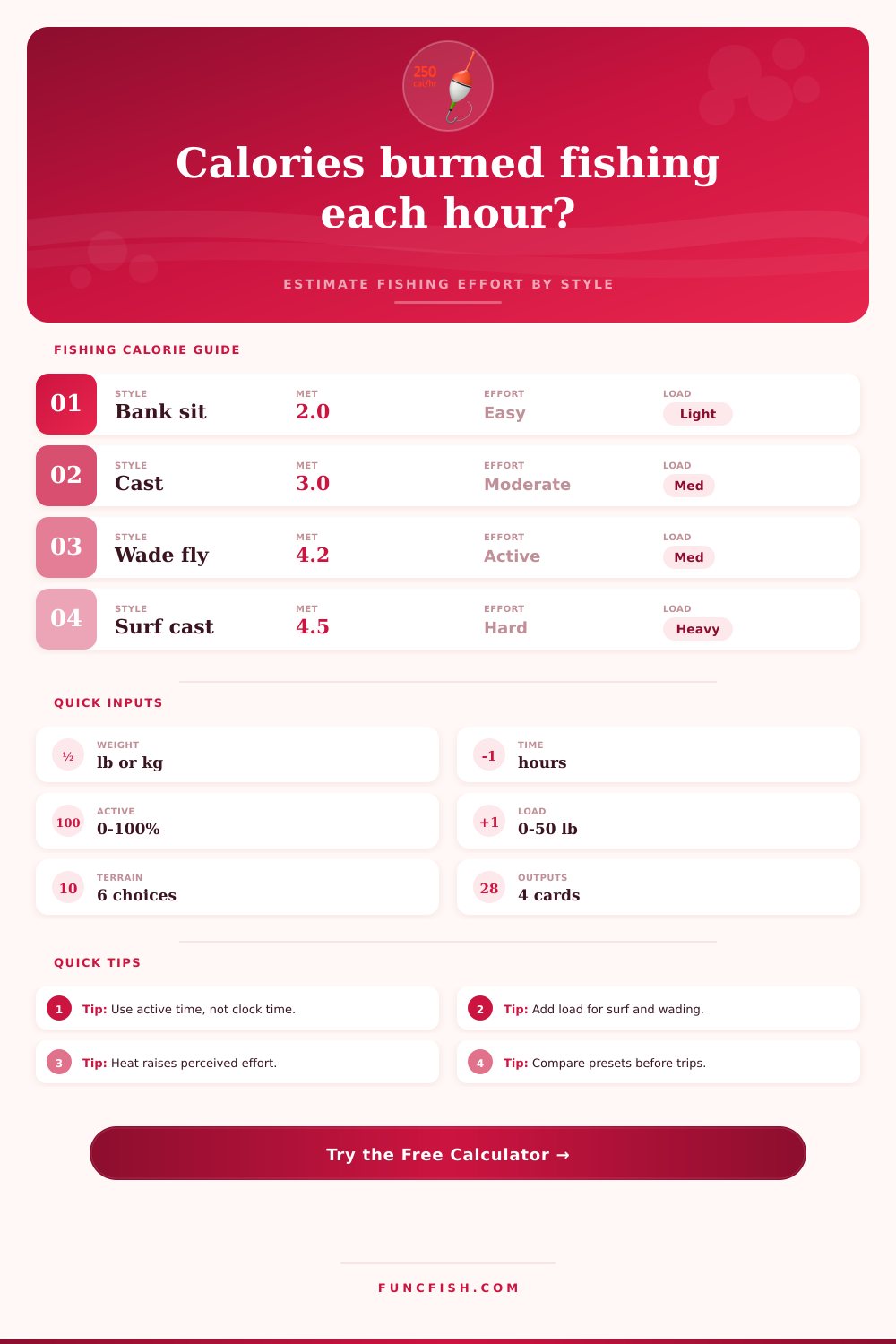
| Fishing style | Base MET used | Typical movement | Best use in calculator |
|---|---|---|---|
| Bank or pier mostly sitting | 2.0 MET | Low standing, bait checks, short walks | Catfish, carp, pier panfish, bait soaking |
| Standing cast-and-retrieve | 3.0 MET | Repeated casts, lure changes, moderate stance work | Bass, crappie, pike, inshore docks |
| Fly fishing with wading | 4.2 MET | False casts, mending, current balance, careful steps | Trout, smallmouth, steelhead pocket water |
| Surf casting and sand walking | 4.5 MET | Long casts, rod holders, soft sand, gear shuttling | Striper, red drum, pompano, surf perch |
| Kayak or paddle fishing | 3.8 MET | Paddle strokes, anchoring, boat control, casting | Redfish, bass, speckled trout, lake trout |
| Boat trolling or drifting | 2.4 MET | Deck movement, rod checks, netting, seated periods | Salmon, walleye, offshore trolling, drift rigs |
| Access or footing | Terrain factor | Why it matters | Calculator interpretation |
|---|---|---|---|
| Dock, pier, or stable deck | 0.95x | Flat footing reduces stance corrections | Best for seated or light standing sessions |
| Firm shoreline | 1.00x | Normal walking and casting mechanics | Default bank-fishing reference |
| Soft sand or beach troughs | 1.18x | Each step sinks or slides slightly | Raises movement and load effects |
| Rocky riprap or uneven shore | 1.16x | Balance corrections and careful stepping | Useful for jetty, dam, and breakwall trips |
| Knee to thigh wading | 1.22x | Water resistance and bottom grip add work | Typical stream or flat wading scenario |
| Waist-deep or pushy wading | 1.34x | Current pressure and slow repositioning | High-strain wading estimate |
| Hourly burn grade | Approx kcal/hr | Adjusted MET range | Fishing examples |
|---|---|---|---|
| Easy | Under 225 | Under 2.6 | Seated bait fishing, trolling, calm pier sessions |
| Moderate | 225-375 | 2.6-4.0 | Steady lure casting, light bank walking, kayak drift control |
| Active | 375-550 | 4.0-5.5 | Fly wading, shore hiking, repeated netting and landing fish |
| Hard | 550-725 | 5.5-7.0 | Surf casting with load, rocky access, strong wading current |
| Very hard | Over 725 | Over 7.0 | Heavy gear moves, hot weather strain, long soft-sand walks |
| Adjustment | Low setting | High setting | Effect on calories per hour |
|---|---|---|---|
| Active time | Waiting, watching rods, seated pauses | Constant casting, paddling, or wading | Blends between idle fishing MET and active style MET |
| Distance per hour | Stationary deck or bank spot | Mobile shore fishing or beach walking | Adds movement MET before terrain and condition factors |
| Gear load | Rod, small box, light pack | Waders, surf cart items, batteries, cooler | Scales burn upward by carried load relative to body weight |
| Weather strain | Mild, shaded, calm | Hot sun, cold layers, current, chop | Applies a field multiplier to the adjusted MET estimate |
💡 Calculation tips
Fishing can be viewed as relaxing passive recreation by most anglers. Sure, every now and then you stand up, reel something in, and sit back down. From the bank, that’s what it appears like. Being out on the water is a different experience when you have ten pounds of gear strapped to your body while you hike across slick rock to reach a distant pool, wade in cold currents, or sit in a chair waiting for a bite. This difference might not seem important, but it makes all the differance in terms of your post-trip appetite and energy budget. Burn rate calculations make sense when you understand that difference.
We all think we’re burning no calories by sitting around. But once you consider the background labor involved in fishing, you realize you are. You has to balance on an unstable surface, heave a cast into a headwind, and lug a full tackle box uphill. The body must work for it and the math is done for you by plugging in your unique circumstances with the calculator above. You don’t have to guess if you’re doing casual leisure or light exercise.
Why Fishing Burns Calories
Active time is perhaps the most overlooked variable. Simply sitting on a dock for four hours doesn’t mean that you sat there for four hours inactive. You might have only made fifty casts. Each cast was a burst of high-intensity activity followed by periods of small adjustments and staying in position. Combining these two styles provides a far more accurate picture different than choosing one style or the other and committing to it.
Everything else do change with footing. It doesn’t take much energy to walk around on solid ground like grass, but it takes your stabilizer muscles working overtime to stay upright when walking in soft sand or rocky riprap. This additional small effort build up very quickly over the course of a long day. When you’re wading, there’s another factor to consider. The water pushes back with each step making knee-deep wading much harder than walking on dry land. By selecting your terrain type, the tool adjust the metabolic equivalent accordingly.
The other silent calorie burner is gear load. That little box and a light vest may seem insignificant until you are wearing them for three hours in the sun at 90 degrees. Add a cooler, some surf rods, boots and waders and what was a casual afternoon has now become a pretty substantial physical task. The weight isn’t everything because the way the weight impacts the challenging footing plays a role too. Thirty pounds on a flat dock can be no problem. Thirty pounds up the sandy beach is a workout, as it requires your legs to use more force each time they move.
Surprisingly enough, weather matters as well. If it’s hot out, your cardiovascular system has to do extra work keeping you cool, which results in you feeling like you’re going faster then you actualy are. Your muscles have to tense up more (to keep yourself warmer) in cold temperatures and that’s also an increase in energy expenditure. These conditions alter the energy cost of doing the same thing, and that’s why there is factors for those included in the calculator.
Look at your result. Look not only at the overall number but its intensity grade. If it’s easy, then go ahead and fuel yourself with water and snacks, but if it’s hard or very hard, you’ll want to be sure to have some electrolytes on hand and plan for a good meal. It will keep you from running out of energy halfway through a long stretch. It will also keep you from being exhausted after hiking back from a short trip.
Fishing is rarely physically passive (but it should of been restorative). The more you recognize how much you’re really working, the easier it is to prepare for the task and fuel up properly. You will also appreciate your efforts. And maybe you’ll even begin thinking of that rocky shoreline less like a spot where you will catch some fish and more like a reason to pack another sandwich.