Casting Trajectory Angle Calculator
Estimate the launch angle, required speed, apex height, hang time, and line-out allowance for a fishing cast using projectile math with fishing-specific drag corrections.
🎯 Real Casting Presets
⚙ Cast Inputs
Casting Trajectory Results
📏 Gear and Trajectory Snapshot
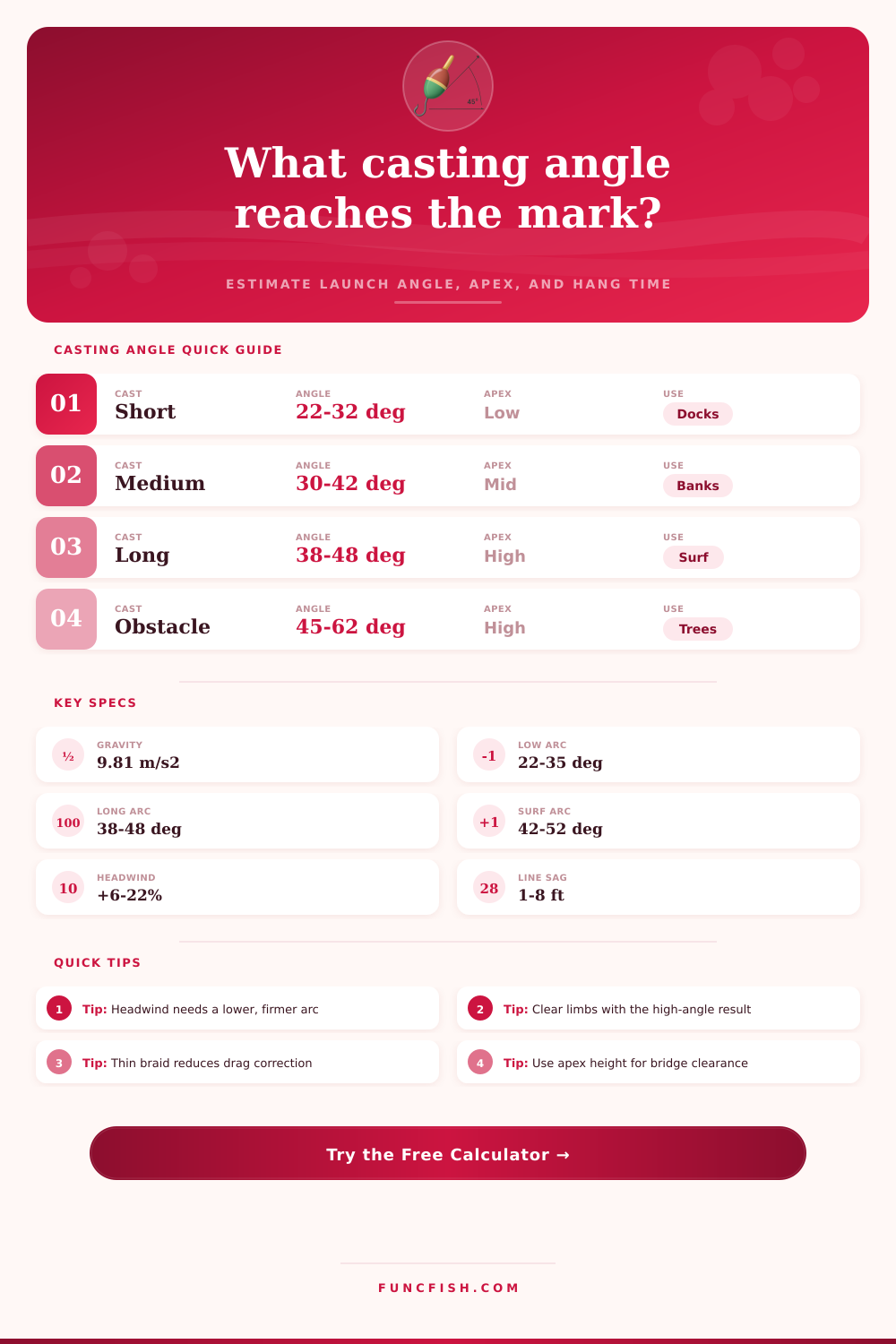
📊 Casting Angle Reference
| Cast situation | Useful angle band | Trajectory behavior | Best fit |
|---|---|---|---|
| Pitching to docks or gaps | 18-30° | Fast, flat, short hang time | Bass jigs, spinnerbaits, soft plastics |
| General bank or boat casting | 30-42° | Balanced distance and control | Cranks, spoons, jigs, floats |
| Open surf or pier distance | 38-48° | Long flight with moderate apex | Metals, plugs, sinkers |
| Low cover clearance | 45-58° | Steep arc, more time aloft | Tree limbs, reeds, bank obstructions |
| Bait lob or sinker arc | 48-65° | High, slower, more vertical landing | Catfish, bait rigs, live bait |
🧵 Line and Lure Drag Reference
| Material or profile | Relative drag | Trajectory effect | Calculator adjustment |
|---|---|---|---|
| Thin braid, slim metal | Low | Flatter path holds speed well | Small distance correction |
| Standard braid, soft jig | Moderate-low | Good distance with light sag | Balanced correction |
| Monofilament and plug | Moderate | More bow and air resistance | Extra range demand |
| Fluoro leader and swimbait | Moderate-high | Heavier profile slows earlier | Higher speed need |
| Fly line or float rig | High | Large air profile, high sag | Strong arc correction |
🐟 Species and Technique Comparison
| Target or technique | Typical range | Common gear | Angle tendency |
|---|---|---|---|
| Bass spinnerbait around cover | 20-45 yd / 18-41 m | 7 ft medium-heavy, 12-17 lb line | Low to balanced, 24-38° |
| Trout stream with limb clearance | 10-30 yd / 9-27 m | 6-7 ft light, 4-8 lb line | High when clearing brush, 38-55° |
| Surf plugs and tins | 55-110 yd / 50-101 m | 9-11 ft surf rod, braid leader | Distance arc, 40-48° |
| Kayak inshore jigging | 15-45 yd / 14-41 m | 7 ft medium, braid to leader | Lower release height, 32-45° |
| Catfish bait and sinker | 30-80 yd / 27-73 m | 7-10 ft medium-heavy, mono | Lob arc, 45-60° |
💨 Wind and Height Corrections
| Condition | Range correction | Angle choice | Watch item |
|---|---|---|---|
| Light tailwind | Reduce by about 4-7% | Normal or slightly lower | Avoid over-running the target |
| Calm or sheltered | No wind correction | Use computed low or balanced arc | Line diameter still matters |
| Crosswind | Add about 6% | Lower angle for less drift | Bow in line during flight |
| Light headwind | Add about 12% | Lower and firmer if possible | Lure profile drag |
| Strong headwind | Add about 22% | Use a compact path | High arcs stall quickly |
💡 Calculation Tips
Ever make a great cast only to watch your bait sail over the mark (or smack into a branch you didn’t see)? That can be frustrating because while fishing is all about feel, it’s also about understanding the geometry. Controlling the line arc make a huge difference in accuracy of pitches and presentations. Knowing the trajectory lets you eliminate guesswork and begin knowing what direction your lure will go.
It’s easier then you think. It is physics 101. It’s just a projectile launched from some height with some velocity that is slowed by air resistance along its travel and pulled down by gravity. The way these two effects work together depend on the angle at which you launch that rod.
How to Control Your Casting Arc
Low launch means fast flat flight that is good for accuracy but lousy for obstacle clearance. High launch mean clearance but doesn’t travel as far. Find the sweet spot for your situation.
For example, I might want to cast underneath a tree limb. You’ll probably default to trying to throw it harder. But more often than not, that’s not going to fix things. Do you know what happens when you fire a low-angled cast at full speed? Yep, your line knocks into those limbs. Do you go steep? Sure, it’ll shoot up there, but then it dies like a fish out of water.
All you have to do is enter the height of the obstacle and your rod length into the calculator above. It tells you exactly how much clearance you need and if your speed is enough. You won’t have to figure parabolas in your head while getting rained on. It simply lets you know how much room you have and if you’re throwing fast enough to cover distance without dying.
This also has everything to do with line. When fishing in the air, your line diameter becomes almost like a sail. Thin braid cuts through the air very well and allows you to keep a flatter trajectory. Thicker fluorocarbon leaders catch a lot of wind and create drag on the lure, making it fall earlier than you might think it should based off purely gravity. Now if you’re throwing a big mono out on a long cast, you have to be able to get a higher release angle to keep it up there, but that same setup will struggle in the wind. The opposite is true with a light braid, which cuts through the air easily to keep a flatter path and hold its line well. It matters both what weight class you use and how it cuts through the air. How it move through the air is important.
And then there’s wind. Headwinds slow down your lure as it flies through the air like hitting a brick wall. You can try throwing harder, but that usually just makes flight higher. Then the lure stalls out and falls short. The key in wind is lowering the angle to punch through the wind better while maintaining a smaller footprint. Tailwinds will push the line ahead and increase the distance, sometimes allowing you to overshoot tight targets on rocks or around dock posts. It’s not so much about how hard you throw but adjusting based off the wind and being able to time up the throw to counteract those uncontrollable outside factors.
This is how high they get off the deck. Most anglers don’t think about this too much. However, standing up on a high bank gives them some extra hang time, so the lure will go farther before splashing into the water. When you cast from a low kayak seat, that’s not really an option anymore, so you have to rely solely on angle and speed to make the same casts. That can mean a few yards of difference in overall casting range for every foot of elevation. Again, it’s nothing huge, but when you’re looking to hit a particular spot like a current seam or the edge of a shadow line, it makes a big difference.
The key thing is getting enough apex without snagging So let’s say the tool recommends an apex of eight feet but your overhanging brush is just six feet tall. That gives you some wiggle room. You can back off the angle a bit more to get more speed and accuracy while still clearing the snags. Having that kind of wiggle room is what makes the difference between the guys who always seem to be fighting their gear and the consistent ones. They can make little adjustments in real time instead of having to start all over trying something totally different.
In short, it’s about geometry, force, and finesse. Yes, you’re fighting against physics, but you could of also been working with it. Learning to understand the connection between drag, speed, and angle allows you to take what would otherwise be a chaotic action and make it a repeatable skill. It’s not so much about getting the lure there as it is putting it right where the waiting fish are. Controlling that arc brings the chaos under control and puts power back in your hands.