Catch Consistency Score Calculator
Turn recent trip logs into a repeatability score by weighing catch rate, bite conversion, quality fish, conditions, species, gear fit, and pattern freshness.
📌Scenario presets
⚙Catch log inputs
Use trips with the same target pattern.
Actual fishing time, not travel time.
Catch consistency forecast
Full breakdown
📋Species and gear consistency grid
Panfish
Trout
Bass
Walleye
Catfish
Redfish
Striper
Tuna
📊Reference tables
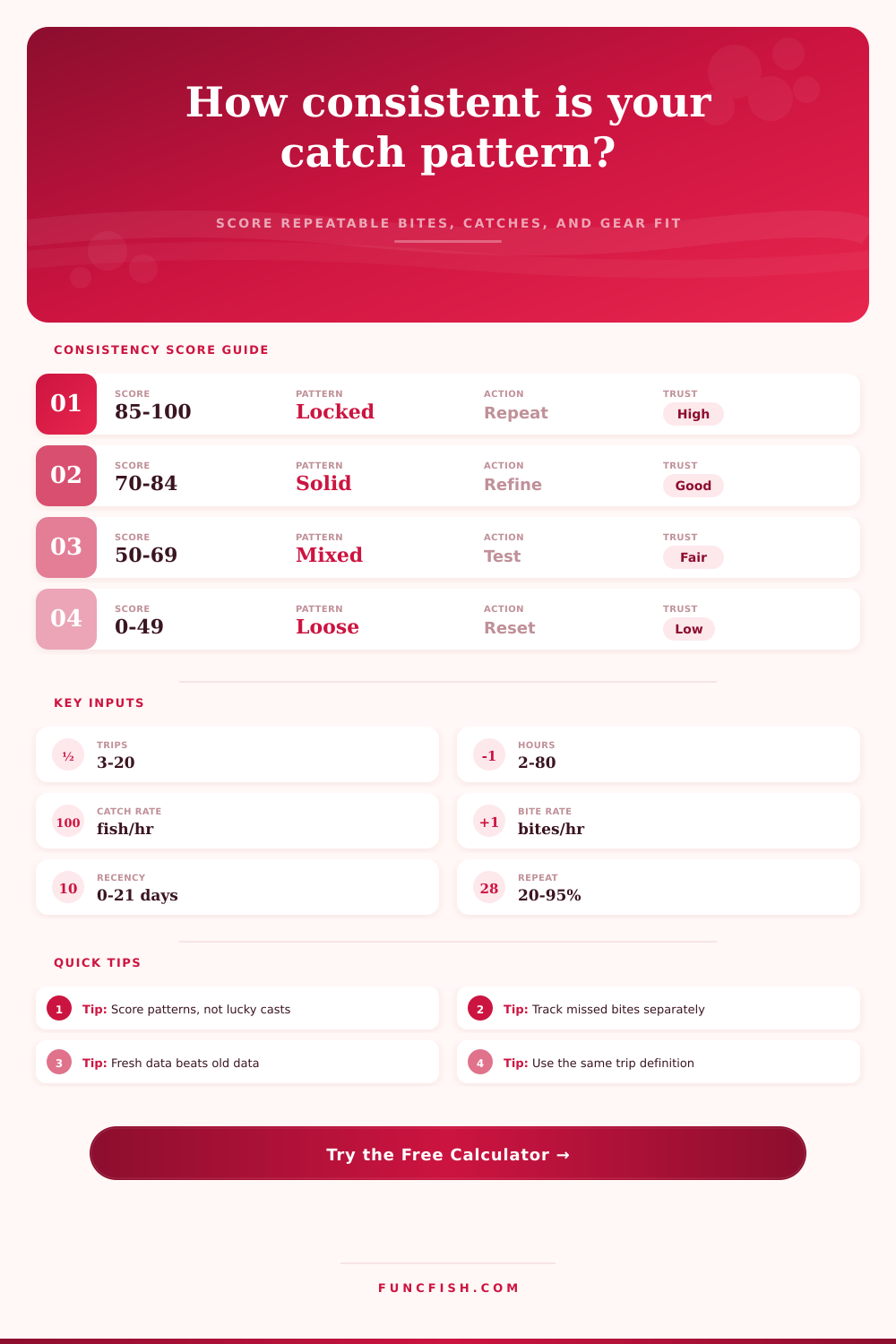
| Score band | Pattern reading | Repeat plan | Data caution |
|---|---|---|---|
| 85-100 | Locked pattern | Repeat the window and route | Watch for major weather changes |
| 70-84 | Solid pattern | Repeat, then tune bait or speed | One weak trip can move the score |
| 50-69 | Mixed pattern | Test one variable at a time | Needs more matching trips |
| 0-49 | Loose pattern | Reset location, timing, or gear | Do not overtrust the sample |
| Species group | Expected fish/hr | Quality threshold | Best sample size |
|---|---|---|---|
| Panfish / bluegill | 2.0+ | Hand-size fish | 5-8 trips |
| Crappie | 1.4+ | Keeper slabs | 5-8 trips |
| Stream trout | 1.0+ | Target-size trout | 4-7 trips |
| Bass | 0.7-0.8 | Above-average fish | 5-8 trips |
| Walleye | 0.7+ | Eating-size fish | 4-7 trips |
| Catfish | 0.5+ | Solid channel or blue | 3-6 trips |
| Striper / redfish | 0.4-0.6 | Slot or strong fish | 4-7 trips |
| Tuna / pelagic | 0.2+ | Landed target fish | 3-5 trips |
| Gear class | Typical line | Best fit | Consistency effect |
|---|---|---|---|
| Ultralight finesse | 2-6 lb / 1-3 kg | Panfish, trout | Helps light-bite conversion |
| Light spinning | 4-10 lb / 2-5 kg | Trout, crappie | Good balance for finesse |
| Medium spinning | 8-15 lb / 4-7 kg | Bass, walleye, redfish | Stable all-around choice |
| Medium-heavy casting | 12-25 lb / 5-11 kg | Bass, pike | Protects landing rate in cover |
| Heavy bottom rig | 17-40 lb / 8-18 kg | Catfish, bait rigs | Supports longer soak patterns |
| Surf casting | 15-50 lb / 7-23 kg | Striper, surf fish | Handles distance and current |
| Fly setup | 3-8 wt | Trout, bass, redfish | Strong when drift is repeatable |
| Offshore trolling | 30-80 lb / 14-36 kg | Tuna, pelagic fish | Scores from bites per pass |
| Factor | High score sign | Low score sign | Weight |
|---|---|---|---|
| Catch rate | Beats species target | Far under expected rate | 24% |
| Trip repeat rate | Most trips produce fish | Only one trip carried it | 18% |
| Bite conversion | Most bites become fish | Many missed or lost fish | 14% |
| Quality ratio | Good fish show often | Only small fish show | 12% |
| Freshness | Recent matching data | Old or stale pattern | 10% |
| Conditions | Stable and repeatable | Volatile or pressured | 12% |
| Gear fit | Matched to species | Overpowered or underpowered | 10% |
💡Practical checks
Tip: Keep one trip definition across the sample. Mixing two-hour quick stops with all-day searches can make a steady pattern look weaker than it is.
Tip: If the score is high but conversion is low, the fish are showing up. Adjust hook size, drag, rod angle, or bait timing before abandoning the spot.
It is a simple formula. So how do you determine if your latest hot hand is repeatable or simply a statistical oddity? While most anglers understands the distinction between a random bite and an actual pattern, very few of us can measure this occurance.
For instance, you go on a good day and the bass are hammering topwaters in the grass, then you come back a week later and all there is is silence. Did you leave because the fish were not there or did you time it wrong? It’s a fine line between fun weekend fishing trips and regular catches.
How to Score Your Fishing Success
Scoring catch consistency is simply about adding context to raw numbers. Four bass might sound great, but you could’ve fished all day at 3 different lakes using 3 different lures, and it still only took 12 hours of fishing time. It is not exactly a pattern but more like a scatter-shot effort.
In order for this thing to spit out something meaningful we must begin to isolate our variables. General location, technique and target species are what the tool inquires about. Your data will become muddied if you take a slow drift in the morning and then bomb ‘em from bank in the afternoon.
What exactly constitutes a trip? That’s the first question you need to answer before the math can tells you anything true.
Recency > Volume
A single trip from last week is worth much more than 10 trips from last year. Bait cycles change, fish move and water temperatures fluctuates. Having a great score using stale information isn’t better than having zero information. It lulls you into a false sense of security with a strategy that may or may not exist anymore.
To ensure you remain focused on what the water is saying today, the calculator punishes old information. This prevents nostalgic reminiscing about how well lake produced in the summers of years past.
Another small factor is gear fit. Even with spot selection and perfect timing, a poor hookup ratio will result if you have to small of hook for the species, or too heavy of line for the bite. The page’s reference table outlines typical gear classes and line weights by species. Catfish on ultralight gear is a mismatch, a drag on your success rate.
It doesn’t mean the fish aren’t there. It means your equipment isn’t tuned to the interaction. Low bite conversion, decent catch rate? Check your gear before you blame the spot.
Sample size is the enemy of intuition., Unknown
That’s why the tool recommends how many trips you should of had under your belt before you can start drawing conclusions for various types of fish. Some species are easier to catch than others. Some may only take five trips, while others could take many trips to get enough data points to account for the randomness of good luck. Don’t believe a low number that comes from such a small sample. It’s akin to eating at a restaurant once and assuming you know what it will be like every time.
Weather greatly impacts consistency. Cloud cover, wind shifts and barometric pressure impact how the fish behave. And if you notice that all of your big bag days occurred on high pressure, calm days, it’s going to be hard for you to duplicate that pattern once a front arrives. That’s why the calculator takes into account weather stability. Your trust level decreases based off changing conditions, because the pattern isn’t as repeatable.
So what does this mean? It means you need to take into account not only what the fish are doing, but also the weather around them. Match your strategy to both the water AND the sky.
But again, the point isn’t to get that magic one hundred. Fishing rarely gets that good. Instead, it’s to help understand where you’re getting close and where you need to adjust. If you get a score between solid and mixed, tweak the timing or maybe even the bait. Improve your approach. But if it’s loose, reset. Change spots, change times, or change lures. Stop fighting the water and go with it.
And that’s really all the math does for us: It takes those weights off our shoulders and lets us make the call; based on numbers instead of hope, as to stay or go. That’s how anglers become consistently good, not by hoping it will happen, but by making a decision based on the math.