
How much feed do you give your catfish? You has to know the right amount to feed at each stage of your catfish’s life. Underfeed your catfish and they won’t grow up. Overfeed them and not only will you spend more money but you’ll wreck water quality.
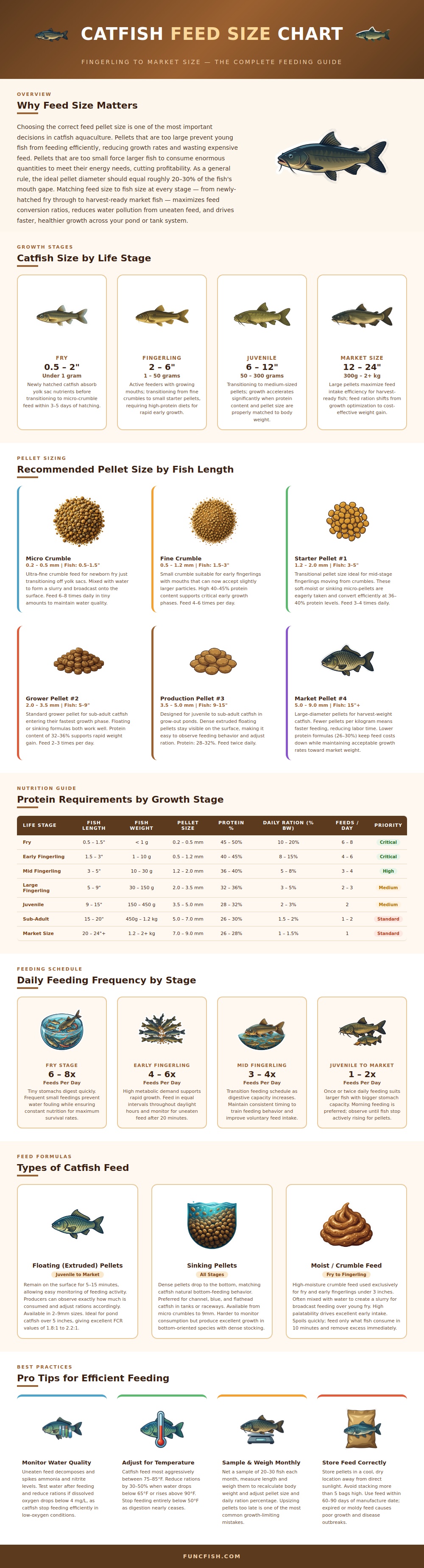
Use the apropriate size pellet for physical capabilities of your fish. Feed a large pellet and it just floats in the water disintegrating into sludge. Feed a small pellet and your fish will chase pellets around wasting energy and not building muscle mass. As the fish grow from tiny fry to market ready animals, so should diameter of pellet. See the graphic chart above for reference.
How to Feed Catfish
The newly hatched fry have some energy stored up inside of their own yolk sac. For several days the fry will survive off those yolk sacs. When the fry finally exhaust that yolk they are ready for immediate food, but their mouths is microscopic! Standard pellets won’t do. As you can see from the chart, micro crumbles and fine slurries take over here.
In this delicate time frame, these smaller particles float on top of the water long enough for the fry to find them (a must since young catfish aren’t good swimmers). Their stomachs are very small. Their stomachs is tiny and empty quickly. And they go through six to eight feedings per day. Growth can be stalled permanently in the early weeks if a feeding is missed by even an hour. Broadcast slurry and mix gentle.
They change from surviving to growing. During fingerling stage, from about two inches long until they reach six inches, fish grow very fast. Pellets changes from fine crumbles to starter pellets to grower pellets. The graphic shows that the jump between pellet sizes goes from less than a millimeter to multiple millimeters during this time as the fish elongate from fine crumbles to grower pellets. Protein requirements are high, often hovering around forty percent or more, because every calorie need to go straight into tissue development rather than maintenance.
When you feed floating pellets, watch them eat; it’s like watching a train wreck, aggressive feeding! It give you a precise idea of their intake rate. Twenty minutes later no food? You are underfeeding them. An hour later still not gone? The water is fouled.
As fish grow to juvenile and market sizes, portion size increase but feeding frequency decreases. Big fish don’t need to be fed as frequently but gobble up much more each time you do. You shift to bigger production pellets that improve intake efficiency as shown on the chart. Protein needs decrease some at this stage; the fish are basicly built now and what you’re doing is adding weight. At this stage most producers only feed one or two times daily. It cuts down on labor and reduces potential water quality problems due to overfeeding multiple times a day.
Temperature becomes a big factor at this stage as well. Because catfish are cold blooded, warm days mean hot-running fish and cold days means stalling fish. You must adjust your rations based off the thermometer, not the calendar. Feeding them too much when the water is too cool will cause trouble because the fish won’t be able to process it.
Observation is key to raising healthy catfish. Your eyes gather the information, while the chart above is just a framework. Sample them monthly for weight. Check the water daily. Observe their eating habits. Get ahead of the curve. Stop throwing money away and get efficient with your growth through matching the pellet size to the actual gape of the fish’s mouth. It keeps things simple and moves chaos into consistency.
Next time you’re standing by the pond, remember: don’t guess; look closely at what they are doing when they are being fed. You should of looked closer.