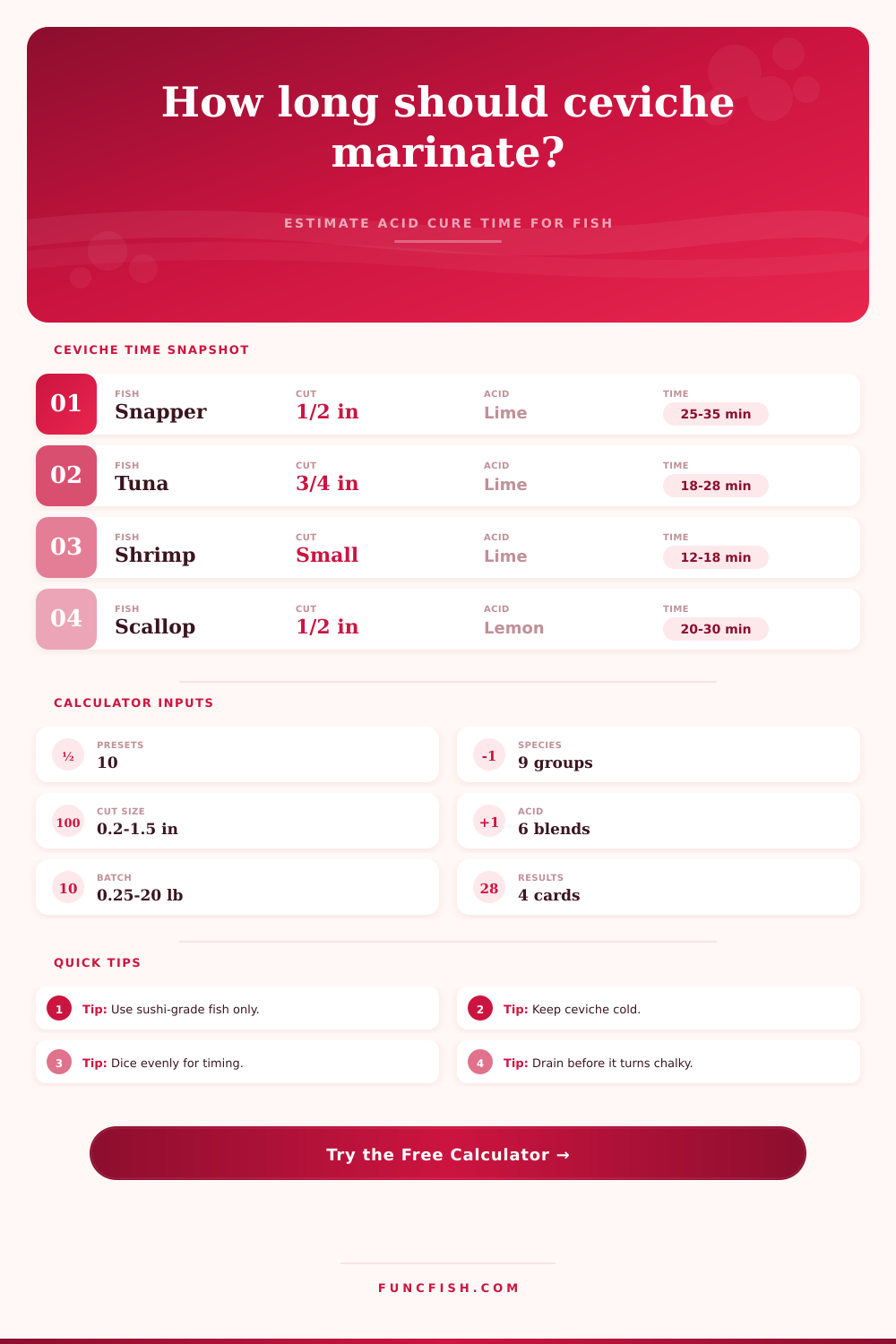
Ceviche Marinating Time Calculator
Estimate acid marinating time from fish texture, cut size, citrus blend, salt level, batch depth, refrigerator temperature, and the serving texture you want.
🐟Quick presets
Choose a realistic ceviche starting point, then adjust the inputs for your actual fish. Acid firms and whitens seafood, but it does not replace safe sourcing, cold handling, or parasite controls.
⚙Ceviche inputs
Ceviche timing estimate
Calculation breakdown
🧪Species and acid grid
Snapper
Sea bass
Tuna
Salmon
Scallop
Shrimp
Lime
Lemon
📊Reference tables
| Seafood | Typical cut | Base time | Texture note |
|---|---|---|---|
| Snapper or rockfish | 1/2 in dice | 25-35 min | Clean flake, quick edge whitening |
| Sea bass or fluke | 1/2 in cube | 30-40 min | Fine texture, holds tender center |
| Mahi mahi or yellowtail | 5/8 in cube | 28-42 min | Meaty bite, good for tostadas |
| Halibut or cod | 3/4 in chunk | 38-55 min | Dense whitefish needs more contact |
| Tuna or bonito | Thin slice | 12-25 min | Often served with rare center |
| Salmon or steelhead | Small dice | 30-50 min | Fat slows acid penetration |
| Cut style | Thickness | Surface effect | Timing factor |
|---|---|---|---|
| Thin slices | 1/8-1/4 in | Very fast acid contact | 0.62x |
| Small dice | 3/8 in | Fast, even whitening | 0.82x |
| Classic dice | 1/2 in | Balanced center and edge | 1.00x |
| Rustic chunks | 3/4-1 in | Slow core firming | 1.34x |
| Whole shellfish | Varies | Shape limits exposed area | 1.12x |
| Uneven bowl | Mixed | Small pieces over-cure first | 1.18x |
| Acid blend | Relative speed | Best use | Flavor result |
|---|---|---|---|
| Fresh lime | Fast | Whitefish, shrimp | Sharp and classic |
| Lime and lemon | Medium fast | General ceviche | Round citrus |
| Fresh lemon | Medium | Scallop, mild fish | Softer acidity |
| Sour orange lime | Medium | Mahi, snapper | Fruitier finish |
| Grapefruit lime | Gentle | Tuna, salmon | Less sharp |
| Citrus plus vinegar | Fastest | Firm whitefish | Clean firm bite |
| Batch condition | Good range | Risk if high | Adjustment |
|---|---|---|---|
| Temperature | 34-40 F | Faster texture change | Check earlier |
| Bowl depth | 1-2 in | Uneven acid contact | Fold more often |
| Citrus ratio | 0.8-1.1 cup/lb | Dry spots or flooding | Rebalance volume |
| Salt level | 0.8-1.5% | Watery or tough bite | Use weighed salt |
| Juicy add-ins | Add near finish | Diluted acid | Delay tomatoes |
| Holding after drain | 0-30 min | Chalky seafood | Serve promptly |
💡Timing notes
Check texture early. Cut one piece at the first-check time. The edge should look opaque while the center matches your intended texture.
Keep acid contact even. A shallow glass or stainless bowl plus regular folding gives a tighter window than a deep container with dry spots.
The instant you squirt lime atop that fish, you’ve begun the cure. It is not a soft sell; it is a deadline in chemistry. Acid change the protein inside the seafood, unfurling its shape and causing it to clump. The result: Flesh that was once translucent grows firm and opaque. Ceviche is actualy cooked…by acid, not heat.
There’s no shortage of variables, which makes timing very dicey. Based off the strength of your citrus, type of fish, and desired cut size, the calculator guesses when you’re in the right ballpark. It saves you the guessing game of looking into a bowl of fish and asking yourself, “Is it done yet?
How to Cook Ceviche Correctly
So what? You shouldn’t just memorize one rule. You should understand the input. For example, a thin piece of tuna in a bowl of lime juice won’t cure different than a half-inch cube of snapper. The acid penetrates slower on meat that’s denser. Firmer, lean fish (like mahi or tuna) fight the acid a little longer then flaky whitefish, which gives up its texture sooner. Which is why the tool starts by asking for either species or general texture group. It establishes the baseline for how aggressive the cure is. Go against that and you’ll overcook delicate types into rubber and undercook dense ones.
The second key is cut size. Smaller pieces has more surface area for their size, so the acid hits them from all sides at once. For example, a rustic chunky-cut ceviche is going to take longer than a fine dice to set up. The timing charts on that page illustrate the trade-off: Thin slices will be ready in a fraction of the time it takes larger cubes. Consistency is also important; your dice should be uniform or else you’ll end up with a dish full of chalky little bits and still-raw big ones in the middle.
There is another level of complication: which citrus should you use? Because of their higher acid content and bright flavor profiles, pure lime juice (that’s why it’s the go-to) does the job quickly. Lemon is more mellow and pairs nicely with a sweeter fish, e.g. With scallops, the resulting flesh has a softer bite. Adding any other acid (e.g. Orange or grapefruit juice) to the mix dilutes the pH and will slow down the curing action; this can be desirable if you desire more flavor development in a longer marinate but aren’t concerned about having to turn the fish into leather. The calculator allow for acid blends as well, and will adjust the timing recommendations accordingly, ensuring that switching juice partway through won’t cause you to overcook your meal.
There’s another factor here that doesn’t talk but makes a big difference: temperature. In warm temperatures, acid reactions accelerate. Set your ceviche bowl down on a hot kitchen counter, and that fish will firm right up, sometimes well ahead of the flavor development. A colder bowl (thirty-eight degrees Fahrenheit, if possible) slows the chemical reaction and allows for a greater margin for error. Besides, it’s safer! Whether your marinade is highly acidic or not, cold handling is essential for both safety and quality.
Don’t cover the fish with citrus: Some recipes direct you to totally cover your fish with citrus. That will cause the fish to be too acidic and mushy. You want to coat your fish well but not flood it. Ideally, there should be enough juice to touch each fish, but you don’t want it to become a soup. By folding or stirring the mixture, you ensure that all of the fish is coated evenly. That way the acid acts on everything consistently and you won’t have any dry pieces that is still raw.
Last but certainly not least: Acid doesn’t kill. Though it will tenderize and add flavor, it isn’t a sterilizer. No matter how well cooked your fish is, if it isn’t from a good source, don’t eat it. For raw dishes, make sure your fish has been previously frozen or sushi grade. Your timing will be just right, but nothing can save bad sourcing on this calculator.
When you’ve reached that sweet spot of tender insides and opaque outsides, pour out any excess juices and serve instantly. Letting it linger makes the delicate flesh chalky, and dulls all those delicious flavors you worked so hard to produce. Knowing exactly what’s in that bowl is key.