
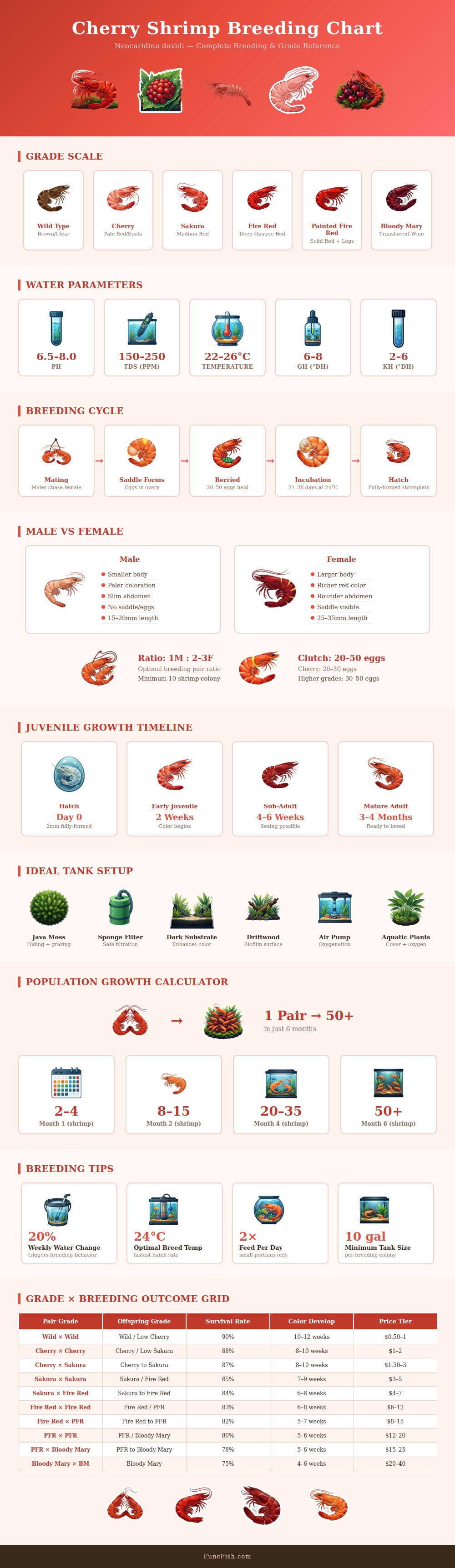
So you begin with one couple of red (translucent) shrimp in your 10g tank. It sounds harmless enough, but before six months have passed, you will have more then fifty shrimp; if you aren’t ready for that explosion, you are just managing a population instead of enjoying a hobby.
Cherry shrimp, aka Neocaridina davidi, reproduce like mad, there’s no vulnerable larvae to worry about. Until hatching she hold 20-50 eggs beneath her tail (females). Upon hatching, the fry are miniature replicas of their parents. They possess no larval stage but rather develops directly into young, an efficient, closed-loop system with low mortality. To sustain its effectiveness, stability is essential.
How to Breed Cherry Shrimp
There’s no need for fancy set-ups. Temperature and pH has wide acceptable ranges. Regular water changes of as little as twenty percent per week typically initiate spawning behavior in the female because it signal “it’s safe” to her. Stick to a routine instead of trying new things; regular care work better than adding extra supplements.
The grade scale from the reference material will be used when choosing pairs. As you might expect, mating two wild type brown shrimp will result in more browns (less exciting). For greater intensity of red, select mates with higher grades such as Fire Reds. Note that those higher grades will tend to change color slowly and may have lower survival rates.
Genetics are not cheap; you don’t buy quantity. You buy genetics. A pair of Bloodys may only survive 75% compared to 90% for wild types, but the ones that survives will command significantly more money on the market.
Adults is easy to identify the sex of if you know what to look at. The females will be bigger (twenty-five to thirty-five millimeters) with a wider abdomen compared to the males who is smaller (fifteen to twenty millimeters). The males will also be lighter than the females. To achieve best results for breeding, keep a 1:2 or 1:3 ratio of males to females. That way the males aren’t overwhelmed and there are enough resource for each female.
This life cycle can be maintained in tank provided it is set up appropriately. For example, dark substrate enhances red color of pigments since they stand out more against a light-colored background. Newly hatched shrimplets hide under java moss and graze on it. Sponge filters provides filtration without sucking up tiny juveniles. Bacterial growth occur on the surface of sponge filters which is a natural food source.
Twice daily feeding with very small amounts prevents overfeeding and deterioration of water quality. Overfed water gets dirty fast and turns ammonia rich. For me, keeping and breeding cherry shrimp is more about allowing nature to run its own course than forcing it. Give them the genetics, give them the environment and stand aside. Take a blank tank and within months, you’ll have a room covered in bright red living carpets.
It is simple stuff that becomes complex through repetition. Two starts an explosion. Let nature run its course and you’re left with a community that thrives.