Clipped Down Rig Length Calculator
Calculate clipped-down rig body length, snood reach, bait-clip drop, hook spacing, lead-link clearance, and release margin for compact distance casting rigs.
📌Clipped Rig Presets
⚙Rig Geometry Inputs
Calculation Breakdown
🧵Rig Body Material Data
📊Clipped Rig Reference Tables
| Rig style | Typical hooks | Snood range | Clip drop range | Best use |
|---|---|---|---|---|
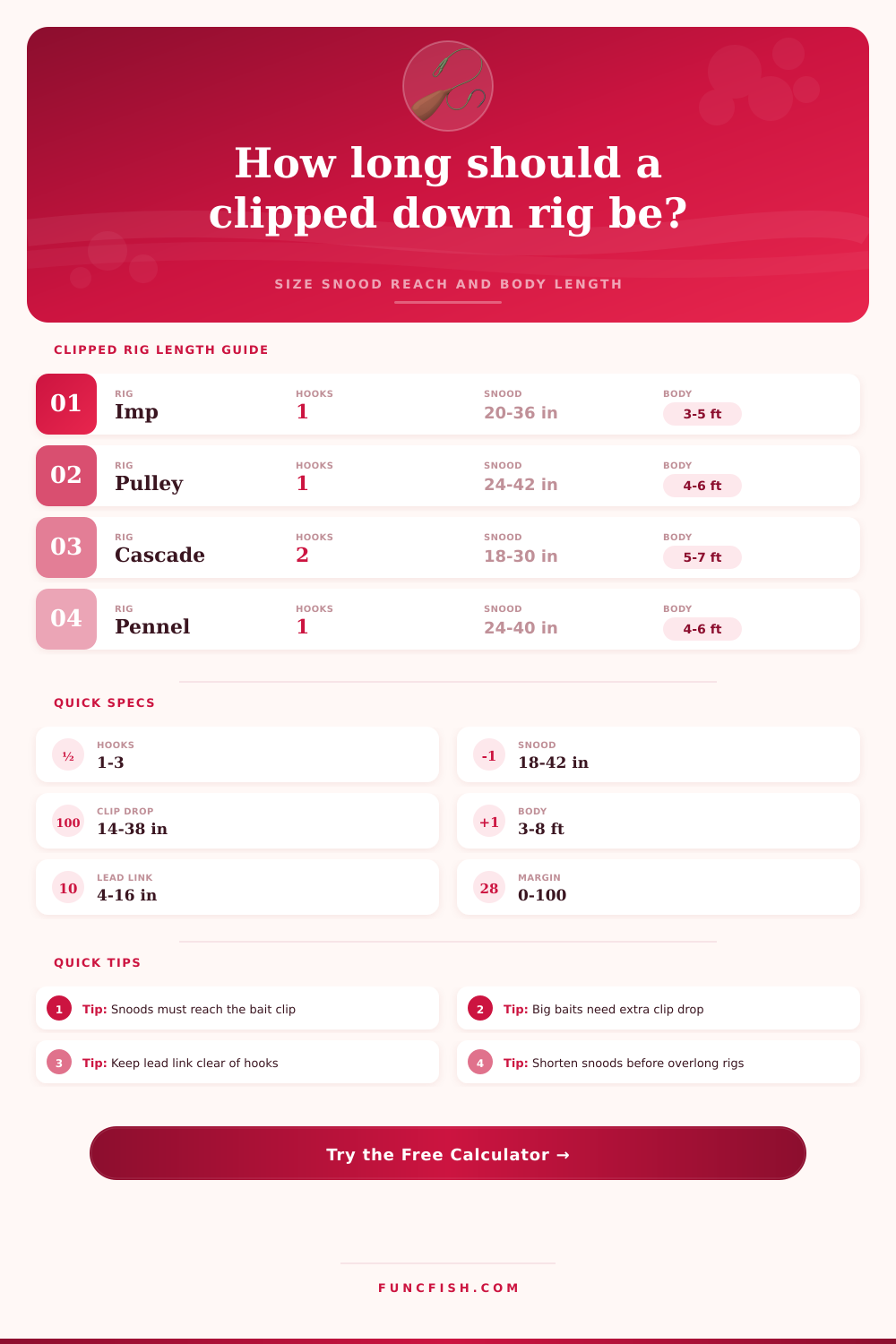
| Impact shield / imp rig | 1 | 20-36 in / 51-91 cm | 16-32 in / 41-81 cm | Long casts with one bait held near the lead |
| Pulley clip-down rig | 1 | 24-42 in / 61-107 cm | 20-38 in / 51-97 cm | Surf bass, cod, ray, and rougher ground |
| Cascade clip-down rig | 2-3 | 16-30 in / 41-76 cm | 14-26 in / 36-66 cm | Multiple compact baits without a long body |
| Pennel clip-down rig | 1 | 24-40 in / 61-102 cm | 20-36 in / 51-91 cm | Large worm, crab, squid, or fish baits |
| Compact match clip-down | 2-3 | 12-24 in / 30-61 cm | 10-22 in / 25-56 cm | Whiting, dabs, and distance scratching |
| Target profile | Bait tail | Suggested hook | Body strength | Geometry note |
|---|---|---|---|---|
| Pompano / whiting | 1-2.5 in / 3-6 cm | Size 4 to 1 | 30-50 lb | Short baits release with modest clip drop |
| Bass / striped bass | 2-5 in / 5-13 cm | 1/0 to 4/0 | 50-70 lb | Leave extra tail space for worm or fish bait |
| Cod / haddock | 3-7 in / 8-18 cm | 2/0 to 5/0 | 60-80 lb | Big baits need larger clip reach and top clearance |
| Ray / hound | 4-9 in / 10-23 cm | 3/0 to 6/0 | 80-100 lb | Longer lead link keeps bait clear of lead hardware |
| Flounder / flatfish | 2-5 in / 5-13 cm | 1 to 2/0 | 40-60 lb | Long snoods need a body that still fits the rod |
| Hardware | Reach effect | Release effect | Allowance | Use when |
|---|---|---|---|---|
| Impact shield | High | Very steady | 2-4 in / 5-10 cm | Lead-mounted clip is the release point |
| Fixed bait clip | Medium | Needs clean angle | 3-5 in / 8-13 cm | Simple one-hook clipped rigs |
| Cascade swivel | Linked | Depends on lower hook | 4-7 in / 10-18 cm | Two or three clipped baits |
| Imp clip | High | Fast release | 2-5 in / 5-13 cm | Distance surf rigs with compact bait |
| Lead link clip | Medium | Lead tail matters | 4-8 in / 10-20 cm | Clip is below the main rig body |
🚩Rig Length Notes
Snood reach logic: The calculator subtracts bait tail, hook offset, hardware, and casting margin from the snood to estimate a reliable vertical reach to the bait clip.
Body fit logic: A clipped-down rig should cast compactly, but the finished body still needs enough top clearance, clip ladder span, and lead-link space.
It feels good when that chunk of lead splashes into the water, until you notice your hook snarled around the line leading back to it. Which is what makes distance casting guys so hung-up about their clipped down rigs: they’re after the same thing… Simple geometric harmony between a bait falling straight down through a fixed clip, while remaining free from snagging the hooks or swivels suspended at various heights along its trace.
Simple, yes; but not something you can just guess at. There’s the physics of a cast landing in rough surf (chaotic tumbling), the material properties of both the monofilament and the softness of the bait itself, and then there are the variables… After entering your drop to the clip and snood length, the calculator does all the subtraction for you (removing both hook offset and knot allowance), so there’s no more fumbling with a ruler trying to guess your offset.
How to Set Up Your Fishing Rig
While most folks gets hung up on casting distance, the struggle begins at the point of release. Too-short snoods cause the bait to hop off the body of the rig rather than falling through the drop, while too-long snoods drags the hooks as you retrieve them or entwine the whole mess on contact with sand. The tool help you find that small sweet spot where the bait falls free through the hardware by several precious inches each time.
Think about the tail of your bait being part of the snood system. You have more drag and bulk with a thicker squid strip versus say, a smaller piece of prawn. When you increase the size of your bait, the calculator accounts for the extra length needed for more material to pass through clip’s jaws. That’s the kind of detail that casual anglers miss. Measure from their swivel to the hook eye and be on their way. But remember, the bait take up space. So if you have an eight inch long squid, then that bait has to be extended out past the swivel to the release point first before the rest of the rig body split. Miss that and you’ll find yourself miscasting, lead flying free while your hook catches in your rod guides.
Just as important as the size is what material you choose for your rig. If you use stiff mono (monofilament), it is stiffer to resist bending and maintains position with the clip during high G-force on a power cast. On the other hand, softer line material such as low-memory mono or fluorocarbon will not abrade the line as much but tends to flop about in mid-air. When calculating body length, this line characteristic are included in the preset. For example, a soft trace requires some extra clearance to prevent tangles with itself. A heavier leader will be stiffer and therefore can makes a little more compact. This explains why settings for delicate whiting rig have such drastic differences than those used for heavy rock fishing.
And then there is cast power. A gentle lob require less structural integrity than a maximum distance throw off the pier. Swinging the heaviest weight possible spreads the hooks further apart and puts more stretch in the line. That’s where you use the tool to consider how much to adjust the suggested margin depending on how far you want to swing.
Another wrinkle is if the ground is rough or the conditions are surging. Then the sea state grabs at the rig and slings it from side to side until it steadies. It’s in those instances a narrower drop keep the lead from swinging back up against the baited hook.
At the end of the day, the most effective clipped down rig is going to be the one that holds together in pressured fishing. It might not be the longest and certainly is not the shortest it could of possibly be. It is the one where all those measurements has been thought through based off the conditions you’re fishing and the sort of fish you think will be there.
Use the tables on this page to check your hunches against some general guidelines, but know that the sea doesn’t often follow the textbook. A half-inch adjustment to a snood can transform a wasted day into a good one. That correct vertical drop make all the difference, transforming an ungovernable piece of air time into a tidy fall and a set hook that remains baited long enough to grab hold of the fish below.