
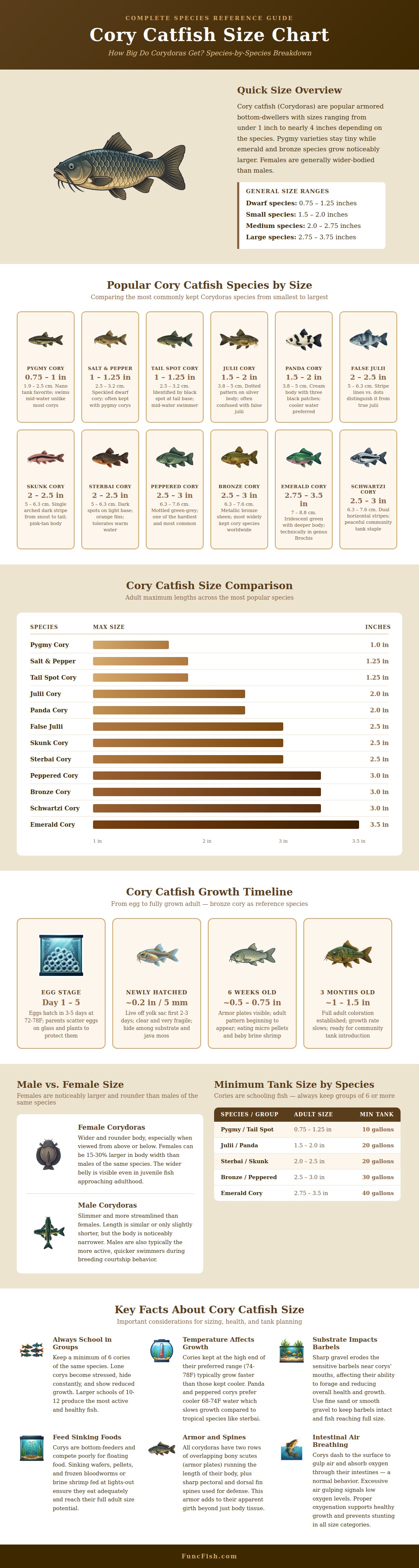
When you got your first cory catfish, it was likely because you thought they were cute and innocent. Most beginners don’t realize that size can matter more then people think. Size affects everything from how you feed them to how you set up the tank, and ultimately whether your fish will thrive or simply survive. This isn’t a trivia question. Knowing the size of each species doesn’t mean you’re going to understand how to care for it, but it is basic knowledge needed to understand your fish well. It also shows the maximum size that each variety will get at the top of the page (the chart is above).
We’re all used to thinking that all corydoras are little bottom feeder, right? Nope. There’s a huge range. On one end of the spectrum, there are dwarf species such as the Tail Spot and Pygmy cory that won’t grow much past an inch. And on the other end is those larger varieties such as the Peppered and common Bronze cory that routinely gets to three inches. Because the Pygmies are so small, you could fit a school of six in a 10 gallon with no problem. You couldn’t, however, do the same thing with a school of six Bronze corys, it’d be cruel. They requires far more space to roam about freely and show their natural schooling behavior. The visual reference provided in the guide makes that point perfectly obvious without having to do any complicated math.
Why Size Matters for Cory Catfish
Knowing some basics about size and sex can help too. Typically, in many cory catfish species, the males is smaller and thinner than the females. They’re typically thinner-bodied as well. So if you’ve got a tank full of Sterbai corys, for example, those that is widest around and have the fullest belly are probably the females. That’s not abnormal or anything. It’s perfectly normal and expected. It doesn’t make either fish stunted or unhealthy. On the contrary, it means the female is most likely feeling comfortable in her surroundings and getting plenty of food because she has a nice rounded belly. Males are usually more streamlined with a narrower body because they pursues females during breeding rituals. Knowing this helps eliminate panic over your odd-sized fish. You don’t have malnourished or stunted fish on your hands. You simply have nature doing what nature does.
Another piece of info to monitor… These fish don’t grow overnight. Yes, I know the “I want my fish to be bigger now” crowd is out there. Sorry. The graph from the infographic indicates that when born, corydoras are tiny little fry and dependent based off their yolk sacs for food. They develop their armor plates by about six weeks old and resemble miniature versions of their adult selves at this point. Full adult size occurs somewhere between one and two years for most species.
Feeding more won’t make them grow any quicker. In fact, it typically does the opposite. It stresses their systems and fouls the water. It’s a patience kind of hobby. If you’ve had some fry for six months and they still aren’t big yet, examine the environment first before assuming something is wrong. Growth depends on your choices of substrate and water quality as much or even more so than diet. The sensitive barbels will get torn up by sharp gravel, making foraging painful and over time reducing appetite. This immediately gets solved with switching to some type of fine sand. Their activity level will increase and you’ll notice they are eating better.
Temperature is also important. For example, certain species such as Pandas prefer cooler water, which can slow their metabolism and growth rate slightly. This is below 75 degrees Fahrenheit. So, their growth rate would of been slowed a bit by cool temperatures, but that’s a tradeoff to keep them healthy in the long run. They’re not built to be sprinters. They’re built to be steady grazers who live for years with proper care.
The final part of the puzzle is schooling. They are very sociable animals. Having only one or two results in stressed-out fish, they hide out and do not grow. To enjoy their personality they require at least six (and preferably many more) of the same species. Larger groups will be healthier and often display more activity than small groups. A little bit of quantity pays big rewards in quality. And once you’ve got the group dynamics figured out, along with enough space and size, those armored bottoms becomes the beating heart of your aquarium ecosystem. They add interest to the lower parts of the tank, clean up leftovers, and, best of all, provide hours of entertainment. Remember, however, to ensure the tank is as large as it needs to be from day one. Better to plan for growth now instead of trying to cram them in later.