Crankbait Dive Angle by Lip Calculator
Estimate dive angle, running depth, lip load, and target-depth distance from crankbait bill geometry, line drag, retrieve speed, and buoyancy.
📌Scenario presets
⚙Lip and retrieve inputs
Crankbait dive geometry forecast
Formula breakdown
📊Lip geometry data grid
Square Bill
Coffin Bill
Round Bill
Long Diver
📐Lip style reference
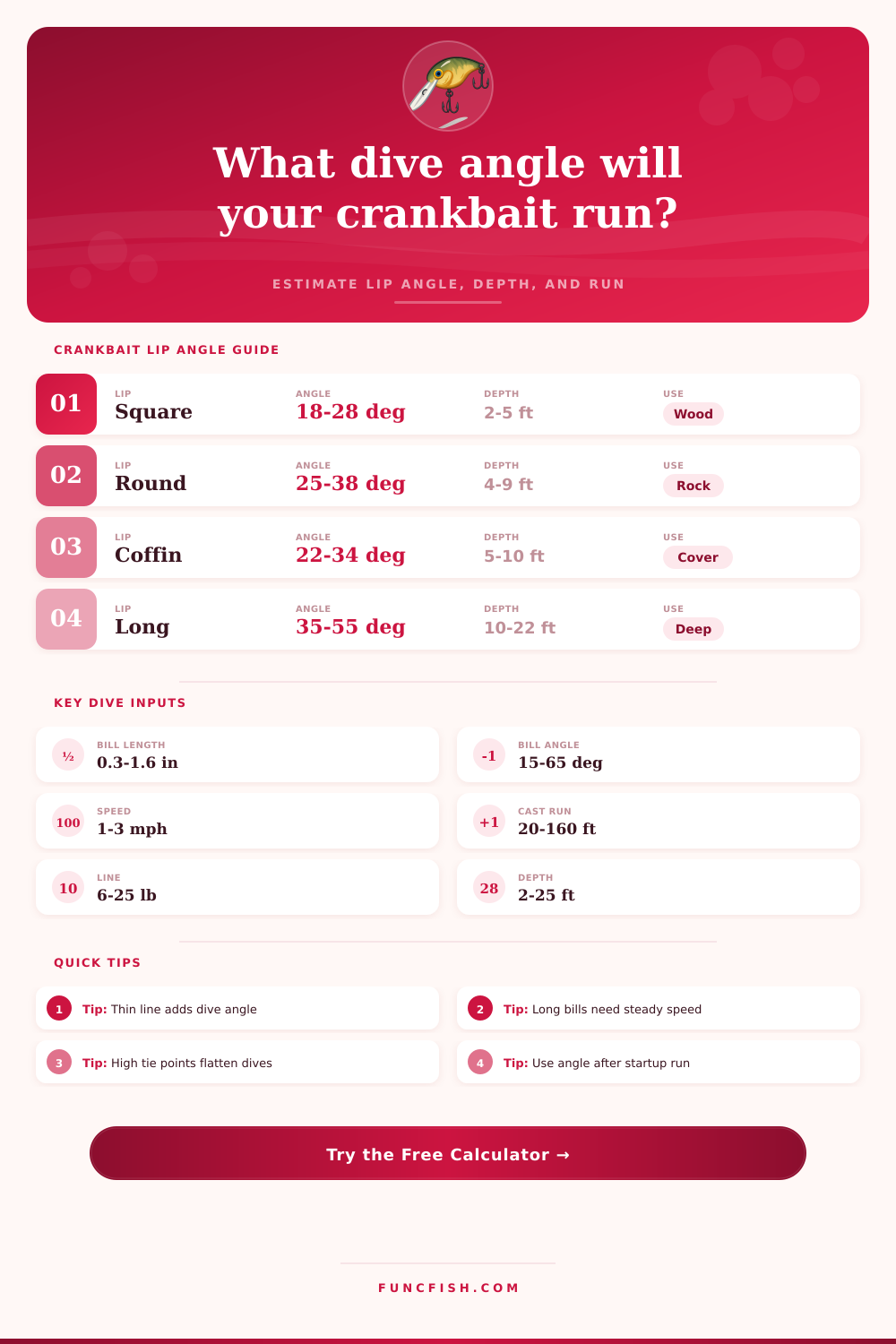
| Lip style | Common angle | Dive behavior | Best contact | Watch point |
|---|---|---|---|---|
| Square bill | 18-30 deg | Quick start, shallower dive | Wood, laydowns, dock posts | Too much speed can roll wide bodies |
| Thin flat lip | 20-34 deg | Tight, cold-water track | Rock banks and sparse grass | Needs clean line angle for depth |
| Coffin bill | 22-36 deg | Moderate dive with cover kick-out | Stumps, rock, mixed cover | High tow eye reduces bite angle |
| Round bill | 25-42 deg | Smooth roll and steady descent | Riprap, points, hard bottom | Bulky line trims max depth |
| Circuit board lip | 26-44 deg | Thin edge with fast startup | Clear rock and sparse cover | Deflection can be sharper |
| Long deep-diver lip | 35-55 deg | Steep pull and sustained depth | Humps, ledges, deep points | Needs long cast and steady load |
🧵Line drag and depth reference
| Line setup | Diameter tendency | Depth effect | Dive angle effect | Best use |
|---|---|---|---|---|
| 8 lb fluorocarbon | Thin sinking line | Adds 8-14% depth | Steeper by 2-5 deg | Clear medium cranking |
| 10-12 lb fluorocarbon | Moderate diameter | Baseline deep control | Neutral to slightly steep | Rock and offshore ledges |
| 12-15 lb copolymer | Mid diameter | Trims 3-8% depth | Flattens 1-3 deg | Cover with stretch |
| 14-17 lb monofilament | Floating, thicker | Trims 8-16% depth | Flattens 3-6 deg | Shallow wood and grass |
| 30 lb braid leader | Thin main, leader drag | Variable by leader | Fast startup, modest flatten | Grass ripping and feel |
| 20-25 lb mono | Heavy floating line | Trims 15-25% depth | Flattens 5-9 deg | Pike, shallow cover, impact |
🐟Species and contact depth table
| Target | Typical crank zone | Lip direction | Line match | Useful dive angle |
|---|---|---|---|---|
| Largemouth in wood | 2-6 ft / 0.6-1.8 m | Square or coffin bill | 12-17 lb mono or copoly | 18-30 deg |
| Smallmouth on rock | 5-12 ft / 1.5-3.7 m | Round or flat lip | 8-12 lb fluoro | 26-42 deg |
| Walleye on breaks | 8-18 ft / 2.4-5.5 m | Long or spoon bill | 10-12 lb fluoro/copoly | 34-52 deg |
| Pike on weed edge | 3-10 ft / 0.9-3.0 m | Round or coffin bill | 17-25 lb mono/leader | 22-36 deg |
| Trout in bank slots | 1-5 ft / 0.3-1.5 m | Wake or small round lip | 4-8 lb mono/fluoro | 12-28 deg |
| Offshore bass ledge | 10-22 ft / 3.0-6.7 m | Long deep-diver lip | 8-12 lb fluorocarbon | 36-55 deg |
⚖Crankbait setup comparison grid
| Setup | Fastest startup | Deepest track | Deflection control | Depth risk |
|---|---|---|---|---|
| Squarebill plus 15 lb mono | High | Low to medium | Excellent around wood | Runs above deeper targets |
| Coffin bill plus 12 lb copoly | Medium-high | Medium | Excellent in mixed cover | Can wander if over-speeded |
| Round bill plus 10 lb fluoro | Medium | Medium-high | Good on rock | Snags if angle is too steep |
| Long bill plus 8 lb fluoro | Medium-low | Very high | Good after contact starts | Needs long cast to reach depth |
| Wake lip plus heavy mono | Very high | Very low | Good over shallow grass | Will not reach subsurface cover |
| Thin flat lip plus 10 lb fluoro | High | Medium | Good in cold rock lanes | Can lose depth with slack bow |
💡Practical dive-angle checks
Tip: Treat calculated dive angle as the stable running angle after the first few yards. Short casts spend more of the retrieve in startup and rarely reach charted depth.
Tip: If the calculator shows enough angle but not enough depth, the usual limiter is line bow, short line out, or a retrieve speed below the lip's load window.
All of the action happen once you put the crankbait in the water. You make a confident cast and hope for the best… Hoping physics aren’t working against you. Pressure differentials from the lip cause bait to stay on surface or push the bait down to its target zone. Knowing how it works allow an angler to be in control of the bite instead of just hoping they get bit.
You put in your line drag, attack angle and bill length, and it calculate the depth. Most folks look at the lip of a plastic, but a thicker monofilament line flatten the angle more different than a thinner fluorocarbon line would. That’s what can make some guys not see those bluegill hugging the bottom. By using your line test and retrieve speed, it predict a running depth based off how the line actualy runs.
How a Crankbait Dives
But what about the bill shape? For example, square bills has that shape because of the impact they make. They are made for hitting things like timber when you need to stop suddenly but do not necessarily need to dive really deep. They also have a shallow diving angle so they stays in the strike zone while avoiding snagging on tree limbs.
Long bills with deep-diving lips work differently as they needs to be pulling the bait’s body down constantly against an increasing load. Slow down too much on your retrieve with a long bill and it let off its load through water pressure, losing depth immediately. That’s where the tool can help us visualize this sacrifice of speed vs. Penetration.
Another factor is buoyancy. A suspending crankbait will suspend itself during pauses (a plus if fishing for wary fish in clear water). But, it lack any lift and requires both line tension and forward momentum to hold its dive angle. Lose one of those factors (casting too short or fighting a current) and the bait stop diving. A floating crank has additional lift working against it, thus requiring more forward speed to reach depth compared to sinking models.
Match the lip style to the best water conditions in reference table. This helps match the tool to the terrain. The geometry of dive also accounts for line selection. The heavier the line, the more it bow out behind the bait. That elevates the tow point above the flow. This creates a different attack angle on the bill which normally causes it to run shallower. The lighter fluorocarbon dives deeper with less drag, letting that lip work at its intended angle.
When you are hunting around tight cover having extra depth control is nice. It’s not just about strength; it’s about presentation. It gets complicated by water conditions, which are not entirely accounted for in any formula. Resistance from wind chop will fight with the downward force of the lip. Current will change your effective speed through the water. This means a steady retrieve might feel much quicker or slower then how fast the lure is actually moving past the fish beneath.
So even though experienced anglers relies on the output of these calculators, they know them more as a starting point than a gospel truth. The numbers provide a starting point to get close but adjustments come next, based off what they see and feel.
Crankbait depth is an equation that you can change by tweaking variables. The lip shape determine how it dives. The line diameter affect both the strength and drag. And the retrieve speed control the hydrodynamic force exerted upon the bill. This is a formula where practice makes perfect, and this calculator help organize that learning process before breaking down and hooking up.
It transforms guess work into a game plan and gives you a better idea of what depth range you should of be targeting. So once you know the interplay between those factors, you cease struggling against current and instead learn to use the flow. Simply stated, you’re trying to get the bait down to the fish, hold it near them until they respond and show it to them to get them to strike.