Crankbait Dive Depth by Line Diameter Calculator
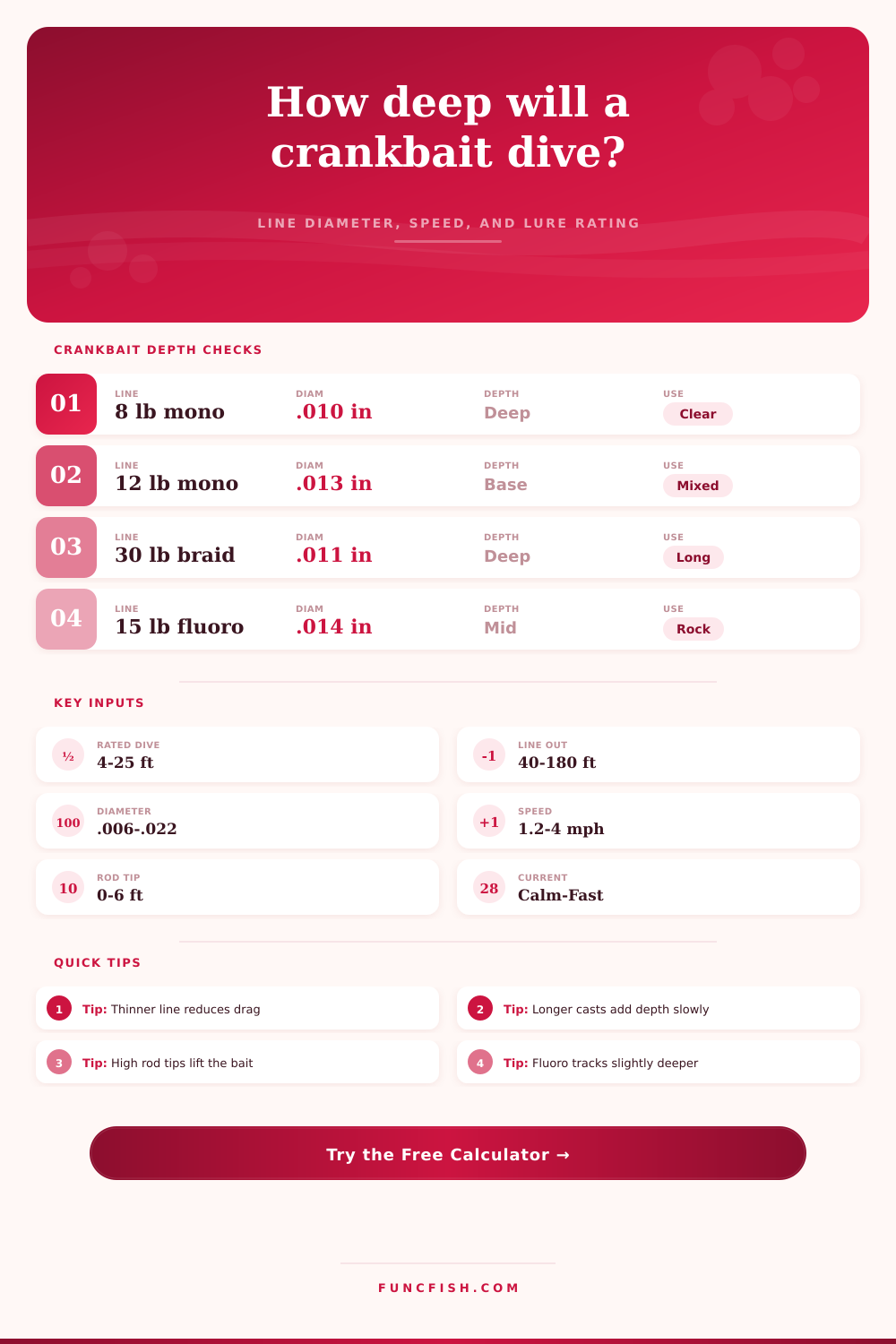
Estimate running depth from line diameter, line type, line out, lure rating, retrieve speed, rod tip height, and current so a crankbait tracks closer to the target zone.
📌Crankbait presets
⚙Dive depth inputs
Depth forecast
Formula breakdown
📋Line material comparison grid
Nylon Mono
Fluorocarbon
Thin Braid
Copolymer
Power Braid
Troll Wire
Hybrid Sink
Thick Mono
📐Crankbait depth reference tables
| Bill style | Typical rating | Baseline line out | Useful contact zone |
|---|---|---|---|
| Squarebill / wake | 1-5 ft / 0.3-1.5 m | 45-70 ft / 14-21 m | Wood, stumps, shallow rock |
| Shallow round bill | 3-7 ft / 0.9-2.1 m | 55-85 ft / 17-26 m | Flats and scattered grass |
| Medium coffin bill | 6-12 ft / 1.8-3.7 m | 75-105 ft / 23-32 m | Riprap and outside grass |
| Deep round bill | 12-18 ft / 3.7-5.5 m | 95-140 ft / 29-43 m | Ledges and deep rock |
| Extra-deep bill | 18-25 ft / 5.5-7.6 m | 120-170 ft / 37-52 m | Deep breaks and shell |
| Trolling plug | 10-30 ft / 3.0-9.1 m | 100-220 ft / 30-67 m | Channel edges and suspended fish |
| Line class | Approx diameter | Drag effect | Depth tendency |
|---|---|---|---|
| 6 lb mono | 0.009 in / 0.23 mm | Low | Runs deeper than baseline |
| 10 lb mono | 0.011 in / 0.28 mm | Baseline | Most lure ratings assume this zone |
| 14 lb mono | 0.014 in / 0.36 mm | Moderate | Lifts medium and deep divers |
| 20 lb mono | 0.018 in / 0.46 mm | High | Shallower track and more bow |
| 30 lb braid | 0.011 in / 0.28 mm | Low diameter | Deep on long casts, floats at rest |
| 15 lb fluoro | 0.014 in / 0.36 mm | Moderate | Sinking line offsets some drag |
| Line out | Depth gain stage | Best use | Calculation note |
|---|---|---|---|
| 40-60 ft / 12-18 m | Early dive | Shallow targets | Depth builds quickly |
| 70-95 ft / 21-29 m | Strong dive | Bank and boat casts | Most medium divers stabilize |
| 100-135 ft / 30-41 m | Near maximum | Deep casting | Extra length gives smaller gains |
| 140-180 ft / 43-55 m | Long soak | Trolling or huge casts | Line drag limits added depth |
| 190-240 ft / 58-73 m | Trolling window | Open water passes | Angle and line bow dominate |
| Condition | Depth modifier | Why it matters | Common adjustment |
|---|---|---|---|
| High rod tip | -0.25 ft per ft | Line enters water at a steeper lift point | Lower the rod to tick cover |
| Slow roll | -4% to -12% | Bill has less planing force | Add speed before downsizing line |
| Fast retrieve | +3% to +8% | More water pressure drives the bill | Watch for blowout on flat baits |
| Crosswind bow | -6% | Line belly increases drag | Cast lower or turn the boat |
| With current | -5% | Less relative water pressure on the bill | Retrieve faster or cast across |
| Against current | +5% | More pressure loads the diving lip | Shorten line if it digs too hard |
💡Depth tuning notes
Tip: Use measured diameter when possible. Two lines with the same pound test can differ enough to change crankbait depth by several feet on a long cast.
Tip: If you need bottom contact, set the target depth slightly shallower than the actual bottom so the lure touches without plowing continuously.
Crankbait hits the water; you fire off a cast. Begin your retrieve, believing what the box says about diving to a dozen feet. You’re fishing above the structure that holds bass, right? Nope. Reel up your crankbait. Pull up your GPS. Your crankbait didn’t dive deeper then eight feet.
The problem usually isn’t the fish or the lure itself. It is the line. Neither is the bait. But most angler fail to realize that line diameter cause drag. Drag raises the bait and inhibits it from reaching advertised depth.
Why Your Lure Does Not Dive Deep Enough
You can put all of this into a calculator. You can factor in your rod tip height, retrieve speed, line diameter and cast distance. This will eliminate much of the guesswork regarding how far down a bait dive and why it’s swimming high.
Knowing the science behind the numbers make you a more efficient angler. The water resist the line. When you have a lot of surface area on the line (thick mono), it becomes drag. That drag pulls bill up and essentially shallows its dive. Fluorocarbon is denser and sinks, offsetting some of the lift. Even though braid is thick and you might be holding rod high, there’s still hydrodynamic resistance.
One other thing about your rod: How do you hold your rod tip? When you stand on the bank with your tip in the air you are limiting depth the lure will run. Where line enters the water makes all the difference. That angle determine the path. With a lower rod tip you change that angle and get a more direct line into the water. The lure dive deeper and straighter.
Try to hit a ledge at a particular point. A little bit matters. The chart on the page shows how different bill styles play off different line classes. You don’t need as heavy a line for something like a squarebill. Not much diving action going on there. But deep diver is very sensitive to added drag. Ten-pound mono vs twenty pound makes a difference of three or four feet.
It also has something to do with distance. The longer you can cast it, the more line will be in the water, which adds drag. It also have to do with how much drag accumulates as you retrieve. So say you make a long cast and it gets down there in first couple seconds of the retrieve. By the time you finish your cast, the line rise because of changes in angle and the buildup of drag.
Sometimes you have to use a thinner line because it has less surface area to build drag. Or sometimes you just need to reel it a little quicker to keep it down when making long casts.
You’re battling both water movement and gravity. But the wind make it all complicated. It will lift the lure, add more drag and give your line a belly when there’s a crosswind. When you’re casting into the current, it takes some of the water pressure off the bill. Throw it into the current. Now it is running too deep, and you could be skipping right along the bottom.
That’s one reason why I say a set depth chart seldom works well in field. Feel what’s happening on the end of your rod. And then read the water. If your rod is vibrating with constant thump of a crankbait working its bill, great. If it’s feeling light or bouncy, chances are the lure are running shallow or getting caught on surface tension.
Knowing what they realy measure Depth ratings is always measured by manufacturers under ideal conditions. They typically use a moderate retrieve speed and a standard line. And that is seldom the case when you’re fishing.
The simplest change to make is adjusting your line diameter. If you’re missing that deep water then drop down two pounds of test. If you’re bottoming out on shallow cover raise it up. It is not necessarily because you will break off on a snag, but because you are tuning the presentation to whatever depth the fish is holding.
When you start to think of your line as an active part of how far your lure travels, your success rate go up. You don’t guess anymore. Instead, you’re fishing with precision. Precision gives you that confidence. You know exactly where your bait is within the water column. It is down to the foot.